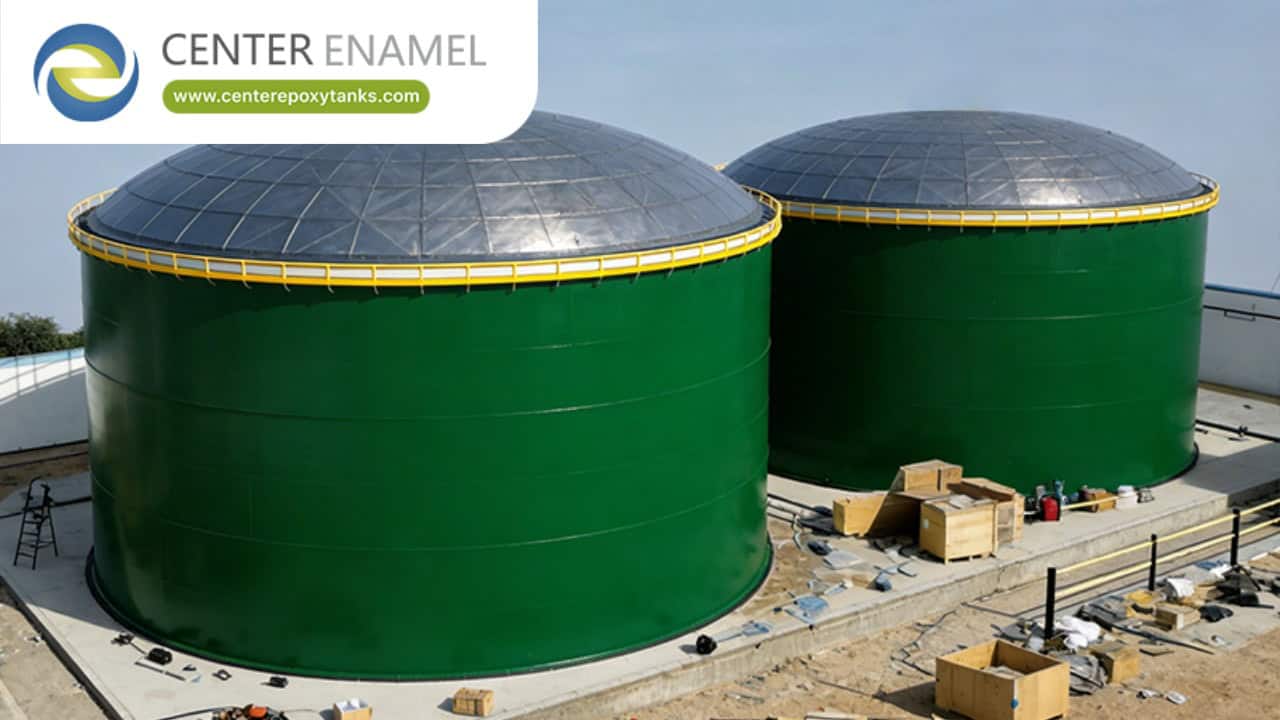
Bulk Oil Storage Tanks: Large-Capacity Design for Terminals and Refineries
Bulk oil storage is where tank engineering meets economics at scale: every extra meter of diameter buys volume more cheaply than the last, until floating-roof mechanics, foundation settlement, and emission rules reshape the curve. Terminal design is the discipline of optimizing that curve across dozens of tanks at once.
Bulk oil storage tanks are large-capacity API 650 vessels — typically 5,000 to 150,000 m3 each — arranged in tank farms with fixed roofs, external floating roofs, or domed internal floating roofs matched to product volatility, integrated with containment, transfer systems, and emissions controls governing terminal operations.
1. How Does Tank Design Scale With Product Type?
At bulk scale, the roof is the emissions and safety strategy.
· Crude oil: External floating roofs (EFR) — pontoon or double-deck — ride the liquid surface and cut evaporative breathing losses up to 95% on volatile crudes.
· Refined light products: Fixed-roof tanks with internal floating roofs, increasingly capped with aluminum geodesic domes for drainage, inspection access, and emission performance.
· Heavy fuel and asphalt: Heated, insulated fixed-roof tanks where volatility is negligible and thermal management dominates.
· Intermediate and slop service: Buffer and off-spec tanks sized to process upset volumes, often with vapor control tie-ins.
2. What Shapes Tank Farm Layout?
The farm is engineered as a system of risk bands and logistics corridors.
· Grouping and bunding: Tanks group by product class with dikes sized for the largest tank in each group; separation follows NFPA 30-type spacing.
· Transfer corridors: Piping racks, pump areas, and metering run along logistics spines connecting marine, pipeline, truck, and rail interfaces.
· Settlement and geotech: Large-diameter tanks impose massive loads; settlement analysis dictates foundation design and fill programs at the heaviest points.
· Fire strategy: Fixed cooling water loops, foam systems for the tank group, and access roads sized for firefighting appliances define the farm's geometry.
3. How Are Emissions and Integrity Managed at Scale?
Modern terminal economics run through vapor control and inspection discipline.
· Vapor recovery and control: Rim-seal systems on EFRs, closed-vent IFR tanks, and VRU connections satisfy emission permits on volatile service.
· Rim seal technology: Primary mechanical shoe plus secondary seals, evolving toward emission-minimizing designs as permits tighten.
· Inspection cadence: API 653-based in-service and out-of-service intervals, robotic in-service bottom scanning, and NDE programs across the farm's fleet.
· Data-driven maintenance: Thickness trending across inspection cycles turns a tank population into a managed portfolio rather than a set of surprises.
Bulk Storage Roof Strategy by Product
Product | Roof Configuration | Primary Driver |
Light crude | External floating roof | Breathing loss control |
Gasoline / naphtha | IFR + geodesic dome | Emissions + weather |
Diesel / jet | Fixed cone roof | Economy |
HFO / asphalt | Heated fixed roof | Pumpability |
Slop / off-spec | Fixed roof + vapor tie-in | Recovery process |
Frequently Asked Questions (FAQ)
Q1: What is considered a bulk oil storage tank?
Field-erected storage above roughly 5,000 m3 per tank, built to API 650 and arranged in tank farms for terminals, refineries, and strategic reserves. The class tops out near 150,000 m3 per single tank, beyond which tank-count economics and seismic/foundation limits dominate.
Q2: Why do crude oil tanks have floating roofs?
Because crude breathing losses are enormous at scale: an external floating roof eliminates the vapor space that expands and contracts with daily temperature, cutting evaporative losses up to 95%. On a 100,000 m3 crude tank, that difference is measured in tonnes of product per week.
Q3: How are bulk tank farms laid out?
By product class groups with dikes around each group sized for the largest tank, code separation distances, shared transfer corridors to loading interfaces, and fire systems covering each tank group. Geotechnical settlement analysis precedes foundation design for every large-diameter position.
Q4: How often are bulk oil tanks inspected?
Per API 653 frameworks: in-service external inspections roughly every 5 years, out-of-service internal inspections on risk-based intervals commonly 10-15 years, with robotic bottom scanning increasingly bridging between outages. Inspection findings feed repair planning and remaining-life calculations for the whole farm.


