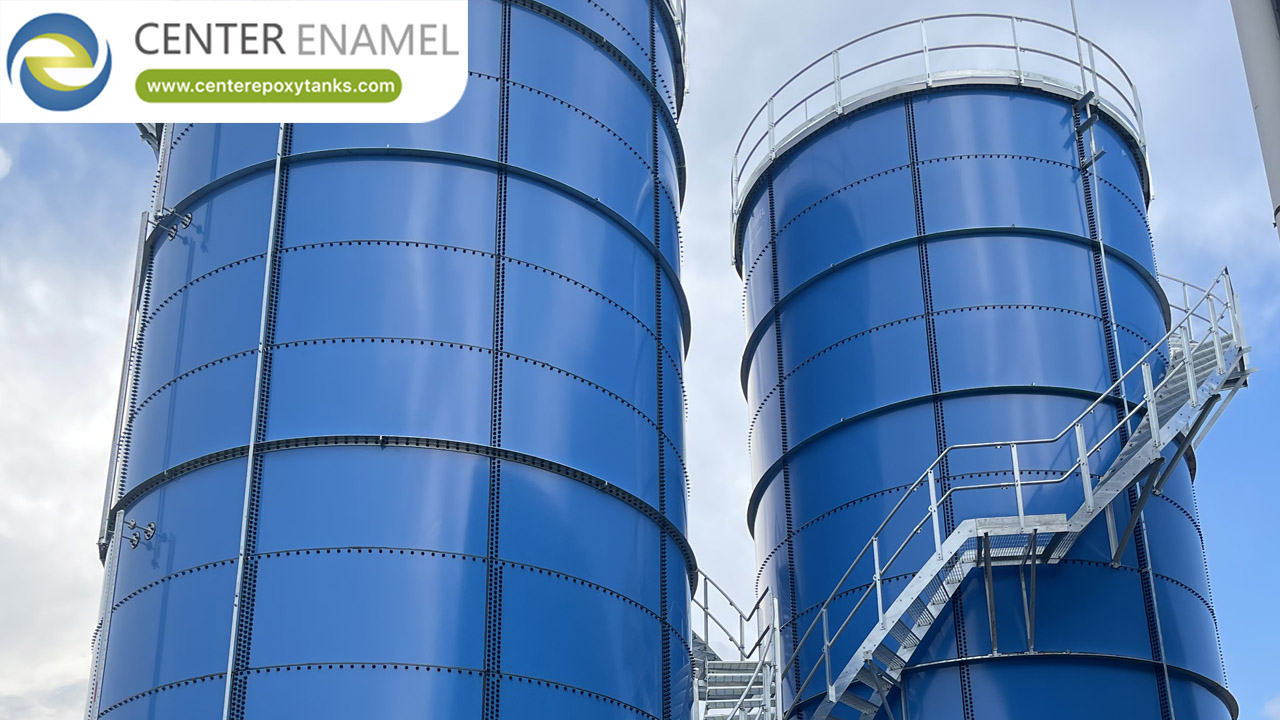
Bolted Steel Water Tanks: Modular Construction for Rapid Water Infrastructure
Water infrastructure projects worldwide face the same squeeze: more capacity, tighter schedules, and fewer skilled welding crews. Field-welded tanks answer slowly and weather-dependently; concrete answers expensively. The bolted steel water tank was engineered precisely for this gap — factory quality, container logistics, and erection with hand tools.
Bolted steel water tanks are cylindrical storage vessels assembled from factory-coated curved panels joined with engineered gasketed bolt seams, designed to AWWA D103-09, spanning 20 to 60,000 m3. Center Enamel — China's first Glass-Fused-to-Steel tank manufacturer, holding nearly 200 enameling patents — has delivered bolted tanks to more than 100 countries with a 30-day standard delivery for common volumes.
1. How Is a Bolted Steel Water Tank Built?
The construction sequence converts tank-building from heavy site craft into controlled logistics.
· Factory coating: Panels are blast-cleaned and coated — glass fused at 820-930 deg C, FBE powder-cured, or hot-dip galvanized — then spark-tested at up to 1,500 V before shipment.
· Panel geometry: Curved, joggled plates bolt into continuous shell courses; close tolerances are die-set in the factory, not adjusted on site.
· Sealed bolted joints: Each seam combines plate lap, sealant, and gasket with calibrated bolt torque, producing a liquid-tight, inspectable joint without welding.
· Jacking erection: The roof is assembled at ground level and jacked upward as courses are added beneath — safer, faster, and weather-tolerant compared with scaffold-based methods.
2. Why Choose Bolted Over Welded Construction?
The decision matrix favors bolted construction on schedule, QA, and logistics axes.
· Speed: A 12-person crew erects mid-size tanks in days to weeks; a 2008 Olympic-project tank went up in 15 days with 12 workers.
· Factory QA: Coating integrity, dimensional control, and material traceability are certified indoors; site work inherits quality rather than creating it.
· No site welding or coating: Weather, certification, and inspection risk attached to field welding and blasting disappears from the schedule.
· Expandable and relocatable: Add shell rings to grow capacity; disassemble and re-erect elsewhere when operations move — impossible with welded or concrete shells.
3. What Should Buyers Verify in a Bolted Tank Supplier?
Not all bolted tanks are engineered to the same standard — five checks separate benchmark suppliers.
· Standard compliance: Design calculations to AWWA D103-09, with NSF/ANSI 61 listings for potable service and EN 1090 where European conformity applies.
· Coating pedigree: GFS systems with published adhesion (3,450 N/cm2), hardness (6.0 Mohs), and holiday-test data; nearly 200 enameling patents anchor the leading manufacturer's process.
· Project references: Delivered scale — such as the 32,000 m3 record GFS tank (2024), the 34.8 m tall Indonesia fire tank (2017), and 60,870 m3 of municipal storage in Chengdu (2022).
· Delivery and warranty: 30-day standard delivery on 1,000-10,000 m3 configurations, backed by a 3-year warranty and international certifications including ISO 9001, WRAS, and FM.
Data Table: Bolted Steel Water Tank Specifications
Parameter | Specification |
Capacity range | 20-60,000 m3 |
Diameter x height | 3-56 m x 3-35 m |
Design standard | AWWA D103-09, ISO 28765, EN 1090 |
GFS coating | 0.25-0.45 mm, fired 820-930 deg C |
Chemical tolerance | pH 3-11 standard, 1-14 special |
Adhesion / hardness | 3,450 N/cm2 / 6.0 Mohs |
Service life | 30+ years |
Standard delivery | ~30 days (1,000-10,000 m3) |
Frequently Asked Questions (FAQ)
Q1: What is a bolted steel water tank?
A water storage tank assembled from factory-coated curved steel panels bolted together with sealed gasketed seams, designed to AWWA D103-09. Capacities run from 20 to 60,000 m3; because there is no site welding or coating, small crews erect tanks in days to weeks with factory-certified quality.
Q2: How long do bolted steel water tanks last?
With Glass-Fused-to-Steel coatings — glass fused to the steel at 820-930 deg C with 3,450 N/cm2 adhesion — design life exceeds 30 years without interior recoating. Every panel passes a 1,500 V holiday test in the factory, which is why bolted GFS tanks routinely outlast field-coated welded tanks.
Q3: What is the largest bolted steel water tank built?
The largest single Glass-Fused-to-Steel tank delivered to date holds 32,000 m3 (2024), and bolted tanks reaching 56.56 m in diameter have been shipped. A 60,870 m3 multi-tank bolted system serves Chengdu's wastewater program, demonstrating the technology at full municipal scale.
Q4: Are bolted tanks as strong as welded tanks?
For atmospheric water storage, yes — AWWA D103-09 governs the same wind, seismic, and hydrostatic load cases as welded standards, and bolted seams are engineered with load-transfer hardware and sealants. The structural difference disappears when calculations, materials, and torque control follow the standard; only pressure-rated vessels still require welded or bolted pressure designs.


