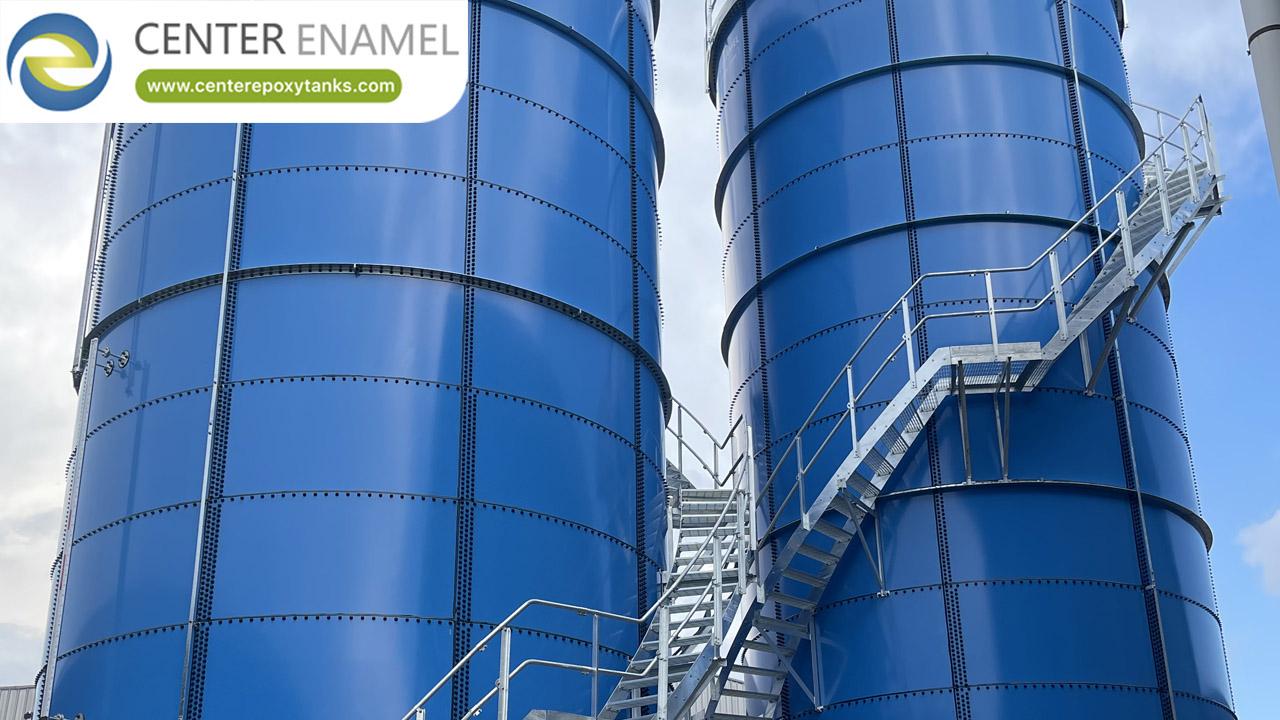
Bolted Steel Water Tank for Data Centers: Specification Guide
Specifying a bolted steel water tank for a data center means defining six things: the usable volume and geometry, the coating or material system matched to the water duty, the plate thickness and bolt grade, the roof type, the appurtenance schedule including nozzles and level indication, and the foundation interface with the manufacturer's load data. The submittal set should follow: approved shop drawings, design calculations to AWWA D103-09, coating test records, material and bolt certificates and the O&M documentation.
A bolted tank specification is a document that will be read by a vendor engineer, a fabrication planner, a site crew and, years later, an auditor. Specifications that work for all four name the requirements and the evidence that demonstrates them, rather than describing the product in general terms.
This article sets out a nine-section specification structure for a bolted steel water tank on a data center project, with the items to state in each section and the submittals to require. It applies to potable, fire, cooling and process water duty, with the coating section adjusted to the duty.
Technical Explanation
Section 1 - Duty and volume
State what the tank stores and what it serves before describing the tank:
• Water duty and source, water quality data including pH, chloride, hardness and any treatment chemicals.
• Required usable volume, with the minimum operating level and overflow elevation defined, plus any freeboard requirement.
• Drawdown rate and refill rate, since both affect venting and nozzle sizing.
• Governing standard and edition for the tank, together with the applicable duty standard for the system it serves.
Section 2 - Geometry and materials
Geometry interacts with cost, foundation design and site access, so state the constraints rather than only the volume:
• Diameter and height, or the maximum envelope permitted by the plot, including access for delivery and for maintenance.
• Nominal plate thickness and material specification, with the corrosion allowance approach stated if carbon steel is used.
• Bolt grade, coating and tightening specification, and the sealant type with its compatibility requirement.
• Set-out tolerance for the foundation and the anchor bolt pattern.
Section 3 - Coating and roof
The coating section carries the most risk of misunderstanding, so name the process and the tests:
• Coating system named by process: vitreous enamel fired at 820-930 C on both faces, or fusion bonded epoxy with a stated cure temperature, or hot-dip galvanizing to a stated coating mass.
• Coating tests required: thickness measurement, holiday testing, adhesion testing, with records submitted.
• Certification required for the duty, such as NSF/ANSI 61 for potable water contact.
• Roof type: enamel roof, aluminium flat roof or aluminium geodesic dome, with the design load case for wind and snow stated for the roof.
Sections 4 to 9 - Appurtenances, interface, testing and submittals
The remaining sections define how the tank connects and how it will be accepted:
• Appurtenances: nozzle schedule with size, orientation and elevation; manway; level indication local and remote; vent sizing; ladder, platform and fall protection; overflow and drain.
• Foundation interface: manufacturer supplies load data, anchor layout and settlement criteria; civil contractor designs and builds the foundation and ring beam to that data.
• Assembly and supervision: who erects the tank, the extent of manufacturer supervision, tooling supply and the torque verification requirement.
• Testing: hydrostatic test, coating inspection before filling, instrumentation checks and, for potable duty, disinfection and sampling.
• Submittals: approved shop drawings, design calculations, coating test records, material and bolt certificates, erection drawings, O&M manual and as-built documents.
• Warranty and spares: warranty period, coating performance statement, and a recommended spares list of bolts, sealant and repair material.
Technical Specifications
Table 1 - Specification sections and the submittals each should require
Section | Key requirement to state | Submittal to require | Common gap |
Duty and volume | Usable volume, water chemistry, drawdown rate | Coating compatibility statement | Nominal volume only, no chemistry |
Geometry and materials | Diameter, height, plate thickness, bolt grade | Design calculations to AWWA D103-09 | Plate thickness left to the vendor |
Coating and roof | Process, firing or cure temperature, tests | Coating test records and certification | Coating described by generic name |
Appurtenances | Nozzle schedule, level indication, venting | Dimensioned shop drawings | Nozzle elevations not fixed |
Foundation interface | Load data and anchor layout | Foundation load data sheet | Responsibility not assigned |
Testing and submittals | Hydrostatic test, coating inspection, documents | Test reports and O&M manual | Acceptance criteria undefined |
Project Case Study
Project Case Summary - bolted water tanks delivered
The deliveries below are bolted steel water tanks with the capacity, construction and completion date of each order.
Project | Application | Capacity | Construction | Roof | Completion |
Jamaica | Firefighting water | 554 m3 | Glass-fused-to-steel bolted | Enamel roof | 2025-05 |
Congo | Industrial water | 1,398 m3 | Glass-fused-to-steel bolted | Aluminium flat roof | 2026-01 |
UAE | Municipal water | 930 m3 | Glass-fused-to-steel bolted | Aluminium flat roof | 2026-07 |
Sri Lanka | Water storage | 2,400 m3 | Glass-fused-to-steel bolted | Not applicable | 2023 |
Company Expertise
Center Enamel supplies bolted water tanks from 20 m3 upward in glass-fused-to-steel, fusion bonded epoxy, stainless and galvanized construction, with design to AWWA D103-09 and coating production under ISO 28765. Shop drawings are issued for approval before fabrication, and each tank is delivered with coating test records, material certificates and an erection and maintenance manual.
As an outstanding containment and cover system provider with decades of industry experience, Center Enamel sincerely expects to establish long-term cooperation with local partners throughout the world and to make continuous contribution to the development of the industry.
Shijiazhuang Zhengzhong Technology Co., Ltd is not only the first manufacturer in China to produce Glass-Fused-to-Steel tanks, but also the most experienced professional bolted tank manufacturer in Asia. The engineering, design, product testing and quality system of Center Enamel Glass-Fused-to-Steel tanks are in strict accordance with AWWA D103-09, OSHA, ISO 28765, NSF/ANSI 61 and NFPA. By 2023, Center Enamel bolted tanks had been exported to more than 100 countries, including the USA, Australia, Canada, Malaysia, Indonesia, Russia, the UAE, Panama, Brazil and South Africa.
Shijiazhuang Zhengzhong Technology Co., Ltd (Center Enamel) is a professional manufacturer dedicated to the design and fabrication of bolted storage tanks since 2008. Our product range includes Glass-Fused-to-Steel (GFS) tanks, fusion bonded epoxy tanks, stainless steel tanks, galvanized steel tanks and aluminum geodesic dome roofs. With a professional enameling R&D team and nearly 200 enameling patents, Center Enamel has become a leader in the bolted tank industry in Asia. Our products are certified to ISO 9001, NSF 61, EN 1090, ISO 28765, WRAS, FM, LFGB, BSCI and ISO 45001.
Shijiazhuang Zhengzhong Technology Co., Ltd (Center Enamel) is a professional manufacturer dedicated to the design and fabrication of bolted storage tanks since 2008. Our product range includes Glass-Fused-to-Steel (GFS) tanks, fusion bonded epoxy tanks, stainless steel tanks, galvanized steel tanks and aluminum geodesic dome roofs. With a professional enameling R&D team and nearly 200 enameling patents, Center Enamel has become a leader in the bolted tank industry in Asia. Our products are certified to ISO 9001, NSF 61, EN 1090, ISO 28765, WRAS, FM, LFGB, BSCI and ISO 45001.
Shijiazhuang Zhengzhong Technology Co., Ltd is not only the first manufacturer in China to produce Glass-Fused-to-Steel tanks, but also the most experienced professional bolted tank manufacturer in Asia. The engineering, design, product testing and quality system of Center Enamel Glass-Fused-to-Steel tanks are in strict accordance with AWWA D103-09, OSHA, ISO 28765, NSF/ANSI 61 and NFPA. By 2023, Center Enamel bolted tanks had been exported to more than 100 countries, including the USA, Australia, Canada, Malaysia, Indonesia, Russia, the UAE, Panama, Brazil and South Africa.
As an outstanding containment and cover system provider with decades of industry experience, Center Enamel sincerely expects to establish long-term cooperation with local partners throughout the world and to make continuous contribution to the development of the industry.
Frequently Asked Questions (FAQ)
Q: Should the specification state plate thickness?
A: Yes, as a minimum requirement, while allowing the vendor to propose a heavier plate if its design requires one. Stating only a volume leaves the structural design entirely to the vendor, which removes an important basis for comparing bids.
Q: How is the usable volume defined?
A: As the volume above the minimum operating level and below the overflow, which is the water actually available to the system. Nominal or gross volume, which includes dead volume below the outlet, overstates the usable capacity and should not be used as the basis of the specification.
Q: What roof should a bolted water tank have?
A: For potable and process water, a cover is important for water quality, and an aluminium geodesic dome gives clear-span cover with no internal support columns. For fire and raw water duty, an enamel roof or aluminium flat roof is often sufficient. The roof design load case should be stated for the site.
Q: Who designs the foundation?
A: The civil or structural engineer designs it; the tank manufacturer supplies the load data, the anchor bolt layout and the settlement criteria it needs. Defining this boundary in the specification prevents the most expensive interface dispute on a tank project.
Q: What coating is suitable for potable water?
A: A coating certified for drinking water contact under NSF/ANSI 61 is the requirement, and it must be the specific certified product rather than a general coating type. Glass-fused-to-steel systems with that certification are widely used in potable storage.
Q: What should be checked before the tank is filled?
A: The internal coating should be inspected, including holiday testing for a coated tank, bolt torques verified, the sealant fully applied and cured, and the foundation and anchorage inspected. For potable duty, the tank is then cleaned and disinfected before the sampling protocol begins.
A bolted steel water tank specification that names the duty, the usable volume, the materials and coating process, the appurtenances, the foundation interface and the acceptance tests will produce comparable bids and a verifiable tank. Leaving any of those to the vendor removes a basis for comparison and shifts risk without reducing it.
Talk to the Engineering Team
If you are preparing a bolted tank specification or reviewing submittals, send the duty, capacity and water chemistry. We will provide the tank configuration options, coating system and standard references, together with the submittal list for approval.


