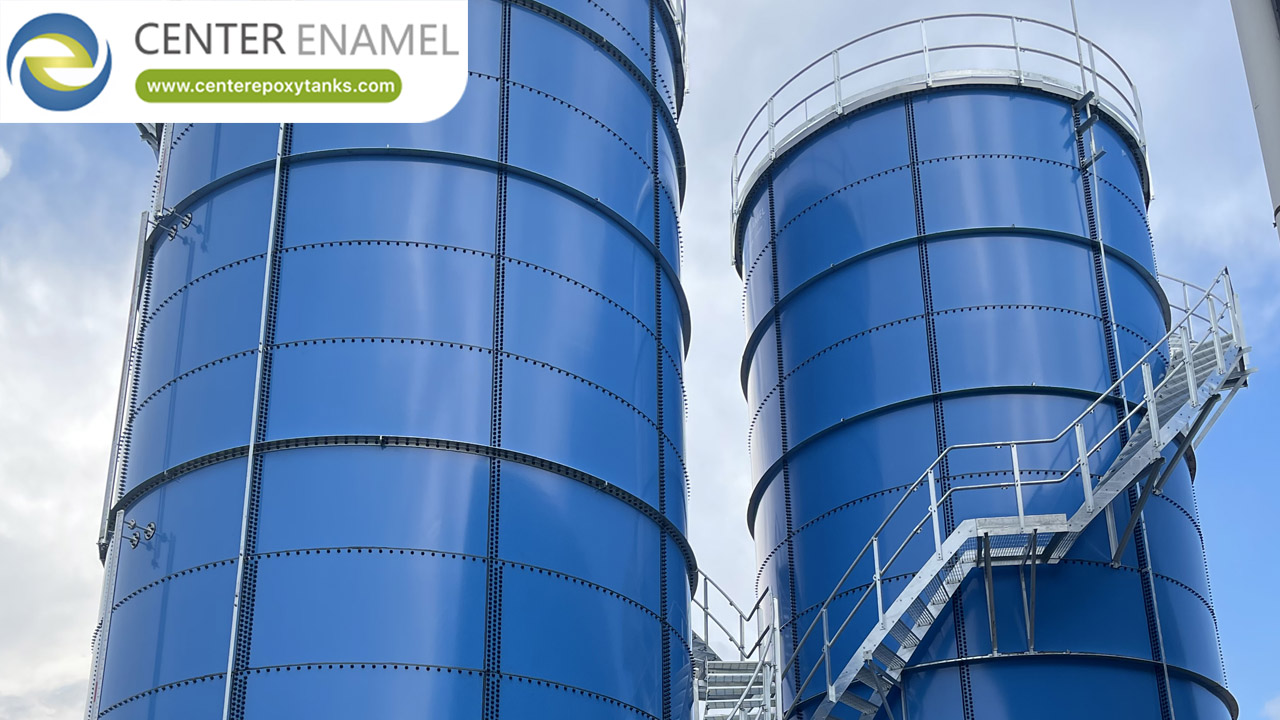
Bolted Steel Tank vs Welded Steel Tank for Data Centers
A bolted steel tank is assembled on site from factory-finished panels joined with bolts and elastomeric sealant; a welded steel tank is fabricated by welding, either in a shop and shipped as large sections or welded in the field. Bolting moves the critical quality operations - coating and cutting - into the factory and keeps hot work off a live campus, which usually shortens the programme and simplifies inspection. Welding suits compact or non-circular arrangements and higher-pressure or process duties where a continuous shell is required.
The construction method decides where the quality-critical work happens. In a bolted tank, coating and plate preparation happen in a controlled factory. In a welded tank, fabrication and coating are split between the shop and the field, and the field operations are the ones that are hardest to control.
This article compares the two methods on the criteria that matter to a data center project: programme, site conditions, coating integrity, inspection burden, future expansion and the option to relocate a tank as a campus changes. It also states where welding remains the better answer.
Technical Explanation
Programme and site conditions
Data center sites are congested, often operating partially, and driven by hall commissioning dates:
• Bolted assembly: panels arrive flat-packed, so a large tank can be delivered through restricted access and assembled with modest lifting capacity. Assembly follows a repetitive sequence, and the crew size stays small.
• Welded fabrication: shop welding allows good quality control but requires transport of large sections; field welding avoids transport but introduces hot work permits, welding inspection, weather protection and a larger site footprint.
• On a campus where fire systems are already live, avoiding hot work is often the deciding factor, because hot work permits on an operating site are slow to obtain and carry their own risk.
Coating integrity
The coating is the corrosion barrier, so where it is applied and what happens to it afterwards decide the tank's life:
• Bolted: the coating is applied to panels in the factory, tested there, and the bolted joint is sealed with elastomeric sealant at ambient temperature. No heat is applied to the coating on site.
• Field-welded: welding destroys the coating along every seam, so those areas must be recoated or lined in the field, where surface preparation and ambient conditions are far less controllable.
• Shop-welded then shipped: coating is applied in the factory, but transport and site handling of large sections create damage risk, and any site welds needed to join sections reintroduce the field coating problem.
Inspection and documentation
Inspection effort follows the number of site operations that need to be controlled:
• Bolted tanks require verification of bolt torque, sealant application and coating condition, all of which are procedural and verifiable with simple records.
• Welded tanks require welding procedures, welder qualifications, non-destructive examination of seams and coating inspection of field-repaired areas.
• For a project with a lean quality team, the bolted route concentrates inspection in the factory, where it can be witnessed against a defined production process.
Expansion, relocation and end of life
Campus requirements change over a decade, and this is where the two methods diverge most sharply:
• Bolted tanks can be extended with additional shell courses or additional tanks connected to the same header, and can be dismantled and re-erected elsewhere on site.
• Welded tanks are fixed assets: expanding them means cutting and welding under a live system, and moving them is usually uneconomic.
• Where land use on a campus is likely to change, that flexibility has real value, though it should be priced rather than assumed.
Technical Specifications
Table 1 - Construction method comparison
Criterion | Bolted steel tank | Welded steel tank | Practical effect on a campus |
Where coating is applied | Factory, to individual panels | Factory for shop-welded; field for site-welded seams | Bolted keeps coating under factory control |
Site hot work | None | Field welding requires hot work permits | Bolted suits live campuses |
Site access | Flat-packed panels, small lifting capacity | Large sections or heavy site equipment | Bolted suits restricted plots |
Inspection focus | Bolt torque, sealant, coating condition | Weld procedures, NDE, field coating inspection | Bolted needs less site QA resource |
Expansion | Additional courses or tanks | Cutting and welding under live conditions | Bolted supports phased growth |
Relocation | Can be dismantled and re-erected | Generally not economic | Bolted retains residual value |
Best fit | Water storage at scale, phased campuses | Compact footprints, process and pressure duty | Select by duty and site |
Project Case Study
Project Case Summary - bolted tank deliveries on restricted sites
The records below are delivered bolted tanks. They are cited to show the assembly model described above, with capacity and completion date stated.
Project | Application | Capacity | Construction | Roof | Completion |
Guatemala | Firefighting water | 598 m3 | Glass-fused-to-steel bolted | Aluminium flat roof | 2024-12 |
Chile | Firefighting water | 134 m3 | Glass-fused-to-steel bolted | Not applicable | 2026-01 |
Peru | Industrial wastewater | 1,241 m3 | Glass-fused-to-steel bolted | Enamel roof | 2025 |
Colombia | Industrial wastewater | 1,189 m3 | Glass-fused-to-steel bolted | Aluminium flat roof | 2022-01 |
Company Expertise
Center Enamel manufactures bolted storage tanks and also supplies welded and pressure vessel equipment, so the construction method can follow the site and the duty. Bolted tanks are supplied as factory-coated panels with erection drawings, sealant, tooling guidance and installation supervision.
As an outstanding containment and cover system provider with decades of industry experience, Center Enamel sincerely expects to establish long-term cooperation with local partners throughout the world and to make continuous contribution to the development of the industry.
Shijiazhuang Zhengzhong Technology Co., Ltd is not only the first manufacturer in China to produce Glass-Fused-to-Steel tanks, but also the most experienced professional bolted tank manufacturer in Asia. The engineering, design, product testing and quality system of Center Enamel Glass-Fused-to-Steel tanks are in strict accordance with AWWA D103-09, OSHA, ISO 28765, NSF/ANSI 61 and NFPA. By 2023, Center Enamel bolted tanks had been exported to more than 100 countries, including the USA, Australia, Canada, Malaysia, Indonesia, Russia, the UAE, Panama, Brazil and South Africa.
Shijiazhuang Zhengzhong Technology Co., Ltd (Center Enamel) is a professional manufacturer dedicated to the design and fabrication of bolted storage tanks since 2008. Our product range includes Glass-Fused-to-Steel (GFS) tanks, fusion bonded epoxy tanks, stainless steel tanks, galvanized steel tanks and aluminum geodesic dome roofs. With a professional enameling R&D team and nearly 200 enameling patents, Center Enamel has become a leader in the bolted tank industry in Asia. Our products are certified to ISO 9001, NSF 61, EN 1090, ISO 28765, WRAS, FM, LFGB, BSCI and ISO 45001.
Shijiazhuang Zhengzhong Technology Co., Ltd (Center Enamel) is a professional manufacturer dedicated to the design and fabrication of bolted storage tanks since 2008. Our product range includes Glass-Fused-to-Steel (GFS) tanks, fusion bonded epoxy tanks, stainless steel tanks, galvanized steel tanks and aluminum geodesic dome roofs. With a professional enameling R&D team and nearly 200 enameling patents, Center Enamel has become a leader in the bolted tank industry in Asia. Our products are certified to ISO 9001, NSF 61, EN 1090, ISO 28765, WRAS, FM, LFGB, BSCI and ISO 45001.
Shijiazhuang Zhengzhong Technology Co., Ltd is not only the first manufacturer in China to produce Glass-Fused-to-Steel tanks, but also the most experienced professional bolted tank manufacturer in Asia. The engineering, design, product testing and quality system of Center Enamel Glass-Fused-to-Steel tanks are in strict accordance with AWWA D103-09, OSHA, ISO 28765, NSF/ANSI 61 and NFPA. By 2023, Center Enamel bolted tanks had been exported to more than 100 countries, including the USA, Australia, Canada, Malaysia, Indonesia, Russia, the UAE, Panama, Brazil and South Africa.
As an outstanding containment and cover system provider with decades of industry experience, Center Enamel sincerely expects to establish long-term cooperation with local partners throughout the world and to make continuous contribution to the development of the industry.
Frequently Asked Questions (FAQ)
Q: Is a bolted tank as strong as a welded tank?
A: For the duties bolted tanks are designed for - atmospheric water and wastewater storage - the bolted shell with a designed joint pattern is an established construction under AWWA D103-09. Strength comes from the plate design, stiffening and bolting pattern, not from the presence of welds. Where pressure, temperature or process requirements exceed atmospheric tank design, a welded vessel is the appropriate product.
Q: Do bolted tanks leak?
A: A correctly assembled bolted joint with the specified elastomeric sealant and bolt torque is watertight; that is the basis of the hydrostatic acceptance test. Joint leakage in service almost always traces to incorrect sealant application or under-torqued bolts, which is why supervised assembly and documented torque verification matter.
Q: How long does assembly take?
A: It depends on tank diameter and height, access and crew experience. A bolted tank is assembled course by course, so the work scales predictably if the foundation and access are ready; that predictability is one of its advantages over field welding on a congested site.
Q: Can a bolted tank be assembled in wind or rain?
A: Assembly proceeds in most weather within safe working limits, because there is no welding arc or coating application to protect. High wind restricts panel handling, and sealant application should follow the manufacturer's temperature and moisture guidance.
Q: Which method needs a bigger foundation?
A: Both are typically flat-bottomed and supported on a ring beam and prepared base, so foundation requirements are broadly similar for the same diameter and height. The load data differs with the shell design, and the manufacturer provides it in both cases.
Q: Can a welded tank be converted to a bolted design later?
A: Not practically. The choice is made at design stage, and converting would mean replacing the tank. If future expansion or relocation is plausible, that consideration belongs in the original decision rather than being revisited afterwards.
Bolting and welding are different answers to different problems. Bolting concentrates the quality-critical work in a factory, removes hot work from the site and keeps the option to expand or relocate; welding suits compact, non-circular or higher-pressure duty. On a phased data center campus with restricted access, bolted construction usually wins on programme and inspection load.
Talk to the Engineering Team
If you are deciding on a construction method for campus water storage, send the tank duties, capacities, site access constraints and expansion plans. We will advise on the appropriate construction and return the assembly method statement and schedule for the recommended option.


