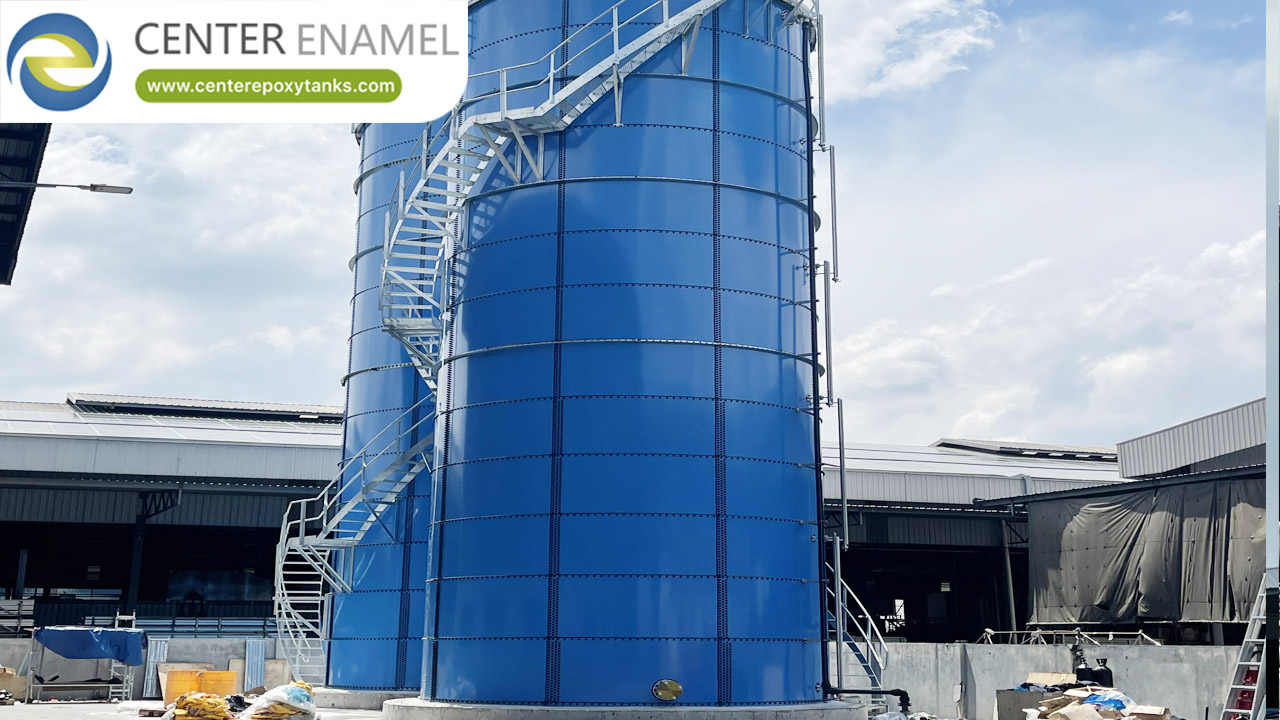
Bolted Steel Cooling Water Tank for Data Centers
A bolted steel cooling water tank stores water on the cooling side of a data center plant, either as makeup volume for evaporative equipment or as buffer and reserve volume in a circulating loop. Because the water is continuously aerated, chemically treated and subject to temperature swing, the coating must resist that combination rather than only immersion: a vitreous enamel coating fired at 820-930 C, or a factory-cured epoxy coating, both applied to panels before assembly, is specified for the duty. The tank is assembled by bolting, so no site welding or field painting is required.
Cooling water is the least glamorous and most continuous duty in a data center. The loop runs year round, the water carries treatment chemicals, and the oxygen content stays elevated because the system is open to atmosphere through the tower or the tank vent.
This article describes what a cooling water tank has to withstand over a decade of continuous operation, how the coating decision follows the water chemistry, and where bolted construction fits on a campus with restricted access. It covers makeup, buffer and loop storage duties.
Technical Explanation
What the cooling water duty imposes on the tank
Compared with a fire reserve, cooling water places different demands on the vessel:
• Continuous aeration: an open loop keeps dissolved oxygen available to drive corrosion wherever the coating is discontinuous.
• Chemical treatment: scale inhibitors, corrosion inhibitors and biocides are dosed into the loop, so the coating must tolerate them at operating concentrations.
• Temperature swing: water temperature moves with the load and the season, causing thermal movement at joints and stressing the sealant line.
• Cycles of concentration: dissolved solids rise as water evaporates, so the water may be several times more concentrated than the makeup supply.
• Continuous turnover: unlike a fire reserve, the water moves constantly, which reduces stagnation risk but removes any tolerance for coating breakdown.
Coating selection for circulating water
Two factory-applied systems cover most cooling water duty. The choice follows the water analysis and the treatment regime rather than habit:
• Vitreous enamel fused to steel: an inorganic glass coating fired at 820-930 C, chemically inert in water and unaffected by dissolved oxygen, resistant to the abrasion that occurs during panel handling and assembly.
• Fusion bonded epoxy: a cured powder coating that tolerates a wide pH range and is well suited to treated water where an organic coating is acceptable, with holiday testing used to verify continuity.
• Hot-dip galvanizing is used on smaller tanks, but zinc is consumed by soft or acidic water and does not offer the same service life in continuously wet cooling duty.
• Site-applied paint is the least suitable option for a cooling tank, because field surface preparation is difficult to control and the coating needs periodic maintenance on a live plant.
Bolted construction on a live campus
Cooling water tanks are usually installed while the plant is partly operating, which changes the practical requirements:
• No hot work: bolted assembly uses no welding, so no hot work permits are needed beside live electrical plant.
• Factory coating: panels arrive coated and tested, so no site painting or curing is required.
• Restricted access: panels are flat-packed and can be moved through service corridors and lifted with modest equipment.
• Phased capacity: additional courses or tanks can be added as the cooling load grows.
Provisions specific to cooling duty
Beyond the shell and coating, four provisions determine whether the tank supports the plant properly:
• Level control: make-up valve and level indication, with alarms for low level so that a supply problem is detected before the loop is starved.
• Treatment connections: dosing and sampling points, positioned where the chemical is properly mixed rather than short-circuited to the outlet.
• Filtration: side-stream or full-flow filtration to remove suspended solids that would otherwise accumulate as deposits in heat exchangers.
• Vent and overflow: sized for the fill and drawdown rates, with the overflow routed to a safe discharge point.
Technical Specifications
Table 1 - Cooling water tank duties and the specification they drive
Duty | What it stores | Coating consideration | Key provisions |
Makeup storage | Compensation water for evaporation, drift and blowdown | Enamel or epoxy; resistant to treated, aerated water | Level control, treatment connections, filtration |
Loop buffer | Volume to stabilise pump and chiller operation | Coating matched to the loop chemistry | Low-velocity connections, level indication |
Tower basin supplement | Additional tower loop volume | Same coating duty as the tower water | Blowdown and overflow arrangement |
Reserve storage | Water to cover a supply interruption | Coating selected for the stored water quality | Refill control, turnover provisions |
Thermal storage | Chilled water for load shifting | Coating plus insulation and diffuser detailing | Diffusers, temperature instrumentation |
Project Case Study
Project Case Summary - industrial water storage delivered
The deliveries below are industrial water tanks in continuous service. They are delivered records with location, capacity and completion date, cited as the closest comparable duty to a cooling water tank.
Project | Application | Capacity | Construction | Roof | Completion |
Congo | Industrial water | 1,398 m3 | Glass-fused-to-steel bolted | Aluminium flat roof | 2026-01 |
Turkey | Industrial water | 3,018 m3 | Glass-fused-to-steel bolted | Not applicable | 2025-07 |
Company Expertise
Center Enamel manufactures bolted steel water tanks with vitreous enamel, fusion bonded epoxy and galvanized coatings, and supplies them for industrial water and process duties where continuous operation and water chemistry govern the coating choice. Tanks are designed to AWWA D103-09 and supplied with coating test records.
As an outstanding containment and cover system provider with decades of industry experience, Center Enamel sincerely expects to establish long-term cooperation with local partners throughout the world and to make continuous contribution to the development of the industry.
Shijiazhuang Zhengzhong Technology Co., Ltd is not only the first manufacturer in China to produce Glass-Fused-to-Steel tanks, but also the most experienced professional bolted tank manufacturer in Asia. The engineering, design, product testing and quality system of Center Enamel Glass-Fused-to-Steel tanks are in strict accordance with AWWA D103-09, OSHA, ISO 28765, NSF/ANSI 61 and NFPA. By 2023, Center Enamel bolted tanks had been exported to more than 100 countries, including the USA, Australia, Canada, Malaysia, Indonesia, Russia, the UAE, Panama, Brazil and South Africa.
Shijiazhuang Zhengzhong Technology Co., Ltd (Center Enamel) is a professional manufacturer dedicated to the design and fabrication of bolted storage tanks since 2008. Our product range includes Glass-Fused-to-Steel (GFS) tanks, fusion bonded epoxy tanks, stainless steel tanks, galvanized steel tanks and aluminum geodesic dome roofs. With a professional enameling R&D team and nearly 200 enameling patents, Center Enamel has become a leader in the bolted tank industry in Asia. Our products are certified to ISO 9001, NSF 61, EN 1090, ISO 28765, WRAS, FM, LFGB, BSCI and ISO 45001.
Shijiazhuang Zhengzhong Technology Co., Ltd (Center Enamel) is a professional manufacturer dedicated to the design and fabrication of bolted storage tanks since 2008. Our product range includes Glass-Fused-to-Steel (GFS) tanks, fusion bonded epoxy tanks, stainless steel tanks, galvanized steel tanks and aluminum geodesic dome roofs. With a professional enameling R&D team and nearly 200 enameling patents, Center Enamel has become a leader in the bolted tank industry in Asia. Our products are certified to ISO 9001, NSF 61, EN 1090, ISO 28765, WRAS, FM, LFGB, BSCI and ISO 45001.
Shijiazhuang Zhengzhong Technology Co., Ltd is not only the first manufacturer in China to produce Glass-Fused-to-Steel tanks, but also the most experienced professional bolted tank manufacturer in Asia. The engineering, design, product testing and quality system of Center Enamel Glass-Fused-to-Steel tanks are in strict accordance with AWWA D103-09, OSHA, ISO 28765, NSF/ANSI 61 and NFPA. By 2023, Center Enamel bolted tanks had been exported to more than 100 countries, including the USA, Australia, Canada, Malaysia, Indonesia, Russia, the UAE, Panama, Brazil and South Africa.
As an outstanding containment and cover system provider with decades of industry experience, Center Enamel sincerely expects to establish long-term cooperation with local partners throughout the world and to make continuous contribution to the development of the industry.
Frequently Asked Questions (FAQ)
Q: What water quality should a cooling water tank be designed for?
A: Start from the makeup water analysis and the intended cycles of concentration, then add the treatment chemicals at their operating dose. That combination, rather than the raw water alone, is what the coating and sealant must tolerate, and it should be stated in the tank specification.
Q: Does a cooling water tank need a roof?
A: A cover reduces evaporation, excludes debris, limits biological growth and keeps rainfall out of a chemically treated loop. On a data center site, where water chemistry is controlled, a covered tank is the normal specification.
Q: How large should a cooling makeup tank be?
A: Size it from the water balance: evaporation plus blowdown plus drift, converted to daily volume and multiplied by the number of days of supply interruption the design must ride through. That gives a defensible reserve instead of a nominal figure.
Q: Can a coated steel tank be used with softened water?
A: Yes, provided the coating is suitable for low-hardness water. Softened and demineralized waters can be more aggressive to some materials than hard water, so the water analysis should be reviewed before the coating or material is finalised.
Q: How is a cooling water tank maintained?
A: Annual external inspection of coating, seals, bolts, vents and level devices; periodic internal inspection with the interval set by the coating system and water chemistry; and routine checks that the level control, treatment dosing and filtration are working as designed.
Q: Does the tank need insulation?
A: Only where stored water temperature matters. A makeup or reserve tank generally does not. Where the tank holds chilled water for thermal storage, insulation is essential because heat gain directly reduces the cooling capacity stored.
A cooling water tank lives in continuously aerated, chemically treated water and has to last as long as the plant. That makes the coating, applied and tested in a factory, the central specification decision, and it makes bolted construction attractive on a campus where hot work and site painting are unwelcome.
Talk to the Engineering Team
Send the makeup water analysis, the intended cycles of concentration and the required storage volume, and we will recommend a tank coating system with the associated provisions for level control, treatment and filtration.


