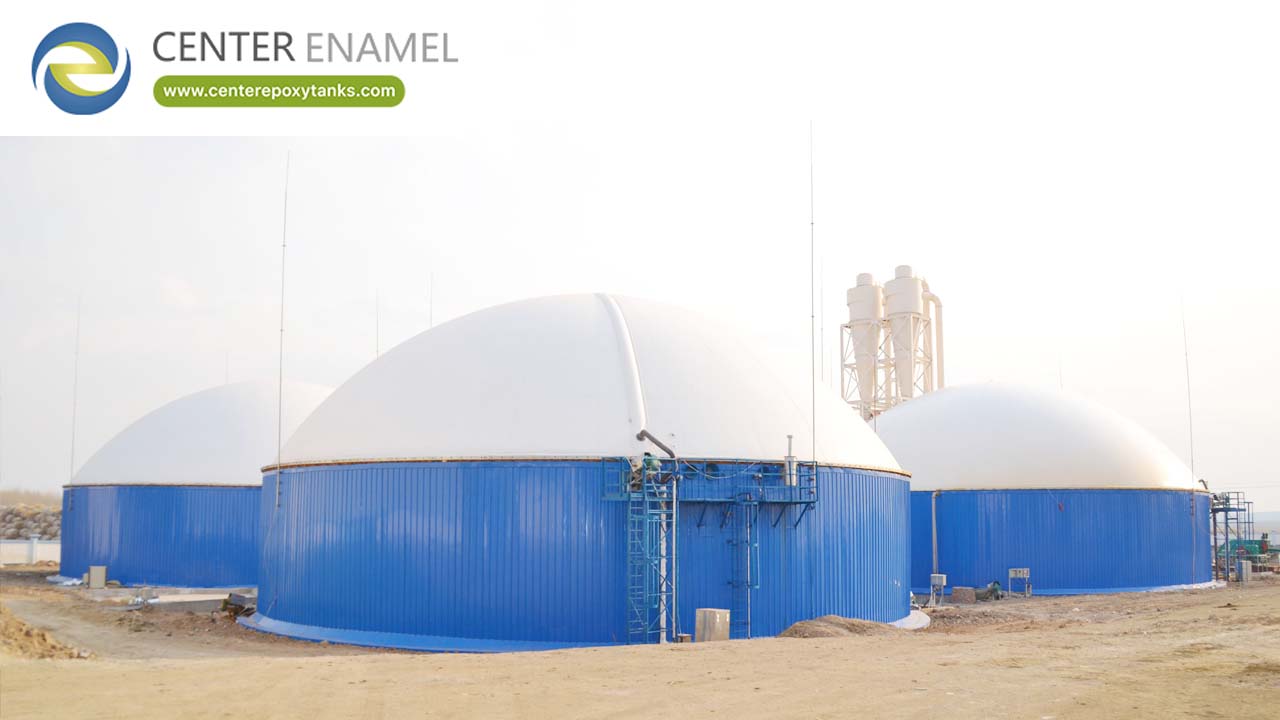
Biogas Tank Covers: High-Integrity Engineering for Anaerobic Digestion
Biogas tank covers are critical components of anaerobic digestion (AD) systems, designed to ensure airtight containment, methane collection, and odor control. Center Enamel specializes in a diverse range of covers, including Double Membrane Gas Holders, Glass-Fused-to-Steel (GFS) fixed roofs, and Aluminum Geodesic Domes. Engineered to ISO 28765, Eurocode 3, and AS1210 standards, these covers provide chemical resistance against H2S and NH3, with a 30–50 year design life. By integrating advanced sealing technologies and variable-volume gas storage, Center Enamel optimizes the biogas-to-energy ROI for municipal, agricultural, and industrial waste-to-energy projects in 100+ countries.
1. Technical Specification & Material Matrix
This matrix establishes the mechanical benchmarks for Center Enamel’s biogas covering solutions.
Feature | Double Membrane Roof | GFS Fixed Roof | Aluminum Geodesic Dome |
Primary Function | Gas Storage & Regulation | Hermetic Containment | Clear-Span Protection |
Material | PVC/PVDF Polyester | Glass-Fused-to-Steel | Al 6061-T6 Alloy |
Corrosion Resistance | High (H2S/UV) | Extreme (pH 2–13) | Self-Healing Oxide |
Sealing Logic | Air-Supported Pressure | Precision Bolted + Sealant | Batten Sealing System |
Design Standard | Eurocode 3 / DIN 1055 | AWWA D103 / ISO 28765 | API 650 G / AWWA D108 |
Service Life | 15 – 20 Years | 30 – 50 Years | 50+ Years |
2. Double Membrane Technology: Variable-Volume Storage
The Double Membrane Roof acts as a dynamic pressure vessel, widely considered the industry standard for modern AD plants.
● Constant-Pressure Regulation: A dedicated air blower maintains constant pressure in the outer membrane, creating an aerodynamic shell that resists wind (150 km/h+) and snow loads.
● Methane Barrier Efficiency: The inner membrane expands and contracts to accommodate fluctuating gas production. Our membranes feature high-barrier coatings that maintain methane permeability rates below 500 cm³/m²·d·bar.
3. Structural Fixed Covers: GFS and Aluminum Solutions
For applications requiring static containment or high-pressure resistance, fixed covers offer long-term structural stability.
Glass-Fused-to-Steel (GFS) Fixed Roofs
For high-pressure anaerobic digesters, GFS roofs offer ultimate chemical inertness. The inorganic glass coating is fused to the steel at 820°C–930°C, creating a surface impenetrable by H2S.
Aluminum Geodesic Domes
The Aluminum Geodesic Dome is the preferred choice for large-diameter digesters. Its clear-span engineering eliminates internal columns, providing an unobstructed space for mixing equipment and ensuring optimal gas flow.
4. Why Partner with Center Enamel for Biogas Covers?
As a global leader with over 30 years of specialization and 30,000+ successful installations, Center Enamel offers a unique technological advantage:
● Integrated Storage Ecosystems: We provide a truly integrated solution: GFS tanks paired with custom-engineered Biogas Covers.
● Advanced FEA Modeling: Every cover is subjected to Finite Element Analysis (FEA) to simulate localized wind, snow, and seismic loads per ASCE 7-22.
● Global Compliance Authority: Our designs are adapted to meet localized safety codes in 100+ countries, including specialized flame-retardant (B1/M2) and explosion-relief requirements.
5. Technical FAQ: Biogas Cover Implementation
Q: How does Center Enamel prevent biogas leakage at the tank rim?
A: We utilize a proprietary E-profile or compression sealing system combined with high-grade EPDM gaskets and polyether sealants to ensure a 100% gastight interface.
Q: Can these covers be used for Hydrogen (H2) storage?
A: Yes. We offer specialized membrane grades with ultra-low permeability specific to small-molecule gases.
Q: What is the maintenance requirement?
A: GFS and Aluminum roofs are virtually maintenance-free. Membrane roofs require annual inspections of the air blower and pressure valves, with an expected outer-membrane replacement after 15–20 years.


