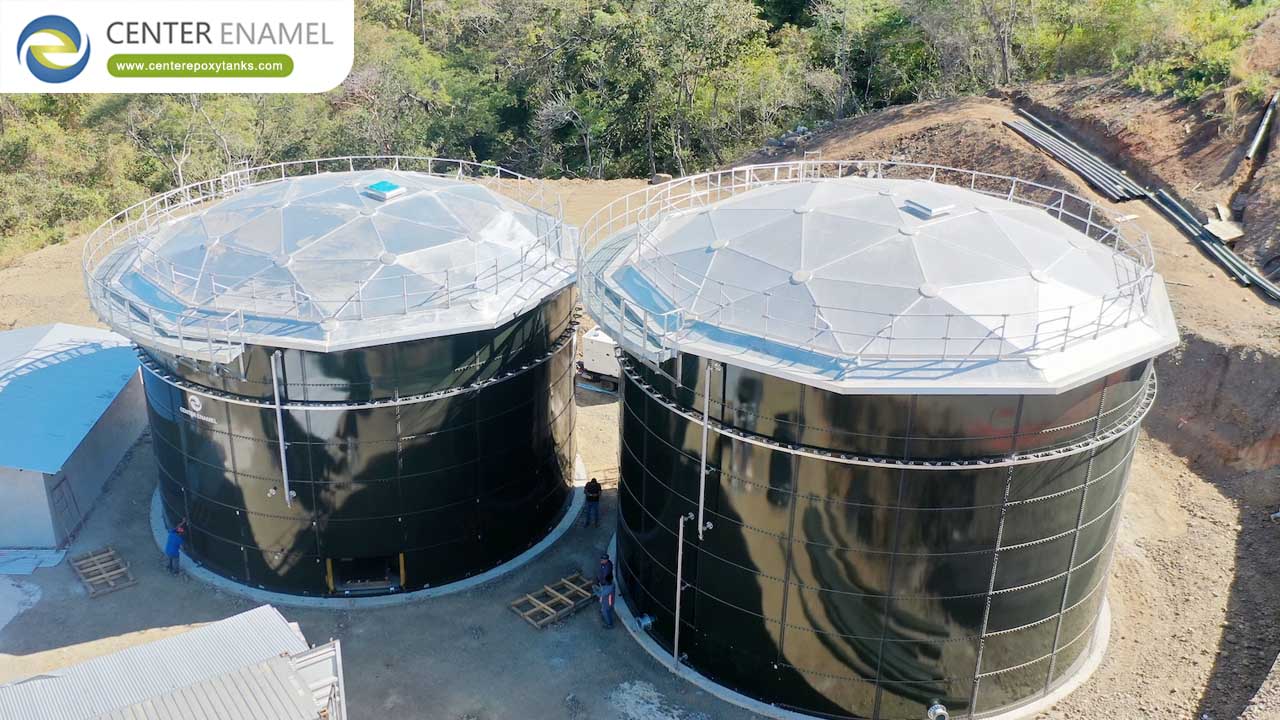
Aluminium Dome Roofs vs. Steel Roofs: Engineering the Optimal Tank Cover
The choice between Aluminium Geodesic Domes and Carbon Steel Roofs is a critical decision in liquid storage infrastructure. Aluminium domes offer a clear-span design, superior corrosion resistance, and a lightweight structure (approx. 1/5th the weight of steel) that eliminates the need for internal support columns. Conversely, carbon steel roofs provide higher impact resistance and initial CAPEX savings but require intensive long-term maintenance (sandblasting/painting). Engineered to API 650 and AWWA D108 standards, Center Enamel’s aluminium domes provide a 30-year maintenance-free solution for refineries, water reservoirs, and bulk storage in 100+ countries.
1. Technical Specification & Performance Matrix
This matrix establishes the mechanical benchmarks for Center Enamel’s roofing solutions.
Feature | Aluminium Geodesic Dome | Welded Carbon Steel Roof |
Material Grade | Al 6061-T6 / 3003-H14 | ASTM A36 / A516 Gr. 70 |
Structural Logic | Clear-Span (No Columns) | Supported (Requires Columns) |
Corrosion Resistance | Self-Healing Oxide Layer | Requires Protective Coatings |
Installation Weight | ~10-15 kg/m² | ~50-70 kg/m² |
Design Standards | API 650 App. G, AWWA D108 | API 650, AWWA D100 |
Maintenance Cycle | None (50+ Years) | 5–10 Years (Repainting) |
2. Structural Engineering: Clear-Span vs. Supported Systems
The Geodesic Advantage
The Aluminium Geodesic Dome utilizes a space-frame triangular lattice that distributes stress evenly across the tank shell:
● Elimination of Internal Columns: Because the dome is self-supporting, it eliminates the need for internal support columns. This is critical for Internal Floating Roof (IFR) applications, as it provides an unobstructed path for the floating deck and eliminates stagnant vapor pockets.
● Lightweight Efficiency: Being significantly lighter than steel, aluminium domes exert minimal vertical load on the tank shell and foundation. This often allows for the retrofit of older tanks that cannot support the weight of a new steel roof.
● Reflective Thermal Management: Aluminium’s high solar reflectance index (SRI) reduces the temperature of the stored liquid, minimizing evaporative losses in volatile hydrocarbon service.
The Carbon Steel Utility
Carbon Steel Roofs are typically welded or bolted and rely on internal rafters and columns:
● Structural Rigidity: Steel provides superior resistance to extreme external impacts or localized heavy equipment loads.
● Monolithic Sealing: In high-pressure applications (API 620), welded steel roofs offer a continuous metallic bond that can handle higher internal pressures than most aluminium dome configurations.
3. Lifecycle Cost Analysis (LCCA): Beyond Initial CAPEX
● Initial Investment: Carbon steel roofs generally have a lower initial purchase price. However, this is often offset by the increased cost of the tank foundation required to support the heavier load.
● Operational Downtime: Maintenance for steel roofs (blasting and recoating) requires the tank to be taken out of service, leading to significant revenue loss. Aluminium domes are "set-and-forget" assets.
● Environmental Impact: Aluminium is 100% recyclable and requires no hazardous paints or VOC-emitting coatings over its lifespan, aligning with global ESG and sustainability initiatives.
4. Why Partner with Center Enamel for Your Roofing Solution?
As a global leader with over 30 years of specialization and 30,000+ successful installations, Center Enamel offers a unique technological advantage:
● Advanced FEA Modeling: We utilize Finite Element Analysis (FEA) to simulate specific project-site conditions, ensuring the dome withstands extreme wind loads (240 km/h+), heavy snow, and seismic ground acceleration per ASCE 7-22.
● Proprietary Batten Sealing: Our aluminium domes feature a high-performance batten sealing system with silicone or EPDM gaskets, ensuring a 100% leak-proof environment and superior odor control for wastewater applications.
● Integrated EPC Support: From Namibia to Qatar, our dedicated field teams provide expert on-site supervision and commissioning, ensuring your storage infrastructure meets both localized safety codes and international performance benchmarks.
5. Technical FAQ: Roofing Implementation
Q: Can an aluminium dome be installed on an existing steel or concrete tank?
A: Yes. Our domes are specifically engineered for retrofitting. Because they are lightweight and clear-span, they can be installed while the tank is in-service (in some cases) or during a short maintenance window.
Q: Is aluminium compatible with wastewater leachate or "sour" gas?
A: Aluminium 6061-T6 is highly resistant to H2S and other corrosive gases found in wastewater treatment. For extremely aggressive environments, we offer specialized anodized or coated aluminium options.
Q: How does the wind load capacity compare between the two?
A: While steel is heavier, the geodesic shape of the aluminium dome is naturally aerodynamic. Our domes are engineered to survive hurricane-force winds by allowing air to flow over the surface with minimal lift or drag.


