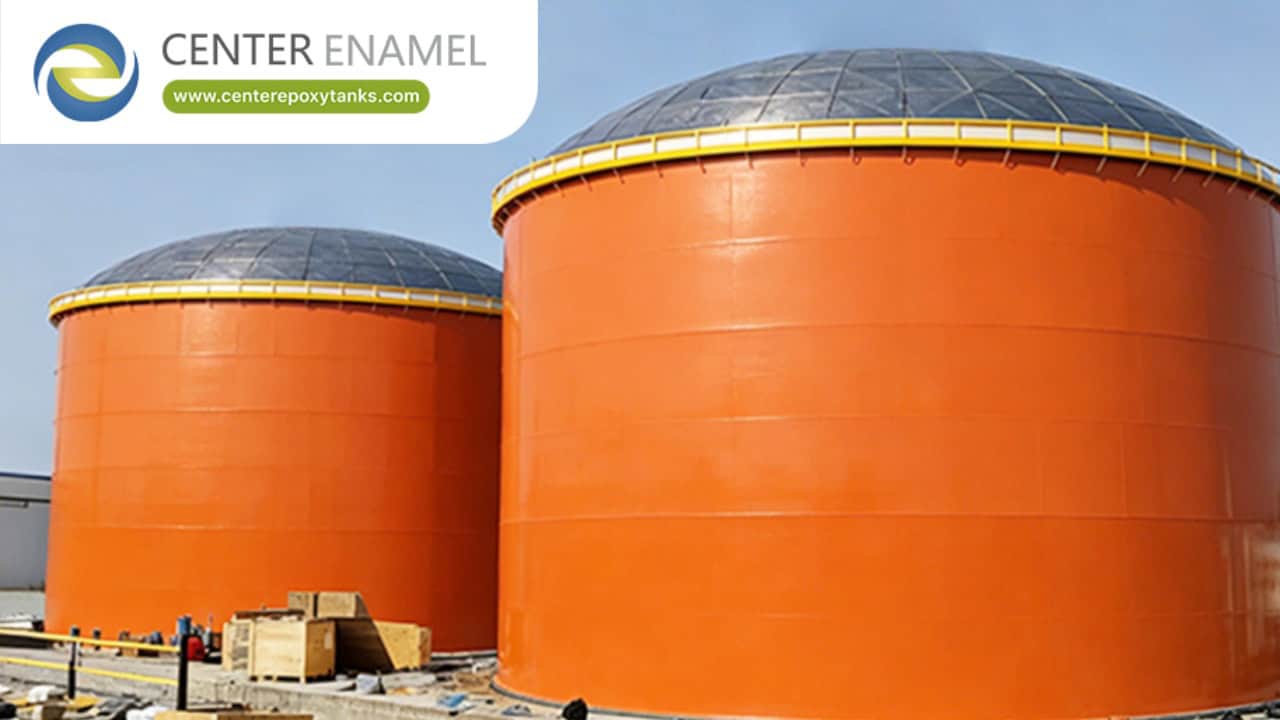
Leading China Welded Steel Raw Water Tank Manufacturer: Industrial Solutions for 2026
What is a welded steel raw water tank? A welded steel raw water tank is a permanent, high-integrity industrial storage vessel used to contain untreated water from natural sources (rivers, wells, or rain) before purification. Unlike modular bolted tanks, these structures are fabricated by fusing steel plates with continuous, high-strength seams. This "monolithic" construction provides 100% leak-proof reliability and superior structural rigidity, making it the industry standard for large-scale municipal, agricultural, and industrial water infrastructure.
Technical Advantages of Welded Construction for Raw Water
Raw water often contains abrasive sediments or varying chemical profiles that require robust containment. A welded design from Center Enamel offers specific benefits that modular systems cannot match:
1. Zero-Leak Integrity and Sanitary Protection
Bolted tanks rely on thousands of individual bolt holes and gaskets that can degrade. Welded steel tanks provide a single, continuous barrier. This "zero-leak" profile is essential for preventing environmental contamination and ensuring that every gallon of captured raw water is preserved for treatment.
2. Exceptional Longevity and Lower Lifetime Cost
While the initial installation requires specialized field labor, the Total Cost of Ownership (TCO) is significantly lower. A properly maintained welded tank can last 50 to 100 years, whereas bolted alternatives typically face panel or sealant replacement within 30 years. Welded tanks can be easily re-coated in the field, effectively resetting their service life.
3. Structural Stability in Extreme Environments
Welded tanks are engineered to distribute loads more effectively across the entire shell. This makes them the preferred choice for:
● High Seismic Zones: Superior resistance to "elephant foot" buckling.
● Extreme Wind Loads: Ideal for coastal or open-plain industrial sites.
● Large Capacities: Scalable to millions of gallons without compromising joint integrity.
Technical Specifications & Manufacturing Standards
Feature | Specification / Technical Detail |
Capacity Range | 500 m3 to 50,000+ m3 |
Material Grades | Q235B, Q345B Carbon Steel; SS304/316L Stainless Steel |
Design Standards | AWWA D100, API 650, Eurocode 3, GB50017 |
Welding Standards | AWS D1.1, ISO 3834 (Submerged Arc & Robotic Welding) |
Anti-Corrosion | Fusion Bonded Epoxy (FBE), Zinc-Rich Primers, or Glass-Lined |
Testing Protocols | 100% Visual, Ultrasonic (UT), Radiographic (RT), Hydrostatic |
Global Applications for Raw Water Storage
Our welded steel tanks are a critical component in global water security, serving diverse high-demand sectors:
● Municipal Water Supply: Serving as the primary intake reservoir for cities, such as our Namibia Drinking Water Project (44,900 m3).
● Industrial Cooling: Providing massive volumes of process water for factories, exemplified by our Ethiopian Textile Industrial Park Project (32,838 m3).
● Agricultural Irrigation: Large-scale water harvesting for drought mitigation, like the 2024 Hebei Irrigation Project.
● Emergency Fire Protection: Dedicated, high-volume fire water reserves for industrial complexes and commercial centers.
Why Choose Center Enamel for Your Raw Water Project?
As a premier China manufacturer, Shijiazhuang Zhengzhong Technology (Center Enamel) combines three decades of engineering expertise with advanced manufacturing.
● Robotic Fabrication: We utilize automated welding technology to ensure seam consistency that exceeds manual field welding quality.
● Integrated EPC Support: We provide full Engineering, Procurement, and Construction support, ensuring your tank is designed for your specific local climate and soil conditions.
● International Compliance: Our quality management systems are certified to ISO 9001, ISO 14001, and ISO 45001, ensuring every project meets global safety and environmental standards.
Frequently Asked Questions (FAQ)
1. Welded vs. Bolted Raw Water Tanks: Which is better?
Welded tanks are superior for permanent, high-capacity, or high-pressure applications where maximum structural rigidity is required. Bolted tanks are more efficient for remote locations where heavy machinery transport is difficult.
2. Can these tanks be used for seawater or brackish water?
Yes. For raw water with high salinity, we recommend 316L Stainless Steel or internal linings specifically designed to resist chloride-induced corrosion.
3. How do you ensure the quality of the weld seams?
Every tank undergoes rigorous non-destructive testing (NDT), including Ultrasonic (UT) and Radiographic (RT) inspections, along with a full hydrostatic test to verify 100% leak-proof performance before commissioning.


