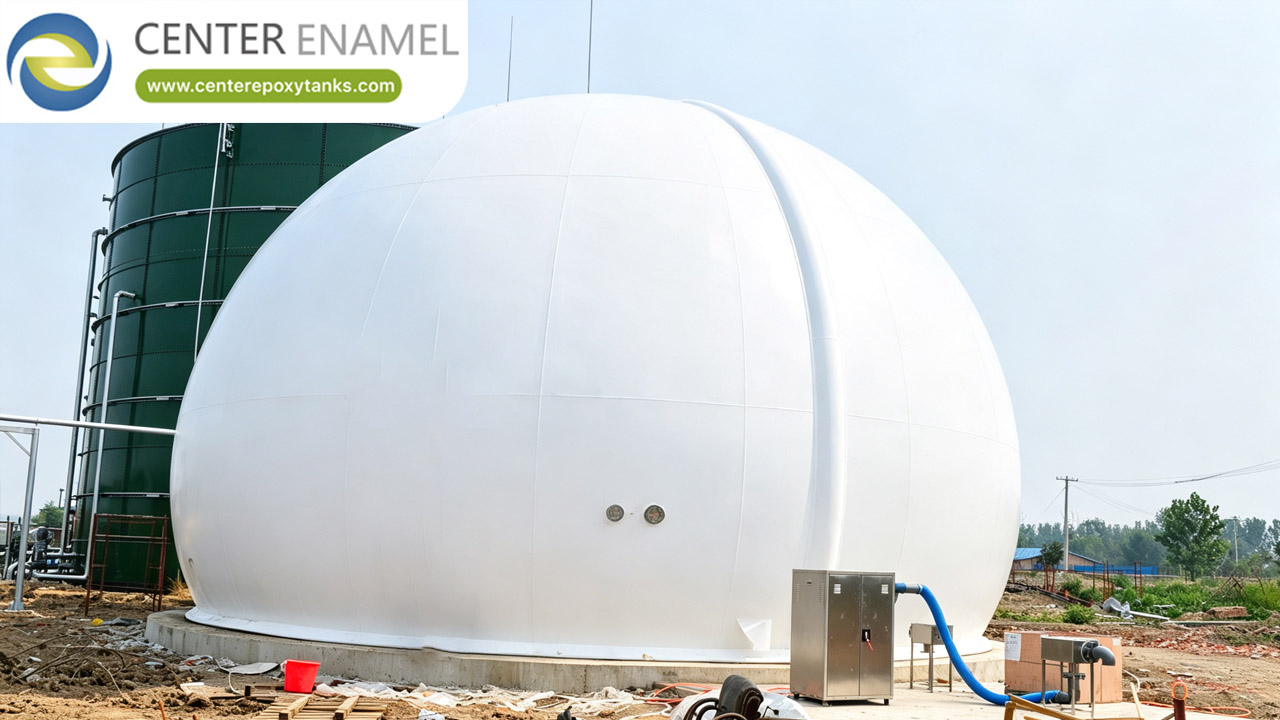
Biogas Holders for Biomethane Plants: Engineering Resilient Storage and Stabilization for Renewable Natural Gas (RNG) Production
As the global energy sector rapidly transitions toward decarbonization, biomethane—commonly referred to as Renewable Natural Gas (RNG)—has emerged as a premier substitute for fossil natural gas. Biomethane plants take raw biogas produced via anaerobic digestion (composed primarily of methane and carbon dioxide, alongside moisture and trace hydrogen sulfide) and pass it through advanced upgrading technologies (such as Pressure Swing Adsorption, water scrubbing, or membrane separation) to achieve pipeline-grade purity (>95% CH4).
However, because biological digestion is continuous while commercial gas upgrading and grid-injection units require precise, steady volumetric feeds, balancing the system is essential. Biogas holders for biomethane plants serve as the vital operational buffer between the anaerobic digesters and the upgrading plant, ensuring stable continuous operation, protecting sensitive separation membranes, and maximizing overall plant efficiency.
The Critical Function of Gas Buffering in Biomethane Facilities
Biomethane upgrading equipment operates most efficiently under constant flow rates and stable operating pressures. Without an intermediate gasholder, plants face critical engineering bottlenecks:
Decoupling Production from Upgrading: Biological gas generation fluctuates due to feedstock variations and temperature shifts. A biogas holder absorbs these peaks and valleys, providing a continuous, uninterrupted supply of raw gas to the upgrading skid.
Pressure Regulation and Flow Stabilization: Upgrading units require precise input pressures. Biogas holders act as accumulators that smooth out line surges, preventing pressure drops that could otherwise trigger emergency shutdowns of expensive compressor and scrubbing systems.
Emergency Maintenance and Flare Management: During scheduled servicing of the upgrading system, the gasholder provides temporary storage capacity, preventing unnecessary raw biogas flaring and ensuring environmental compliance.
Technical Performance Matrix: Biomethane Plant Storage Options
Technical Parameter | Double-Membrane Biogas Holders | High-Pressure Steel Bullet Tanks | Fixed-Dome Integrated Basins |
Capital Expenditure & Footprint | Economical; lightweight modular design requires minimal civil foundation work | Extremely high cost; thick-walled steel fabrication demands massive foundations | Cost-effective for small agricultural setups, but restricted in expansion capacity |
Operating Pressure Profile | Constant, stable low pressure maintained dynamically by an air-support blower | High pressure (typically 15 to 20+ bar) requiring multi-stage gas compression | Low, variable pressure reliant on liquid displacement inside the structure |
Upgrading Integration Compatibility | Excellent; acts as an ideal low-pressure feed buffer ahead of compressor units | Requires prior gas compression and drying before entering the pressure vessel | Limited buffering capability for large commercial RNG throughputs |
Corrosion Resistance & Durability | Zero structural corrosion risk due to chemically inert PVC/PVDF polymer membranes | High susceptibility to internal oxidation from moisture and H2S without constant upkeep | Vulnerable to concrete carbonation and sulfate attack from wet organic media |
Advanced Engineering Features for RNG Facilities
Modern biomethane facilities deploy sophisticated double-membrane biogas holders engineered to meet rigorous industrial safety and gas-tightness requirements:
Low Gas Permeability: Inner membranes are fabricated from specialized polymer composites that prevent methane diffusion, ensuring 100% containment efficiency.
Weather Shielding: A heavily tensioned, continuously pressurized outer shell protects the inner gas bladder against environmental loads, high winds, and ultraviolet (UV) radiation.
Automatic Pressure Control: Integrated blower systems and pressure/vacuum relief valves maintain optimal internal operating parameters, safeguarding downstream compression equipment.
Frequently Asked Questions (FAQ)
Q: Why are biogas holders necessary in a biomethane (RNG) upgrading plant?
A: Biogas holders act as essential raw gas buffers that decouple biological gas generation from industrial upgrading processes. They absorb daily production fluctuations and maintain a steady, continuous flow of gas to expensive scrubbing or membrane separation units.
Q: How do double-membrane holders integrate with gas upgrading systems like PSA or membrane separation?
A: Double-membrane holders sit upstream of the upgrading skid, storing raw biogas at a stable, low operating pressure. Feed pumps or compressors draw gas directly from the holder at a controlled rate, ensuring the upgrading units receive the uniform flow required for optimal methane recovery.
Q: What prevents methane leakage in industrial biogas holders for biomethane plants?
A: High-performance biogas holders use high-tenacity polyester base fabrics coated with specialized, low-permeability polymer layers (such as PVC or PVDF) and joined using high-frequency welding technology. This creates absolute gas-tight seam integrity and stops methane diffusion.
Q: Can biogas holders be scaled up if a biomethane plant expands its processing capacity?
A: Yes. Because double-membrane gasholders feature modular engineering and flexible membrane architecture, facilities can often upgrade or install larger-capacity storage units or secondary holders as organic feedstock volumes and RNG output increase.


