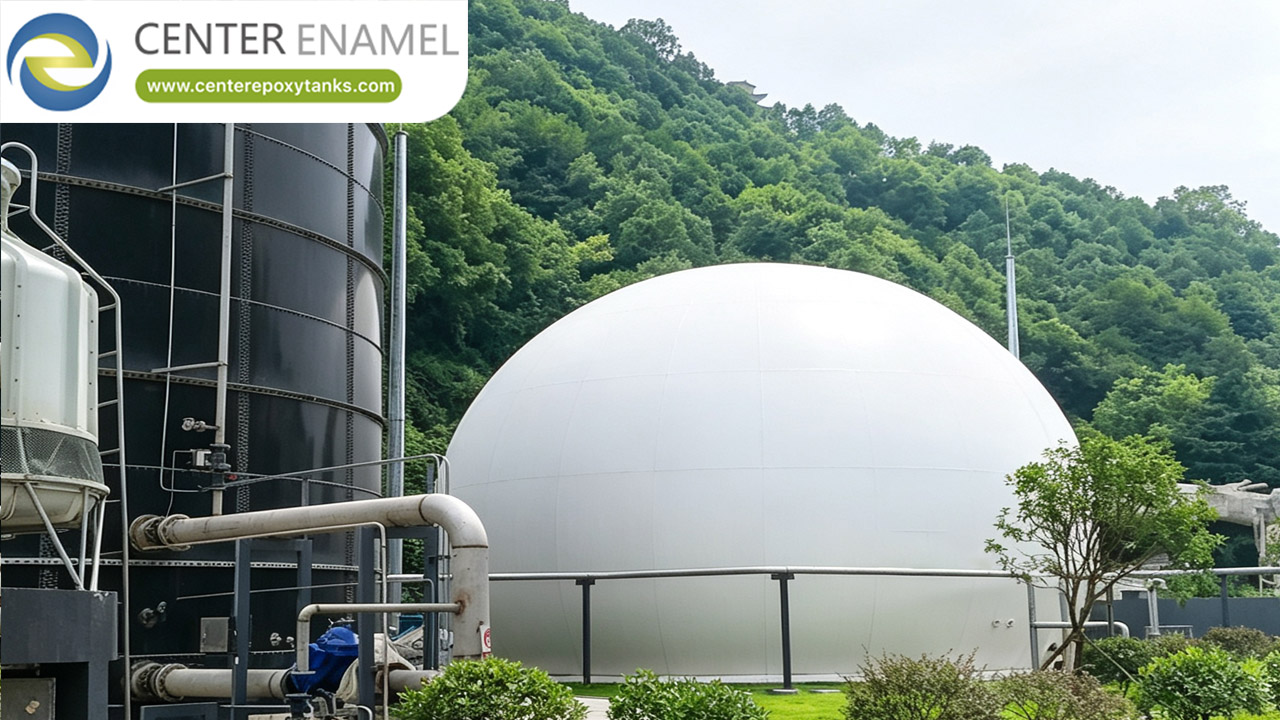
Biogas Holders for Biogas Plants: Engineering Efficient Renewable Energy Storage and Pressure Regulation
As global municipal and industrial sectors accelerate their transition toward circular bioeconomies and green energy mandates, anaerobic digestion (AD) has become a primary technology for converting organic waste into clean power and biomethane. However, generating biogas—a valuable mixture primarily composed of methane (CH4) and carbon dioxide (CO2), along with moisture and trace hydrogen sulfide (H2S)—is only half the operational equation.
Because biological digestion is a continuous biological process while energy consumption fluctuates based on peak demand, balancing supply and consumption requires dependable intermediate containment. Biogas holders for biogas plants serve as the critical buffering core of any successful anaerobic digestion facility, absorbing production variations, protecting downstream equipment, and maximizing overall energy efficiency.
The Critical Role of Biogas Storage in AD Infrastructure
In a standard anaerobic digestion facility, gas generation rates fluctuate depending on feedstock composition, feeding schedules, and digester temperature stability. Without adequate storage infrastructure, plants face severe operational bottlenecks:
Demand-Oriented Energy Supply: Storing biogas allows combined heat and power (CHP) engines, boilers, or grid-injection upgrading units to run independently of immediate biological generation spikes, satisfying peak electrical grid demands.
Pressure Stabilization: Biogas holders act as accumulators that smooth out line pressures, protecting sensitive gas compressors, flow meters, and combined heat and power units from damaging pressure surges or starvation.
Emergency Buffer Capacity: During scheduled maintenance or unexpected equipment downtime, a reliable gasholder provides temporary containment, preventing the environmentally hazardous and wasteful flaring of excess gas.
Technical Performance Matrix: Biogas Storage Technologies
Technical Parameter | Double-Membrane Biogas Holders | Traditional Rigid Steel Gasholders | Fixed-Dome Integrated Basins |
Capital Expenditure & Footprint | Highly economical; lightweight design requires minimal civil foundation work | High cost; heavy steel plate construction demands massive concrete foundations | Cost-effective for small agricultural setups, but limited in expansion flexibility |
Operating Pressure Profile | Constant, stable pressure maintained dynamically by an air-support blower | Variable pressure; internal gas pressure drops as the storage volume depletes | Low, variable pressure reliant on liquid displacement inside the masonry structure |
Corrosion Resistance & Chemical Defense | Zero structural corrosion risk due to chemically inert PVC/PVDF polymer membranes | High susceptibility to internal oxidation from H2S and moisture without constant recoating | Vulnerable to concrete carbonation and sulfate attack from wet organic slurries |
Mounting Versatility | Can be tank-mounted directly on anaerobic digesters or ground-mounted as standalone units | Requires dedicated standalone foundation plots and heavy-duty crane staging | Intrinsic and permanent part of the concrete digester structure |
Advanced Engineering Features of Modern Double-Membrane Holders
Modern industrial biogas holders utilize sophisticated multi-layer membrane architecture to ensure absolute safety and gas-tightness:
Inner Gas Membrane: Directly houses the raw biogas, expanding and contracting smoothly within the protective outer shell.
Outer Weather Shell: Constantly pressurized by an explosion-proof air blower, this external layer protects the inner bladder against wind shear, heavy snow loads, and ultraviolet (UV) radiation.
Bottom Membrane (Ground-Mounted): For standalone installations, a robust base membrane seals the gas volume against the concrete foundation.
High-Frequency Seam Welding: Fabric panels are joined using high-frequency welding technology, producing molecular bonds that guarantee 100% gas permeability resistance and long-term joint integrity.
Frequently Asked Questions (FAQ)
Q: Why are biogas holders essential for a commercial biogas plant?
A: Biogas holders act as energy buffers that decouple gas production from consumption. They absorb production fluctuations, stabilize operating pressures, and allow facilities to run power generators during high-tariff peak demand hours.
Q: What is the difference between tank-mounted and ground-mounted biogas holders?
A: Tank-mounted gasholders sit directly on top of the anaerobic digester, serving as a dual-purpose tank cover and storage vessel to save space and capital costs. Ground-mounted holders are standalone spherical or ¾-sphere structures installed on concrete foundations, offering massive independent storage capacities for large industrial or municipal plants.
Q: How do double-membrane biogas holders resist corrosion from hydrogen sulfide (H2S)?
A: Unlike traditional steel tanks that rust when exposed to moisture and H2S, modern double-membrane holders are constructed from high-tenacity polyester fabrics coated with chemically inert polymers (such as PVC or PVDF) that are completely immune to sulfur and organic acid degradation.
Q: What safety mechanisms are integrated into modern biogas storage systems?
A: Industrial biogas holders include critical safety equipment such as pressure/vacuum relief valves, automatic air-blower backup controls, flame arresters, gas leak detectors, and liquid-level sensors to prevent overpressurization and ensure safe plant operation.


