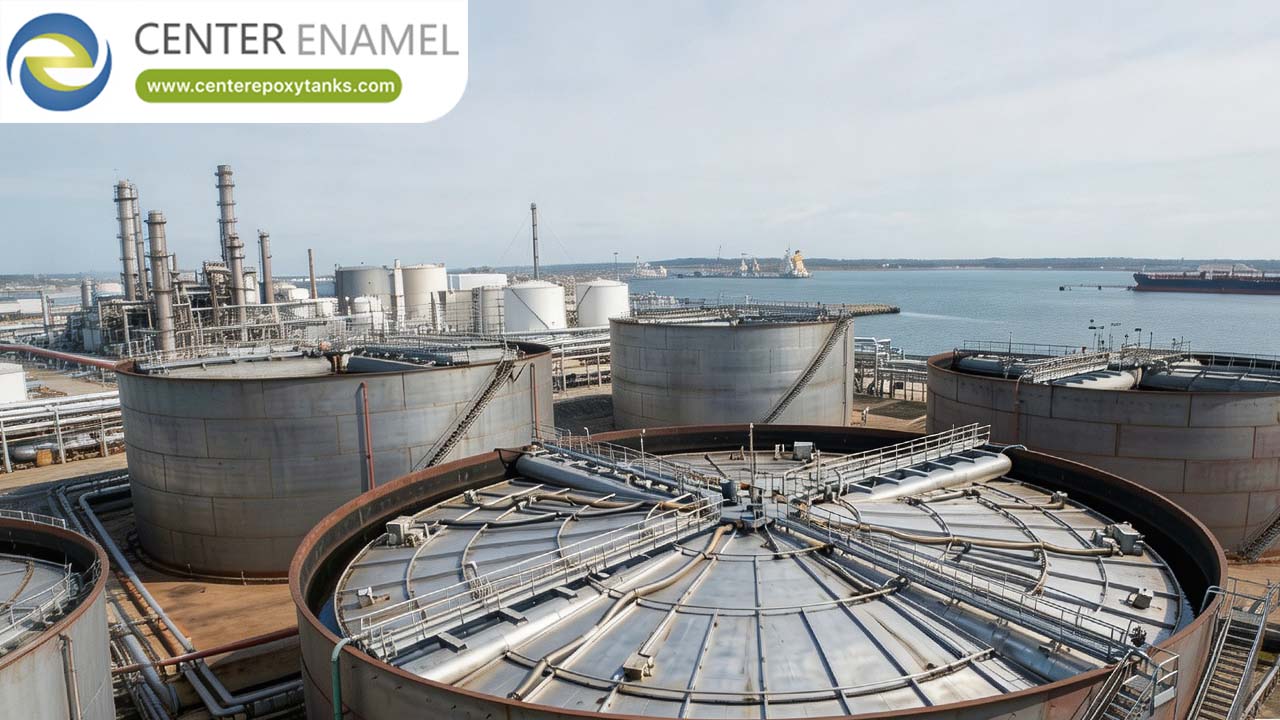
Benefits Of Full Contact Internal Floating Roofs: Safety, Emission Control And Efficiency
An internal floating roof is the emission control answer for volatile products: the roof rides directly on the liquid surface, so there is no vapor space for the wind to work across and no large annular gap to leak through. The full-contact variant closes the gap that pontoon roofs leave, and the difference shows up in the emission inventory.
This article covers the engineering: how the roof works, the full-contact-versus-pontoon comparison, the evaporation and emission outcomes, and the safety and maintenance regime.
What An Internal Floating Roof Does
An internal floating roof sits inside a fixed-roof tank and floats on the product surface. As the level moves, the roof moves with it — so the vapor space above the liquid is reduced to the small gap at the tank wall rather than the whole roof volume. Standing losses fall accordingly.
The roof also removes the wind action across the surface entirely, because the fixed roof above blocks the wind and the floating roof blocks the surface. The two together are the control.
Full Contact Vs Pontoon
A pontoon roof floats on compartments and leaves an annular gap between the roof edge and the tank wall — the largest remaining loss path on an internal floating roof. A full-contact roof closes that gap with a continuous seal riding the shell, and the difference shows in the inventory.
The trade is mechanical: full-contact seals have more contact with the shell and need their inspection and renewal regime; pontoons are more forgiving mechanically and leak more.
Aspect | Full Contact | Pontoon |
Annular gap | Closed by continuous seal | Open gap at the wall |
Evaporation loss | Lowest available | Higher; gap is the path |
Seal maintenance | Contact seal inspection and renewal | Compartment integrity checks |
Mechanical tolerance | Shell condition sensitive | More forgiving |
Evaporation Loss Reduction
The evaporation reduction is the roof’s economic case: standing losses fall when the vapor space and the wind action are removed, and the product retained is product that does not have to be replaced. The full-contact design takes the reduction to the lowest available level.
The verification is the level record and the emission estimate — the same tank, the same period, before and after.
Safety Considerations
The safety case has two sides. The floating roof removes the large vapor space that makes a fixed-roof tank a stronger explosion hazard, and it eliminates the surface ignition exposure. Against that, the roof is equipment inside a confined space with its own inspection and entry regime.
The design also manages the roof’s own failure modes: the support legs that carry it when the tank is empty, the anti-rotation arrangement, and the seal system that has to survive the shell condition.
Emission Control
The emission control outcome is the inventory: the covered-plus-floating configuration reports the lowest standing losses of the standard fixed-roof options, and the seal condition is the variable that decides whether the reported number is real.
The verification regime is the seal inspection and the periodic re-test — because the emission claim is only as good as the seal that closes the gap.
Maintenance
The maintenance regime is the seal regime: primary and secondary seal inspection, seal renewal on condition, leg and anti-rotation checks, and the drain system that keeps the roof surface clear. The regime is planned rather than reactive.
The regime runs at planned shutdowns, with the roof at its support legs and the tank prepared for entry — the access design is what makes the regime executable.
Inspection
Inspection covers the seal system, the roof structure and its fittings, the support legs and the drainage. The inspection points are designed in — access hatches positioned for safe entry, with the roof surface visible from the access points.
The inspection record is also the emission evidence: the seal condition record is what supports the reported inventory.
Compatibility With Tank Types
Internal floating roofs suit fixed-roof tanks of the right diameter and internal condition, in both welded and coated configurations. The shell condition matters: the seal rides the shell, and a shell out of tolerance wears seals faster.
The roof selection also interacts with the product: volatile products justify the investment, and the heavier products often do not.
Tank Type | Floating Roof Compatibility | Key Consideration |
Welded steel fixed-roof tank | Well suited as a retrofit | Roof support and access integration |
Welded steel open-top tank | Standard application | Wind exposure and rim seal design |
Bolted steel tank | Suited with shell tolerance control | Roundness and seal track accuracy |
Existing concrete tank | Case-by-case assessment | Shell geometry and coating condition |
Installation On Existing Tanks
Retrofitting an internal floating roof is a standard emission control project: the shell is assessed for the internal condition, the roof is fabricated to the tank’s internal geometry, and the installation happens at a planned shutdown with the tank prepared for entry.
The retrofit scope includes the seal specification against the measured shell condition — because the seal is only as good as the surface it rides.
Compliance And Documentation
The compliance documentation covers the roof design, the seal specification and the installation records — and the inspection regime that keeps the emission claim current. The records support the inventory the installation reports.
The documentation discipline is generation as the work happens: the installation record and the initial seal inspection establish the baseline the later inspections are measured against.
Center Enamel Floating Roof Engineering
Center Enamel engineers floating roof and vapor control systems for volatile product storage: the full-contact and pontoon selection against the emission objective, the seal specification against the shell condition, and the inspection regime that keeps the claim defensible.
For vapor control, the standard we hold is the one the inventory demands — a roof whose seal condition is known and whose records support the number that gets reported.
About Company
Shijiazhuang Zhengzhong Technology Co.,Ltd(Center Enamel) is a professional manufacturer dedicated to the design and fabrication of bolted storage tanks since 2008. Our products range includes Glass-Fused-to-Steel (GFS) tanks, fusion bonded epoxy tanks, stainless steel tanks, galvanized steel tanks and aluminum geodesic dome roofs. With professional enameling R&D team and nearly 200 enameling patents, Shijiazhuang Zhengzhong Technology Co.,Ltd has become the leader in bolted tanks industry of Asia. Our products are certified to ISO9001, NSF61, EN1090, ISO28765, WRAS ,FM, LFGB, BSCI, IS0 45001 and other international standards.
Shijiazhuang Zhengzhong Technology Co., Ltd is not only the first manufacturer in China which produces Glass-Fused-to-Steel tanks, but also the most experienced professional bolted tanks manufacturer in Asia.The engineering & design, product testing and quality system of Center Enamel Glass-Fused-to-Steel tanks is in strict accordance with AWWA D103-09, OSHA, ISO 28765, NSF/ANSI 61, NFPA and other international standards. Until 2023, Center Enamel bolted tanks have been exported to more than 100 countries including USA, Australia,Canada, Malaysia, Indonesia, Russia, UAE, Panama,Brazil and South Africa etc., the superior tank quality and prompt service gains us worldwide recognition.
As an outstanding containment and cover system provider with decades of industry experience, Shijiazhuang Zhengzhong Technology Co., Ltd sincerely expects to establish long-term cooperation with the local partners throughout the world and make continuous contribution to the development of the industry.
Suggested CTA
Center Enamel delivers internal floating roof engineered for oil storage vapor control duty, with floating roof and vapor control engineering. Contact our engineering team for engineering guidance on your next internal floating roof benefits project — including sizing, standards compliance and delivery scheduling.
Frequently Asked Questions
Q: What does an internal floating roof do?
A: It rides on the stored product inside a fixed-roof tank, so the vapor space is reduced to the small gap at the wall rather than the whole roof volume — and the fixed roof above blocks the wind action across the surface.
Q: What is the difference between full-contact and pontoon roofs?
A: A pontoon roof floats on compartments and leaves an annular gap at the wall — the largest remaining loss path. A full-contact roof closes that gap with a continuous seal riding the shell, at the cost of more seal maintenance.
Q: How much of the standing loss does the configuration remove?
A: The fixed roof plus floating roof combination removes the wind action and the large vapor space, and the full-contact design takes the standing loss to the lowest available level among standard fixed-roof options.
Q: What safety effects does the roof have?
A: It removes the large vapor space that strengthens the explosion hazard and eliminates the surface ignition exposure — while introducing its own confined-space entry regime and failure modes that the design has to manage.
Q: Can an internal floating roof be retrofitted?
A: Yes — the shell is assessed for internal condition, the roof is fabricated to the tank’s internal geometry, and installation happens at a planned shutdown, with the seal specified against the measured shell condition.
Q: What maintains the emission claim over time?
A: The seal inspection and renewal regime, plus the periodic re-test — because the reported inventory is only as good as the seal that closes the gap.


