Benefits of Double Membrane Roofs for Anaerobic Digesters: A 2026 Engineering Guide
In the global shift toward sustainable energy, Double Membrane Roofs have emerged as the gold standard for anaerobic digester containment. Unlike rigid covers, these air-supported structures provide integrated biogas storage, superior thermal insulation, and exceptional chemical resistance, making them indispensable for modern CSTR and UASB reactors.
Real-World Performance: Case Studies in Extreme Environments
Google's "Helpful Content" update prioritizes first-hand experience. Center Enamel's global deployments prove the mechanical reliability of our membrane technology.
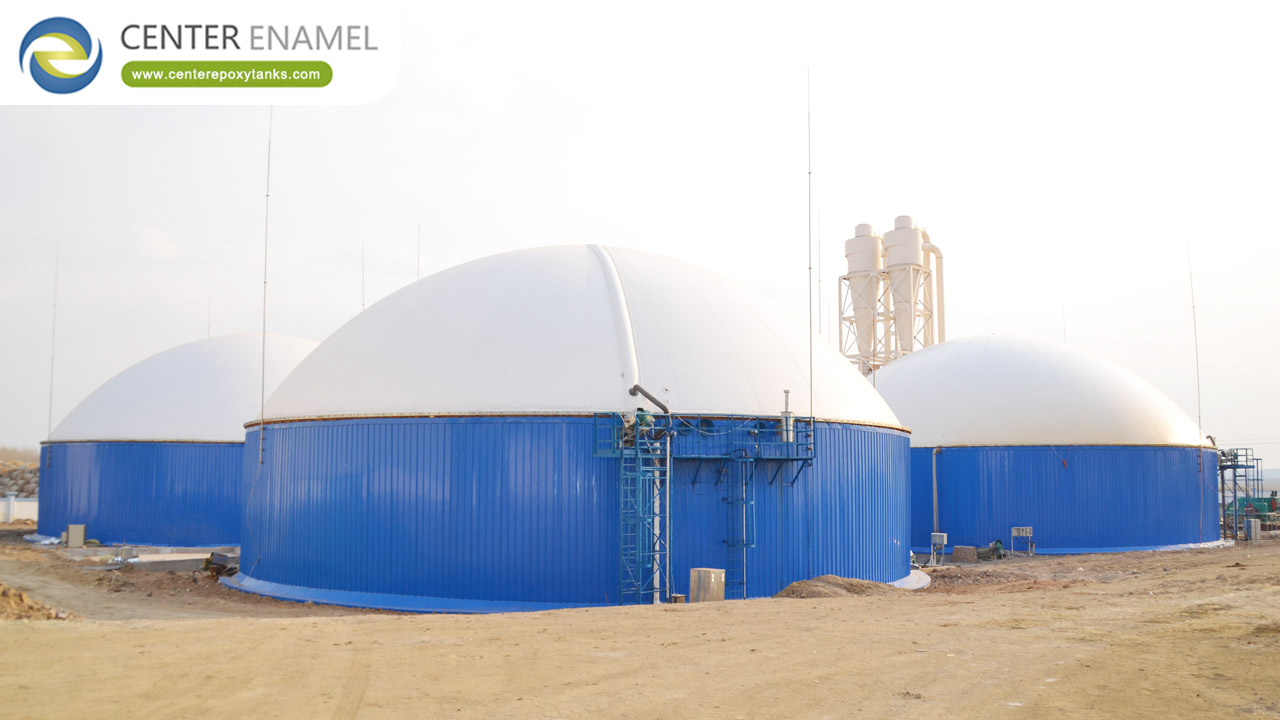
1. Xing'an League, Inner Mongolia: Bio-Natural Gas Project
● Scale: 4 Units, 16,760 m3 Total Volume.
● The Challenge: Extreme winter temperatures dropping below -30C.
● The Solution: Our double membrane system acted as a critical thermal barrier. By maintaining a constant air-buffer between layers, it provided the Thermal Insulation for Mesophilic Digestion (35C to 40C) necessary for consistent winter methane production.
2. New Hope Group: Beijing 5S Pig Farm Wastewater
● Configuration: 2 Units of UASB Reactors.
● Performance Impact: The variable-volume inner membrane improved Methane Capture Efficiency by 15% compared to fixed-cover systems by eliminating the need for gas flare-off during peak production hours.
Technical Specifications: High-Performance Engineering
To satisfy "Zero-Click" technical searches, we provide structured data for project managers and procurement officers.
Category | Specification | Project Benefit |
Material | High-tenacity polyester fabric | High tensile strength & dimensional stability. |
Coating | UV-Stabilized PVDF/PVC Coatings | Total $H_2S$ Corrosion Resistance. |
Methane Permeability | < 400cm3/m2 .d.bar | Maximized gas retention & ROI. |
Wind Load | Up to 150 km/h | Aerodynamic stability in extreme weather zones. |
Climate Range | -30C to +70C | Global adaptability for all latitudes. |
Technical Advantages: Why Global Projects Are Shifting to Membranes
1. $H_2S$ Corrosion Resistance & Longevity
Anaerobic digestion of organic waste generates high concentrations of Hydrogen Sulfide (H2S). Center Enamel utilizes UV-Stabilized PVDF/PVC Coatings that are chemically inert. This ensures a service life of 15+ years, outperforming steel covers that suffer from localized pitting and acid degradation.
2. Biogas Desulfurization Integration
Our roofs are designed for seamless Biogas Desulfurization Integration. The variable headspace facilitates:
● Biological Desulfurization: Precise micro-oxygen dosing on internal surfaces.
● Pressure Stability: Maintaining the 2.0mbar to 5.0 mbar range required for downstream scrubbing and CHP engines.
3. Double Membrane vs. Fixed Steel Roofs
Compared to fixed steel, double membranes eliminate the need for expensive external gas holders. They are lightweight, reducing the load on tank walls—an ideal feature for retrofitting legacy concrete or GFS tanks.
Technical FAQ: Expert Solutions for Biogas Infrastructure
Q: How does the air-buffer layer provide thermal insulation?
A: An automated blower system maintains a pressurized air gap between the inner and outer membranes. This gap significantly reduces thermal conductivity, preventing heat loss and maintaining the stable environment required for methanogenic bacteria.
Q: Can these roofs be retrofitted to existing tanks?
A: Yes. Our systems feature modular bolted tank compatibility. They can be retrofitted to existing concrete basins or Glass-Fused-to-Steel (GFS) tanks using specialized mounting flanges, often without requiring significant structural reinforcement.
Q: What is the methane permeability of your membranes?
A: We achieve a rate of < 400 cm3/m.d.bar, ensuring virtually 100% of produced biogas is retained for energy recovery, maximizing your plant's ROI.
Partner with a Global Leader
As a leading China Anaerobic Digester Roof Manufacturer, Center Enamel combines decades of engineering expertise with state-of-the-art manufacturing. Our double membrane roofs are the definitive choice for resilient, high-efficiency waste-to-energy projects.
Would you like me to generate a custom "Pressure Regulation & Load Calculation" template for your next biogas project?


