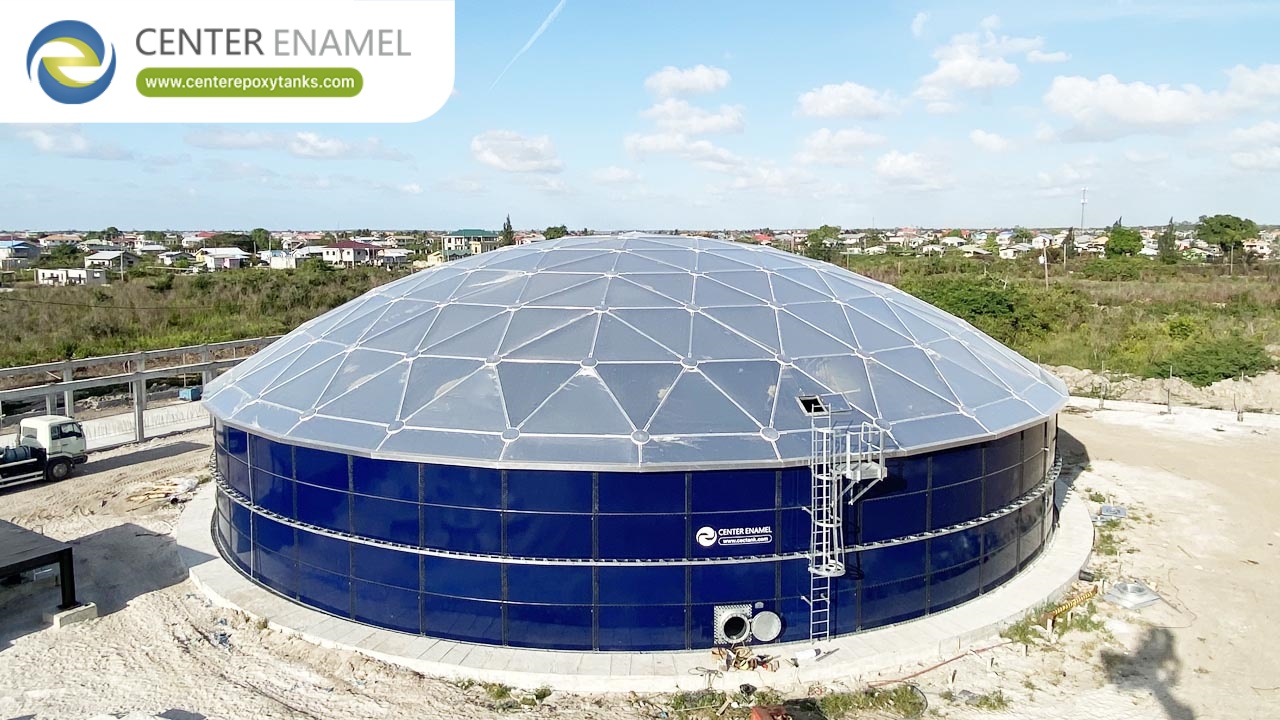
Benefits Of Aluminum Geodesic Dome Roofs For Refined Oil Tanks: Safety, Efficiency And Compliance
Refined product tanks are cleaner duty than crude — no sludge, lighter headspace chemistry — but they breathe more, and the breathing is what the emission inventory measures. Covering them is a safety, efficiency and compliance decision: the dome eliminates wind action and solar gain, contains the headspace vapor, and integrates with the venting set that manages the breathing.
This article covers the refined product covering duty: the safety drivers, the efficiency gains, the compliance outcomes, and the emission control engineering that makes the claim defensible.
Refined Product Covering
Refined products — gasoline, diesel, kerosene, jet fuel — are lighter duty than crude on corrosion but heavier on vapor: the products are more volatile, the turnover is faster, and the emission inventory is more sensitive to the cover and venting performance.
The covering decision therefore integrates three objectives: safety at the surface, efficiency in the losses, and compliance in the inventory. The dome delivers all three through one envelope.
Safety Drivers
The safety case is direct: the cover removes the wind-driven vapor release across the surface, blocks the solar gain that drives the breathing cycle, and eliminates the open-surface ignition exposure. The work environment around the tank improves with it.
The cover also removes the weather exposure that makes roof inspection unpleasant and therefore deferred — which is a safety case in itself.
Safety Element | Mechanism | Design Detail |
Surface ignition exposure | Enclosed headspace | Sealed envelope, engineered penetrations |
Vapor release | Wind action eliminated | Dome geometry |
Breathing control | Venting set manages the cycle | Vents sized for transfer rates |
Access discipline | Defined, secured openings | Lockable hatches, screened vents |
Efficiency Gains
The efficiency case is the product retained: standing losses fall when the wind action and the solar gain are removed, and the working losses are managed by the transfer and venting design. The product that stays in the tank is product that does not have to be replaced.
The gains compound with the thermal stability: the covered tank’s narrower temperature band reduces the breathing cycle that drives the losses in the first place.
Environmental Compliance
The compliance case is the emission inventory: covered tanks report lower standing losses, and the cover’s sealing condition is part of the compliance evidence. Where the installation reports to a regulated inventory, the sealing test record and the re-test regime belong in the dossier.
The compliance scope also covers the venting integration: the vent setpoints certified against the design limits, and the vapor recovery connection where the installation runs one.
Emission Control Outcomes
The outcomes are measurable: the emission estimate before and after, the sealing test record at commissioning, and the periodic re-test that detects degradation before it becomes an inventory discrepancy. The outcomes are what the compliance file runs on.
The penetration discipline is what makes the outcomes durable: every penetration engineered as a sealed unit, tested at commissioning and inspected on schedule.
Breathing And Venting Integration
The venting set is where the cover meets the tank’s pressure management: pressure and vacuum vents sized for the transfer rates, set against the cover and shell design limits, and detailed as engineered penetrations. The two design sets are reconciled rather than assumed compatible.
The integration also covers the flame arrestor where the product is flammable, and the vapor recovery connection where the installation runs one — each a designed penetration with a sealing detail.
Vent Function | Sizing Basis | Protection Function |
Pressure vent | Maximum pumping-in rate and thermal expansion | Prevents overpressure during filling |
Vacuum vent | Maximum pump-out rate and thermal contraction | Prevents vacuum collapse during drawdown |
Flame arrestor | Vent group classification of the product | Stops flame propagation on flammable service |
Vapor recovery connection | Controlled venting volume | Routes vapor to recovery rather than atmosphere |
Refined Vs Crude
The refined-versus-crude difference is the duty profile: refined products are cleaner chemistry, faster turnover and more breathing; crude brings sour vapor, sludge and slow turnover. The cover structure does not change; the material set and headspace detailing follow the product.
The refined duty also puts more weight on the venting and emission scope, because the faster turnover makes the working losses the larger term.
Inspection And Maintenance
The regime is external inspection of structure and connections, seal and penetration checks, drainage clearing, and internal inspection at shutdown. Bolted construction keeps every item accessible without dismantling structure.
The seal renewal cycle is planned rather than discovered: elastomer selection matched to the service, parts on the shelf, and renewal as a scheduled activity.
Retrofit On Refined Tanks
Most refined product tanks that would benefit from covering already exist, and the retrofit path assesses the shell for the new loads, designs the interface against the as-built condition, and erects without hot work. The venting integration is part of the retrofit scope.
The retrofit case closes on the emission and product retention gains, with the before-and-after emission estimate as the demonstration.
Supplier Qualification
The qualification criteria for a refined product cover are the standard ones: engineering against the load set, material certification, fabrication records, erection experience and a sample dossier. The emission scope adds the sealing test capability and the venting integration experience.
The buyer’s check is the evidence chain from a past project — read end to end — rather than the certification on the wall.
Center Enamel Refined Product Cover Engineering
Center Enamel engineers aluminum geodesic domes for refined product storage: the envelope that eliminates wind action and damps surface temperature, the venting integration reconciled with the tank’s pressure management, the sealed penetration discipline, and the verification records the compliance file runs on.
For refined product covering, the standard we hold is the one the inventory demands — a cover whose tightness is verified and whose records survive the audit.
About Company
Shijiazhuang Zhengzhong Technology Co.,Ltd(Center Enamel) is a professional manufacturer dedicated to the design and fabrication of bolted storage tanks since 2008. Our products range includes Glass-Fused-to-Steel (GFS) tanks, fusion bonded epoxy tanks, stainless steel tanks, galvanized steel tanks and aluminum geodesic dome roofs. With professional enameling R&D team and nearly 200 enameling patents, Shijiazhuang Zhengzhong Technology Co.,Ltd has become the leader in bolted tanks industry of Asia. Our products are certified to ISO9001, NSF61, EN1090, ISO28765, WRAS ,FM, LFGB, BSCI, IS0 45001 and other international standards.
Shijiazhuang Zhengzhong Technology Co., Ltd is not only the first manufacturer in China which produces Glass-Fused-to-Steel tanks, but also the most experienced professional bolted tanks manufacturer in Asia.The engineering & design, product testing and quality system of Center Enamel Glass-Fused-to-Steel tanks is in strict accordance with AWWA D103-09, OSHA, ISO 28765, NSF/ANSI 61, NFPA and other international standards. Until 2023, Center Enamel bolted tanks have been exported to more than 100 countries including USA, Australia,Canada, Malaysia, Indonesia, Russia, UAE, Panama,Brazil and South Africa etc., the superior tank quality and prompt service gains us worldwide recognition.
As an outstanding containment and cover system provider with decades of industry experience, Shijiazhuang Zhengzhong Technology Co., Ltd sincerely expects to establish long-term cooperation with the local partners throughout the world and make continuous contribution to the development of the industry.
Suggested CTA
Center Enamel delivers aluminum dome engineered for refined oil storage covering duty, with refined product cover engineering. Contact our engineering team for engineering guidance on your next aluminum dome roofs refined oil tanks project — including sizing, standards compliance and delivery scheduling.
Frequently Asked Questions
Q: Why cover a refined product tank?
A: Safety, efficiency and compliance: the cover removes wind action and solar gain across the surface, contains the headspace vapor, and delivers the emission reduction the inventory measures.
Q: How does the cover reduce standing losses?
A: By eliminating the wind action across the liquid surface and damping the solar gain that drives the breathing cycle — the two mechanisms that drive standing loss on an open tank.
Q: What is the breathing valve interface?
A: The point where the cover meets the tank’s pressure management: pressure and vacuum vents sized for the transfer rates, set against the design limits and detailed as engineered penetrations, with the two design sets reconciled.
Q: How does refined duty differ from crude duty?
A: Refined products are cleaner chemistry, faster turnover and more breathing — so the venting and emission scope carries more weight. Crude brings sour vapor, sludge and slow turnover, shifting the emphasis to headspace corrosion management.
Q: Can a dome be retrofitted to an existing refined tank?
A: Yes — shell assessment for the new loads, interface design against the as-built condition, erection without hot work, and the venting integration included in the scope. The case closes on emission and product retention gains.
Q: What extra qualification applies to emission-control covers?
A: The sealing test capability and the venting integration experience: every penetration engineered as a sealed unit, tested at commissioning, with the re-test regime that detects degradation before it becomes an inventory discrepancy.


