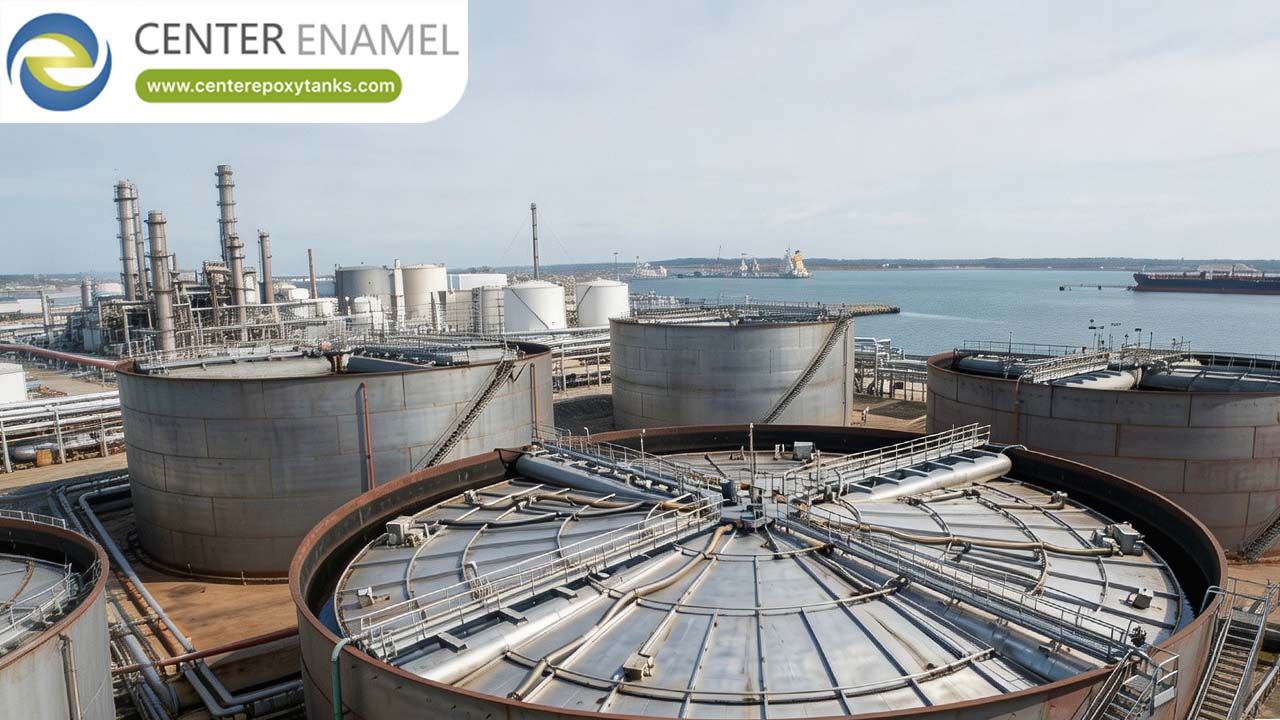
Benefits of Using Full Contact Internal Floating Roofs: Maximizing Safety, Emission Control, and Operational Efficiency in Petroleum Storage
In the global oil, gas, and petrochemical sectors, the aboveground storage of volatile organic liquids (VOL)—such as crude oil, gasoline, aviation fuel, and chemical solvents—presents significant environmental and safety challenges. As these liquids absorb solar heat and undergo daily temperature fluctuations, they generate vapors that seek to escape into the atmosphere.
Traditional fixed-roof tanks without internal floating covers suffer from massive evaporation losses and hazardous vapor accumulation. To combat this, full contact internal floating roofs (IFRs) have become the industry gold standard. Unlike conventional pontoon designs that leave an air gap above the liquid, full contact roofs rest directly on the product surface, delivering unmatched emission control and structural reliability.
The Engineering Mechanics of Full Contact Floating Roofs
A full contact internal floating roof is engineered using a matrix of lightweight, closed-cell honeycomb panels or sealed box sections that float in direct, physical contact with the stored liquid.
Complete Elimination of Vapor Space: By removing the air pocket between the liquid surface and the underside of the roof, the liquid cannot vaporize into a headspace. This eradicates the primary driving force behind evaporation losses.
Continuous Buoyancy Distribution: The uniform honeycomb structure distributes buoyancy evenly across the entire surface area, ensuring smooth vertical travel along the tank shell without tilting or binding.
Advanced Sealing Systems: Equipped with high-performance primary and secondary peripheral seals, full contact roofs maintain a tight barrier against the tank shell throughout liquid level drawdown and refilling cycles.
Technical Performance Matrix: Storage Tank Roof Technologies
Technical Parameter | Full Contact Internal Floating Roofs | Conventional Pontoon Internal Floating Roofs | Fixed Roofs Without Internal Covers |
VOC Emission Reduction Efficiency | Maximum efficiency; near-zero vapor loss due to direct liquid contact | Moderate to high; vapor space exists beneath pontoons allowing continuous evaporation | Zero emission control; massive atmospheric evaporation and odor release |
Risk of Sinking & Catastrophic Failure | Exceptionally low; closed-cell honeycomb core prevents liquid accumulation and sinking | Moderate; punctured pontoons can flood and cause roof tilting or sinking | Not applicable (fixed structure, but prone to explosive vapor pocket accumulation) |
Vapor Space Fire & Explosion Hazard | Minimized; complete absence of flammable vapor-air mixtures under the roof | Present; flammable gas pockets accumulate in the open spaces between pontoons | High; large explosive vapor volumes collect in the tank headspace |
Compliance & Engineering Standards | Engineered strictly to API 650 Appendix H and strict global environmental mandates | Governed by API 650 Appendix H standards with variable pontoon designs | Standard fixed structural codes with high environmental penalties |
Core Operational Advantages for Terminal Operators
1. Drastic Reduction of Volatile Organic Compound (VOC) Emissions
Fugitive emissions represent both a severe environmental hazard and a direct financial loss of valuable product. By eliminating the vapor space, full contact internal floating roofs reduce hydrocarbon losses by up to 99% compared to fixed-roof tanks, helping facilities easily comply with strict environmental agency regulations.
2. Elimination of Rim Fires and Explosion Risks
In conventional pontoon roofs, an oxygen-hydrocarbon vapor mixture trapped in the headspace creates a continuous explosion risk if exposed to a static discharge or lightning strike. Full contact roofs remove this hazardous vapor pocket entirely, drastically improving terminal safety.
3. Prevention of Roof Sinking
Open-pontoon roofs are vulnerable to sinking if a pontoon develops a leak, fills with liquid, or if heavy rain accumulates unevenly on top. Full contact designs utilize closed-cell foam or honeycomb cores that cannot flood, ensuring continuous, stable buoyancy under all operating conditions.
Frequently Asked Questions (FAQ)
Q: What is a full contact internal floating roof and how does it differ from a pontoon roof?
A: A full contact internal floating roof consists of panels that rest directly on the surface of the stored liquid, eliminating any trapped vapor space. Traditional pontoon roofs feature open spaces beneath the deck, leaving a gas pocket between the liquid and the roof underside.
Q: How do full contact IFRs reduce VOC emissions?
A: Because the roof makes direct contact with the liquid product, there is no headspace for the liquid to evaporate into. This stops the vaporization process at the source, preventing volatile organic compounds (VOCs) from escaping into the atmosphere.
Q: Can a full contact internal floating roof sink if damaged?
A: No. Full contact roofs utilize a closed-cell honeycomb core or foam-filled structure. Even if the outer skin is penetrated, the internal cellular structure prevents liquid from flooding the roof, ensuring it remains buoyant and operational.
Q: What international standards govern the manufacturing and design of these floating roofs?
A: Full contact internal floating roofs are engineered and fabricated in strict accordance with API 650 Appendix H (Welded Tanks for Oil Storage - Internal Floating Roofs), alongside relevant environmental and fire safety codes such as NFPA 30.


