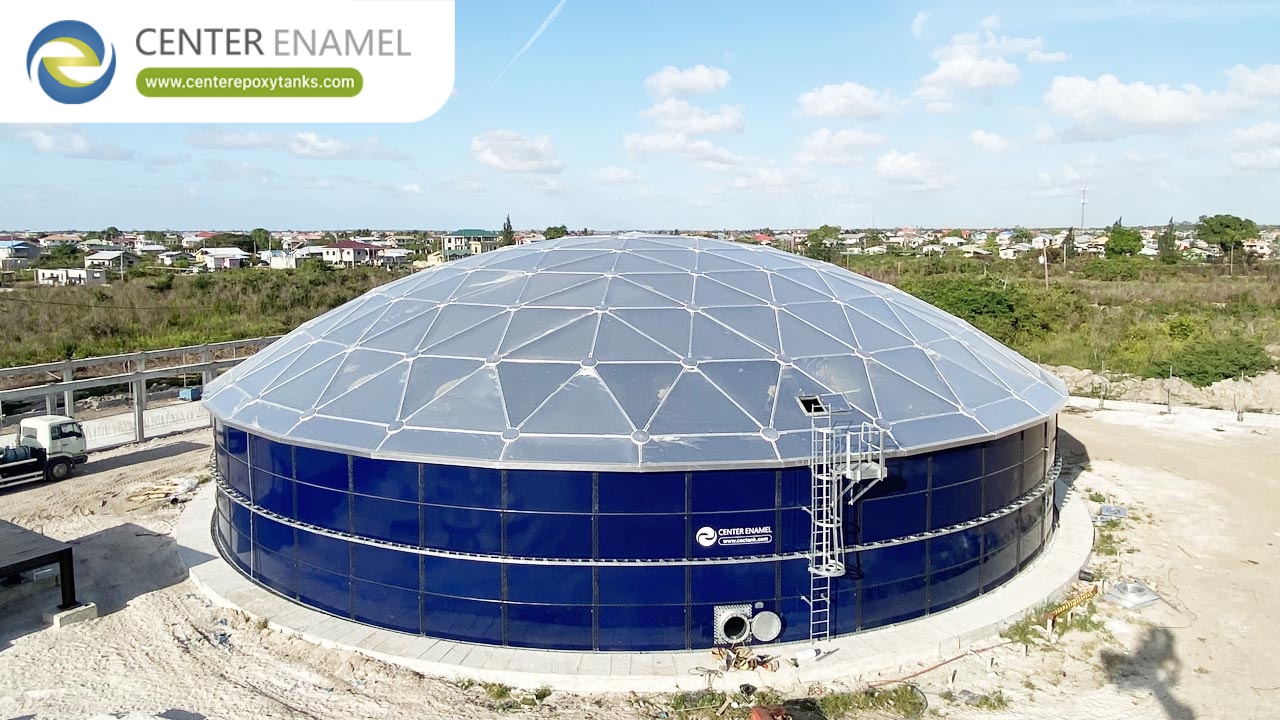
Benefits of Aluminum Geodesic Dome Roofs: Engineering Excellence in Industrial Tank Protection
In modern industrial, municipal, and commercial storage sectors, protecting valuable liquid and dry bulk assets from environmental degradation is a critical engineering priority. Whether covering municipal potable water reservoirs, wastewater treatment clarifiers, bulk oil terminals, or agricultural dry bulk silos, the roof system dictates the long-term integrity, safety, and operational efficiency of the entire facility.
Traditional roofing solutions—such as painted carbon steel plates prone to rapid oxidation or flat concrete decks susceptible to micro-cracking and joint seepage—frequently impose heavy maintenance burdens. To eliminate these operational vulnerabilities, aluminum geodesic dome roofs have become the definitive global standard, offering a unique combination of structural engineering, material science, and economic longevity.
Core Advantages of Aluminum Geodesic Dome Roofs
The widespread adoption of aluminum geodesic domes across diverse industries stems from several foundational engineering benefits:
True Clear-Span Architecture: By utilizing a three-dimensional space-truss geodesic geometry, these domes distribute loads uniformly across the perimeter tension ring. They require zero internal support columns, rafters, or central trusses, maximizing internal storage volume and simplifying the operation of internal mixers, agitators, or conveyors.
Inherent Corrosion Immunity: Fabricated from high-strength, marine-grade aluminum alloys (typically 5000 and 6000 series), these domes develop a natural, protective aluminum oxide layer. They are completely immune to atmospheric oxidation and moisture, eliminating the need for periodic abrasive blasting and protective repainting.
Lightweight Structural Efficiency: The high strength-to-weight ratio of aluminum drastically reduces dead loads transferred to the underlying tank shell or concrete foundation. This lightweight design is especially valuable when retrofitting older storage infrastructure.
Hermetic Environmental Sealing: Equipped with advanced batten bar clamping systems and continuous elastomer gaskets, aluminum domes provide an airtight, watertight barrier that locks out rainwater, dust, insects, and ultraviolet (UV) radiation.
Technical Performance Matrix: Storage Tank Roof Technologies
Technical Parameter | Aluminum Geodesic Dome Roofs | Traditional Carbon Steel Conical Roofs | Cast-in-Place Concrete Flat Decks |
Corrosion Defense & Lifespan | Exceptional; marine-grade aluminum requires zero repainting; 40+ year lifecycle | Moderate to low; prone to rust flaking, pitting, and coating failure requiring frequent upkeep | Moderate; susceptible to micro-cracking, water seepage, and structural spalling over time |
Internal Support Structure | 100% clear-span; zero internal columns or support trusses required | Often requires internal rafter beams and center support columns for large diameters | Requires heavy internal support pillars and shoring formwork during construction |
Installation Speed & Method | Rapid modular assembly; can be craned or jacked into place without heavy scaffolding | Labor-intensive field welding, heavy crane mobilization, and painting overhead | Slow civil construction, extensive formwork, and multi-week curing |
Compliance & Design Standards | Engineered strictly to AWWA D108, API 650 Annex G, and ADM2015 | Governed by general steel design codes with variable field quality | Governed by local civil masonry and structural concrete standards |
Diverse Industrial Applications
The versatility of aluminum geodesic domes allows them to excel across multiple sectors:
Municipal Water & Wastewater: Protecting drinking water purity by blocking UV-induced algae growth, and containing corrosive hydrogen sulfide (H2S) gases in wastewater plants.
Oil and Petrochemical Terminals: Serving as lightweight, spark-resistant covers that minimize volatile organic compound (VOC) emissions and weather exposure.
Dry Bulk Storage: Sealing grains, cement, fertilizers, and mineral powders against caking and moisture ingress while providing obstruction-free overhead material handling.
Frequently Asked Questions (FAQ)
Q: What are the primary benefits of choosing an aluminum geodesic dome roof?
A: Key benefits include a 100% clear-span structure that eliminates internal columns, complete corrosion immunity without needing paint, a lightweight design that reduces foundation loads, and superior weather resistance that ensures a 40+ year lifecycle.
Q: Do aluminum geodesic domes require ongoing maintenance?
A: They require virtually no routine maintenance. Because marine-grade aluminum naturally forms a protective oxide layer that prevents rusting, facility managers save significant operational costs over decades of service.
Q: How do aluminum domes handle extreme weather like high winds and heavy snow?
A: Engineered in compliance with international standards such as AWWA D108, ASCE 7-10, and IBC 2012, the triangular geodesic geometry distributes loads uniformly, allowing the curved surface to easily shed snow and withstand high wind velocities.
Q: Can an aluminum geodesic dome be installed on an existing storage tank?
A: Yes. Because aluminum domes are lightweight and prefabricated in modular components, they are frequently used to retrofit aging concrete reservoirs or steel tanks without requiring structural modifications to the existing tank walls.


