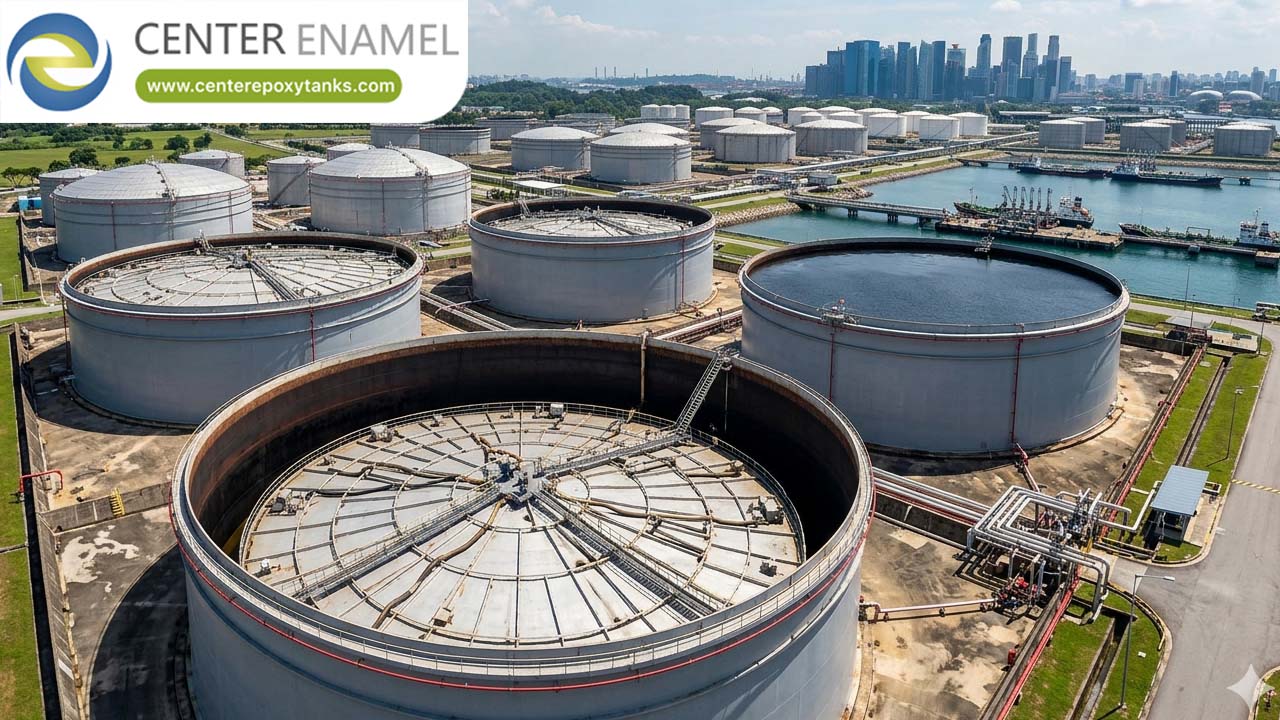
An In-Depth Look at Floating Roof Tanks and Their Benefits
In the 2026 industrial landscape, the storage of volatile liquids—such as crude oil, gasoline, and jet fuel—demands infrastructure that prioritizes environmental stewardship and operational safety. The floating roof tank has emerged as the definitive engineering solution for bulk liquid containment. By eliminating the "ullage" or vapor space common in fixed-roof tanks, this technology provides a critical barrier against product loss and hazardous emissions.
Shijiazhuang Zhengzhong Technology Co., Ltd (Center Enamel), with over 30 years of global expertise in more than 100 countries, leads the industry in providing API 650-compliant floating roof solutions tailored for the world's most demanding energy terminals.
1. What is a Floating Roof Tank?
A floating roof tank is a vertical, cylindrical storage vessel equipped with a roof that floats directly on the liquid surface. Unlike a stationary roof, it rises and falls dynamically as the tank is filled or emptied. This movement ensures that there is virtually no vapor space between the liquid and the roof, which is the primary driver of Volatile Organic Compound (VOC) emissions.
Types of Floating Roof Configurations
1. Internal Floating Roof (IFR): Operates inside a fixed-roof tank (cone or dome). The fixed roof protects the floating deck from wind, rain, and snow.
2.
3. External Floating Roof (EFR): Has no fixed cover; the floating deck is the primary weather barrier. These are typically used for massive capacities (50,000 $m^3$ and above).
4.
2. Core Engineering: How the Technology Works
The efficiency of a floating roof is dictated by the buoyancy system and the rim seal. In 2026, the focus has shifted toward high-performance materials that survive the chemical aggression of modern refined fuels.
● Buoyancy Mechanics: The roof is supported by air-tight compartments called pontoons. Per API 650 standards, the roof must remain buoyant even if two adjacent pontoons are punctured.
●
● Rim Seal Integrity: This is the flexible barrier between the roof deck and the tank shell. Center Enamel utilizes mechanical shoe seals and secondary resilient seals to ensure a gas-tight environment.
●
● Floating Roof Drainage: For EFRs, rainwater must be removed to prevent structural overloading. Modern designs utilize high-strength, multi-layered flexible hoses that are resistant to aromatic hydrocarbons.
●
3. The 5 Strategic Benefits of Floating Roof Tanks
A. 99% Vapor Loss Prevention
The most significant benefit is the reduction of evaporative losses. By keeping the roof in constant contact with the liquid, "breathing losses" (caused by temperature changes) and "filling losses" (caused by air displacement) are virtually eliminated. For a large gasoline terminal, this can save thousands of barrels of product annually.
B. Enhanced Fire & Explosion Safety
In a standard tank, the vapor space can host an explosive mixture of air and fuel. A floating roof removes this fuel source, dramatically lowering the risk of lightning-induced or static-induced fires.
C. 2026 Environmental (ESG) Compliance
As global mandates for air quality tighten, floating roofs are recognized as the Best Available Control Technology (BACT). They allow facilities to meet strict VOC emission targets and maintain their social license to operate.
D. Product Purity & Protection
Especially in an Internal Floating Roof (IFR) configuration, the liquid is protected from atmospheric moisture, dust, and UV degradation. This is critical for high-purity products like Sustainable Aviation Fuel (SAF).
E. Operational Longevity
Center Enamel’s use of Aluminum Geodesic Domes to cover floating roofs creates a maintenance-free environment. These domes protect the internal deck and seals from the elements, extending the service life of the tank to 30+ years.
4. Technical Comparison: IFR vs. EFR
Feature | Internal (IFR) | External (EFR) |
Vapor Control | Superior (Dual containment) | Excellent (Requires secondary seals) |
Weather Protection | High (Protected by fixed roof) | Exposed to rain and snow |
Maintenance | Lower (Components are protected) | Higher (Requires drain cleaning) |
Best For | Refined fuels, Jet Fuel | Crude oil, High-volume terminals |
5. Why Choose Center Enamel?
Partnering with a premier China floating roof manufacturer ensures access to advanced manufacturing automation and global engineering standards.
● 30+ Years Experience: Proven reliability in 100+ countries.
● Custom FEA Engineering: Every tank undergoes Finite Element Analysis to withstand local seismic and wind loads.
●
● Turnkey Ecosystem: We provide the tank shell, the internal floating roof, and the aluminum geodesic dome as a single, technically compatible package.
The Future of Bulk Storage
A floating roof tank is more than a container; it is a precision instrument for safety, profit preservation, and environmental stewardship. By choosing API-compliant systems from Center Enamel, you ensure your energy infrastructure is optimized for the rigorous demands of the 2026 energy sector.
Optimize your energy reserves with industry-leading technology. Contact Center Enamel today for a technical consultation and an API-compliant project quote.


