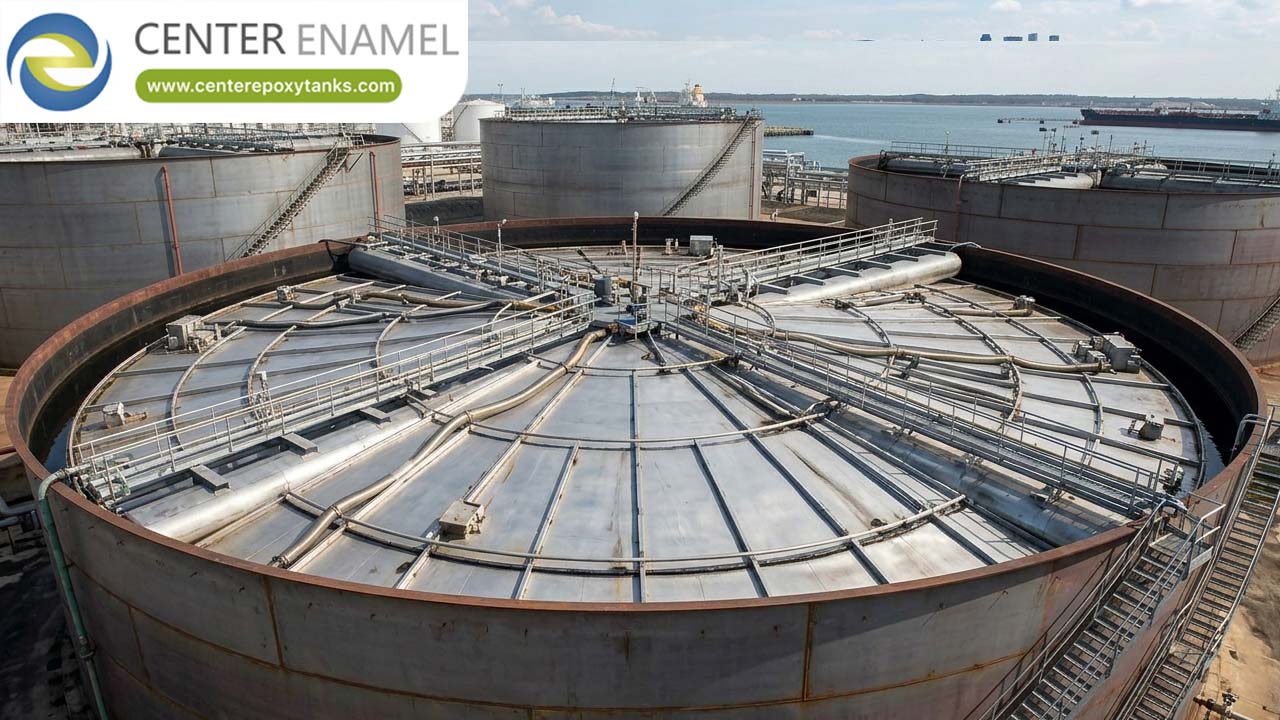
8 Designs of Floating Roofs in Storage Tanks: A Technical Authority Guide
In the 2026 industrial landscape, the selection of a floating roof design is a critical engineering decision that impacts a terminal's safety, environmental compliance, and bottom line. Governed by API 650 (Appendix C and H), floating roofs are designed to sit directly on the liquid surface, eliminating the vapor space that leads to product loss and hazardous emissions.
As a global leader in storage technology for over 30 years, Shijiazhuang Zhengzhong Technology Co., Ltd (Center Enamel) provides precision-engineered floating roofs that reduce VOC emissions by up to 99%. Below is a technical breakdown of the 8 primary designs used in the energy and chemical sectors.
1. Single Deck Pontoon Roof
The most common design for External Floating Roofs (EFR). It consists of a center deck made of steel plates, supported by a ring of air-tight pontoons around the perimeter.
● How it Works: The pontoons provide buoyancy, while the center deck is designed to flex slightly under rain or snow loads, directing water toward the roof drain.
● Best For: Large-diameter crude oil tanks.
2. Double Deck Pontoon Roof
This design features two layers of steel across the entire surface, creating air compartments throughout the roof.
● Structural Advantage: It offers superior buoyancy and thermal insulation compared to single-deck versions. It is virtually "unsinkable" because the entire roof is a series of independent pontoon compartments.
● Best For: Extremely large tanks where maximum structural rigidity is required.
3. Pan-Type Floating Roof
A pan roof is a single, flat metal plate with a vertical rim at the edge.
● Critical Constraint: It lacks inherent buoyancy compartments (pontoons). If the deck is punctured, it is at high risk of sinking. Because of this, it is rarely used in modern 2026 facilities unless strictly regulated for minor, non-volatile storage.
4. Bulkhead Pan Roof
An evolution of the pan-type, this design includes vertical bulkheads (partitions) on the deck.
● Improved Safety: The partitions prevent a single leak from flooding the entire roof, offering a marginal improvement in buoyancy over the standard pan-type.
5. Skin and Pontoon (Non-Contact) IFR
This is the industry standard for Internal Floating Roofs (IFR). It consists of a lightweight aluminum or stainless steel frame with a "skin" of thin sheeting, supported by a series of independent tubular pontoons.
● Design Note: It is a "non-contact" roof, meaning there is a small vapor space between the liquid and the skin.
● Strategic Advantage: Highly cost-effective and easy to install in existing fixed-roof tanks.
6. Full-Contact Honeycomb Roof
Constructed using high-strength aluminum honeycomb cores sandwiched between two sheets of metal.
● How it Works: The entire roof is in direct contact with the liquid, leaving zero space for vapor to form.
● Efficiency: Provides the highest level of vapor suppression and structural strength-to-weight ratio.
● Best For: High-purity products like Jet Fuel and gasoline.
7. Full-Contact Bolted Panel Roof
These roofs are composed of independent, pre-fabricated panels that are bolted together on-site.
● Maintenance Benefit: If one section of the roof is damaged, a single panel can be replaced without replacing the entire deck.
● Center Enamel Advantage: Our bolted panels are precision-manufactured via CNC to ensure a gas-tight fit.
8. Integrated Floating Roof with Geodesic Dome
While technically a system, the integration of an IFR with an Aluminum Geodesic Dome is a 2026 engineering benchmark.
● How it Works: The dome roof provides a clear-span, column-free interior. This allows the floating roof (any of the types above) to move unobstructed, eliminating the need for column seals—a common source of vapor leakage.
● Longevity: Protects the floating roof from weather, extending the seal life to 30+ years.
Floating Roof Design Comparison Matrix
Design Type | Contact Level | Buoyancy Safety | Primary Material | Standard |
Single Deck Pontoon | Non-Contact (Center) | High | Carbon Steel | API 650 App C |
Double Deck Pontoon | Full Contact | Highest | Carbon Steel | API 650 App C |
Skin & Pontoon | Non-Contact | Medium | Aluminum/SS | API 650 App H |
Full Contact Honeycomb | Full Contact | High | Aluminum | API 650 App H |
Why Choose Center Enamel for Your Floating Roof Project?
Selecting the right design requires a partner who understands the chemistry of the stored product and the environmental loads of the site.
1. 30+ Years Expertise: Projects successfully delivered in 100+ countries.
2. Custom FEA Engineering: We use Finite Element Analysis to ensure stability during high-fill rates.
3. Total Solution Provider: We manufacture the tank shell, the floating roof, and the aluminum dome as a single, technically compatible package.
Future-Proofing Your Storage Operations
Whether your facility requires the robust buoyancy of a Double Deck Pontoon or the high-purity protection of a Full-Contact Honeycomb IFR, Shijiazhuang Zhengzhong Technology Co., Ltd (Center Enamel) delivers world-class engineering. In 2026, the right floating roof is the key to balancing operational yield with environmental responsibility.
Optimize your energy infrastructure today. Contact Center Enamel for a technical consultation and a customized floating roof quote.


