 What is the Difference Between a Cone Roof Tank and a Dome Roof Tank?
In industrial liquid storage, selecting the appropriate roof architecture is critical for structural longevity, product purity, and environmental compliance. While both cone roofs and dome roofs serve as atmospheric covers for welded or bolted steel tanks, their engineering principles, load-bearing capacities, and operational benefits differ significantly.
Shijiazhuang Zhengzhong Technology Co., Ltd (Center Enamel), a global leader in storage technology for over 30 years, provides precision-engineered solutions for both configurations. Below is a technical breakdown of the differences between these two industry standards.
1. Structural Engineering & Design
The primary difference lies in the geometric distribution of stress and the necessity of internal supports.
Cone Roof Tanks (Fixed Roof)
A cone roof is a simplified structure where the roof plates form a conical shape.
● Support Requirements: For large-diameter tanks, cone roofs typically require internal support columns and rafters to prevent sagging or structural failure under snow or wind loads.
● Design Standard: Generally governed by API 650, focusing on slope angles that facilitate drainage while maintaining atmospheric pressure integrity.
Dome Roof Tanks (Geodesic Dome)
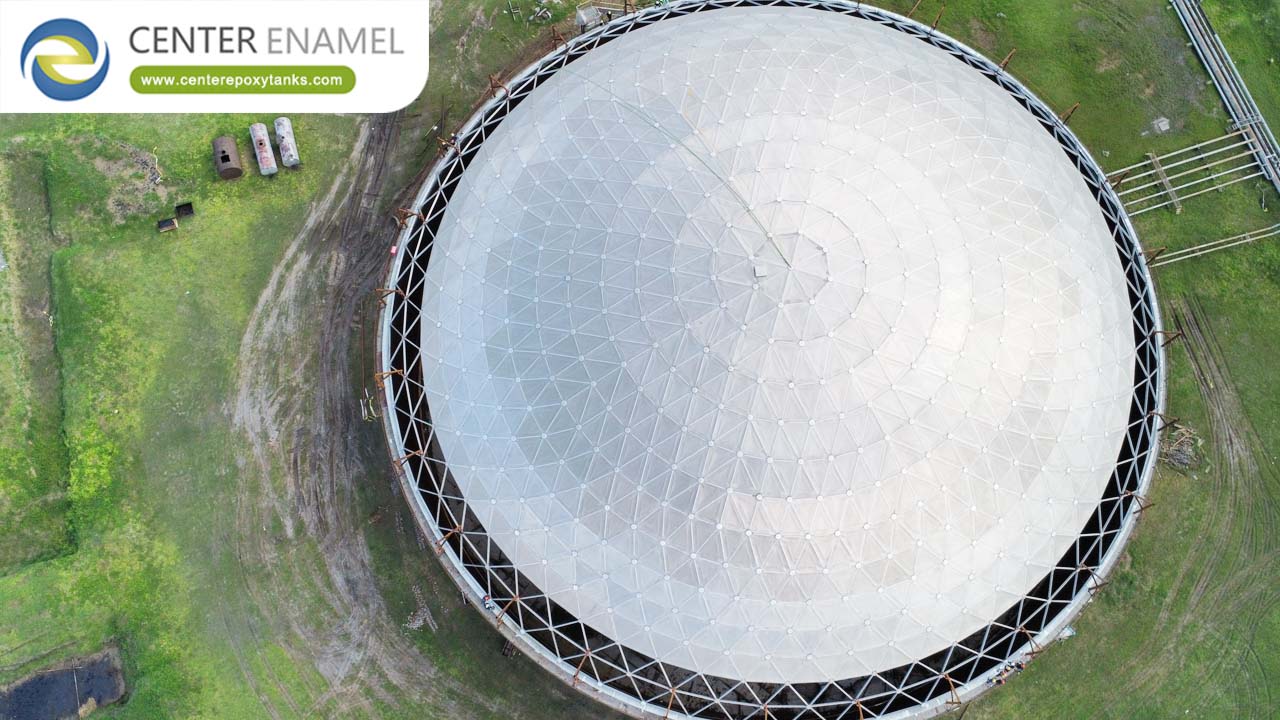
A dome roof, particularly the Aluminum Geodesic Dome, is a self-supporting structure based on a network of triangles.
● Clear-Span Design: Domes are self-supporting, meaning they require zero internal columns. This provides an unobstructed interior space.
● Load Distribution: The triangular geometry distributes stress evenly across the tank shell, allowing it to handle higher wind speeds and heavier snow loads than a standard cone roof.
2. Technical Comparison Matrix
Feature | Cone Roof Tank | Dome Roof Tank (Aluminum) |
Internal Supports | Required for large diameters | None (Clear-Span) |
Material | Usually Carbon Steel | High-Strength Aluminum Alloy |
Corrosion Resistance | Requires coating/maintenance | Inherently resistant |
Weight | Heavy (Impacts foundation) | Lightweight (~1/3 of steel) |
Vapor Control | Standard | Superior (Ideal for IFR integration) |
Service Life | 15–20 years (before repainting) | 30–50+ years (maintenance-free) |
3. Vapor Mitigation & Environmental Impact
In the 2026 regulatory environment, VOC (Volatile Organic Compound) control is a top priority.
● Dome Roof Advantage: Because dome roofs provide a column-free interior, they are the preferred choice for tanks utilizing an Internal Floating Roof (IFR). Internal columns in cone roof tanks create sediment traps and complicate the seal of a floating deck. A dome-covered IFR tank can reduce vapor loss by up to 99%.
● Cone Roof Limitation: While they can host IFRs, the necessary support columns require "penetrations" in the floating deck, which can lead to minor vapor leakage and increased maintenance of the column seals.
4. Maintenance and Total Cost of Ownership (TCO)
While a cone roof may have a lower initial capital expenditure (CAPEX), the Dome Roof often wins on TCO.
● Corrosion: Steel cone roofs are susceptible to internal corrosion from stored vapors and external rust. They require periodic sandblasting and repainting.
● Durability: Aluminum geodesic domes from Center Enamel are immune to the corrosive vapors of oil refining and petrochemistry. They do not require painting or protective coatings, significantly reducing long-term operational expenditure (OPEX).
5. Applications: Which One Should You Choose?
● Choose a Cone Roof Tank if: You are storing non-volatile, non-corrosive liquids (like heavy fuel oils or some municipal waters) in smaller-diameter tanks where CAPEX is the primary constraint.
● Choose a Dome Roof Tank if: You are storing volatile products (Gasoline, Crude Oil), high-purity liquids (Jet Fuel), or if you require a large-diameter tank with zero maintenance and high environmental compliance.
The Center Enamel Expertise
Whether your project requires the traditional reliability of a cone roof or the advanced efficiency of an Aluminum Geodesic Dome, Shijiazhuang Zhengzhong Technology Co., Ltd (Center Enamel) delivers world-class engineering. With projects in over 100 countries, we ensure every tank is designed using Finite Element Analysis (FEA) to survive local seismic and weather extremes.
Optimize your storage infrastructure with the right roof technology. Contact Center Enamel today for a technical consultation and API-compliant quote.


 What is the Difference Between a Cone Roof Tank and a Dome Roof Tank?