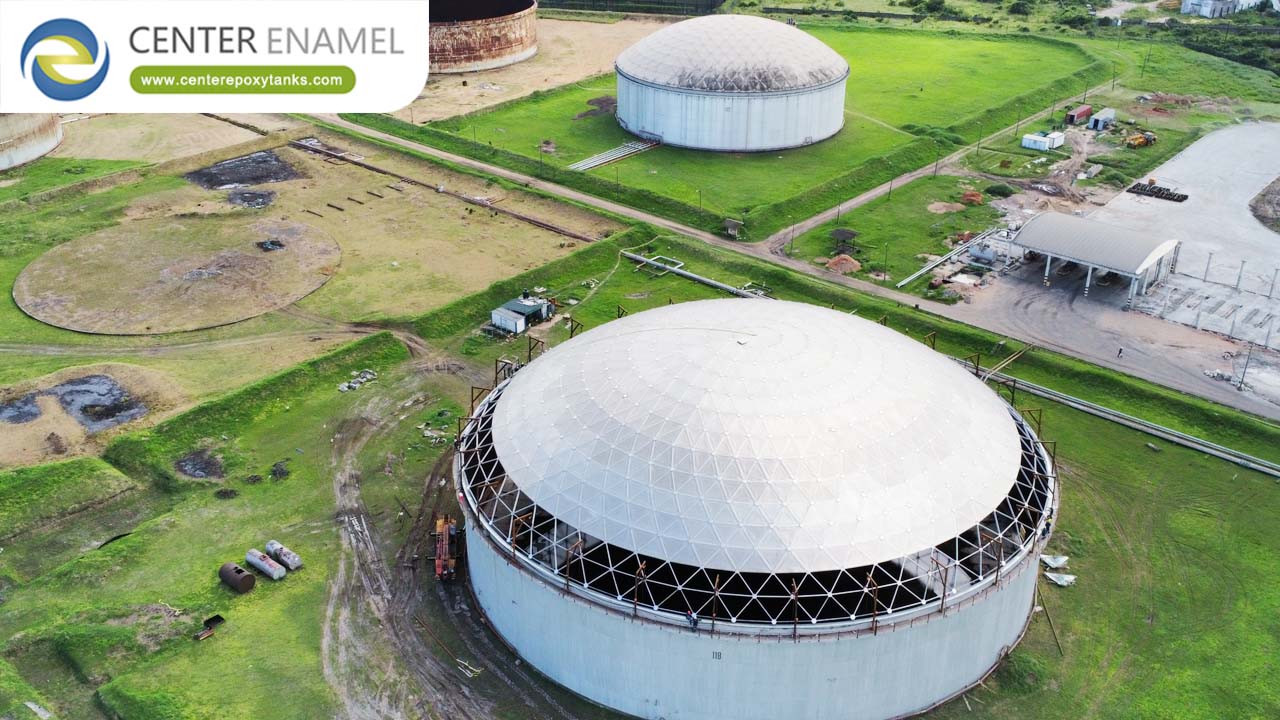
Aluminum Geodesic Domes For Large Storage Facilities: Clear-Span Protection At Scale
Covering one tank is a project; covering a tank farm is a program. The engineering repeats — the same load cases, the same geometry family, the same erection methodology — but the delivery problem changes: standardization across the facility, logistics at scale, erection sequencing that respects the operating plan, and a quality regime that holds across every unit.
This article covers covering at facility scale: the clear-span engineering, the modular scaling, the logistics and the integration that makes a tank farm program work.
Covering At Facility Scale
Facility-scale covering applies the same clear-span dome solution across many tanks, and the value comes from the repetition: one design family, one fabrication program, one erection methodology and one documentation format. The second and third domes cost less than the first because the engineering is done.
The scale also changes the risk profile: a defect repeated across a program is a program-wide defect, so the quality regime has to catch it at the first unit rather than the tenth.
Clear-Span Engineering For Very Large Tanks
At very large diameters the clear-span dome is the only cover that keeps the volume usable: columns consume capacity, complicate cleaning and create corrosion details inside the tank. The geodesic geometry spans the full diameter through its own structural action, with the reactions delivered into the shell through a designed ring beam.
The engineering at scale is the same load set executed at larger scale: member sections and connection capacities sized for the span, and the tolerance discipline between fabricated geometry and as-built shell more important as the numbers grow.
Modular Scaling
The design family scales by diameter band rather than by bespoke geometry: each band has its member sections, node set and packaging arrangement, and a new tank in the band is a configuration exercise rather than a new design. That is what makes a facility program affordable.
The scaling discipline also carries the spares and maintenance logic: one node set, one fastener specification, one seal type across the facility — which simplifies the maintenance regime and the spare parts inventory.
Scale Band | Module Approach | Delivery Model |
Small diameter | Few member types, single package | Standard configuration |
Mid diameter | Modular member sets, ring erection | Configured from the family |
Large diameter | Heavier members, staged erection | Engineered configuration |
Very large diameter | Project-specific analysis | Bespoke within the family |
Integration With Tank Farms
The covered tank does not sit alone: it connects to piping, transfer systems, vapor management and the site’s access and safety regime. The cover design has to accommodate the appurtenances the tank farm carries — nozzles, vents, instrumentation and access — as engineered penetrations.
The integration work happens at design stage: the penetration schedule reviewed against the facility’s operating and compliance requirements before anything is fabricated.
Logistics At Scale
A program moves a steady stream of modules rather than a one-off shipment, and the logistics plan is built for the rate: packaging sized for the route, delivery scheduling matched to the erection sequence, and a laydown area that works for a program rather than a single delivery.
The route survey governs the module dimensions — a member that cannot reach the site is fabricated twice — and at program scale the packaging standardization is what keeps freight efficient.
Erection Sequencing Across A Tank Farm
Erection sequencing is where the program meets the operating plan. Tanks are covered in an order that respects shutdowns, access and the site’s construction traffic, with each tank’s erection window fixed against its availability. The no-hot-work property of bolted aluminum erection is what makes live-facility sequencing possible.
The sequencing also carries the learning curve: the first tank’s erection refines the methodology for the rest, which is why the first unit is supervised most closely.
Quality Control At Scale
The quality regime has to hold across every unit: the same inspection points, the same records, the same acceptance criteria — executed per tank rather than per program. A program-level average hides the one tank that was different.
The first unit carries the qualification weight: its records establish the baseline that the rest are held against, and its survey record is the reference for the family.
Standardization Across The Facility
Standardization is the economic engine of a facility program: one member set, one node design, one fastener specification, one seal type and one documentation format. The engineering cost is paid once and the fabrication, erection and maintenance costs follow it down.
The standardization discipline extends to the interface: the same ring beam detail across the facility means the tank design and the cover design are reconciled once and repeated.
Operations With Covered Tanks
The operating regime changes when the farm is covered: no open-hatch weather exposure, a defined inspection regime per tank, and maintenance that follows the standard rather than the exception. The covered farm is simpler to operate, which is a return on the covering investment.
The operations case is also the safety case: fewer open-hatch exposures, controlled headspaces and a defined access regime across the facility.
Phased Implementation
Facility covering is usually phased: the tanks with the clearest case first, the rest following as budget and shutdown windows allow. The design family makes phasing cheap — later tanks join the program without re-engineering it.
The phased plan also manages the program risk: the first phase proves the methodology, the documentation and the erection performance before the full commitment is made.
Phase | Scope | Gate |
Phase 1 | Clearest cases first | Methodology proven |
Phase 2 | Main tank farm | Quality regime holding |
Phase 3 | Remainder of facility | Program close-out |
Center Enamel Facility-Scale Delivery
Center Enamel delivers facility-scale dome programs: a standardized design family scaled by diameter band, fabrication and packaging built for the route and the erection rate, erection sequencing against the operating plan, and a quality regime that holds per tank rather than per program.
For facility-scale covering, the standard we hold is the one the program demands — the first unit qualified, every unit verified, and the standardization that makes the program affordable.
About Company
Shijiazhuang Zhengzhong Technology Co.,Ltd(Center Enamel) is a professional manufacturer dedicated to the design and fabrication of bolted storage tanks since 2008. Our products range includes Glass-Fused-to-Steel (GFS) tanks, fusion bonded epoxy tanks, stainless steel tanks, galvanized steel tanks and aluminum geodesic dome roofs. With professional enameling R&D team and nearly 200 enameling patents, Shijiazhuang Zhengzhong Technology Co.,Ltd has become the leader in bolted tanks industry of Asia. Our products are certified to ISO9001, NSF61, EN1090, ISO28765, WRAS ,FM, LFGB, BSCI, IS0 45001 and other international standards.
Shijiazhuang Zhengzhong Technology Co., Ltd is not only the first manufacturer in China which produces Glass-Fused-to-Steel tanks, but also the most experienced professional bolted tanks manufacturer in Asia.The engineering & design, product testing and quality system of Center Enamel Glass-Fused-to-Steel tanks is in strict accordance with AWWA D103-09, OSHA, ISO 28765, NSF/ANSI 61, NFPA and other international standards. Until 2023, Center Enamel bolted tanks have been exported to more than 100 countries including USA, Australia,Canada, Malaysia, Indonesia, Russia, UAE, Panama,Brazil and South Africa etc., the superior tank quality and prompt service gains us worldwide recognition.
As an outstanding containment and cover system provider with decades of industry experience, Shijiazhuang Zhengzhong Technology Co., Ltd sincerely expects to establish long-term cooperation with the local partners throughout the world and make continuous contribution to the development of the industry.
Suggested CTA
Center Enamel delivers aluminum geodesic dome engineered for large facility covering duty, with large-span dome engineering, facility-scale delivery. Contact our engineering team for engineering guidance on your next aluminum geodesic dome large storage project — including sizing, standards compliance and delivery scheduling.
Frequently Asked Questions
Q: What changes when covering moves from one tank to a facility program?
A: The engineering repeats but the delivery problem changes: standardization across the facility, logistics at rate, erection sequencing against the operating plan, and a quality regime that holds per tank rather than per program.
Q: Why is clear-span important at very large diameters?
A: Because columns consume capacity, complicate cleaning and create corrosion details inside the tank. The geodesic dome spans the full diameter through its own structural action with reactions delivered through a designed ring beam.
Q: How does modular scaling make a program affordable?
A: By scaling through diameter bands with defined member sets, node designs and packaging arrangements — a new tank in a band is a configuration exercise rather than a new design, and spares and maintenance standardize with it.
Q: How is erection sequenced across a tank farm?
A: Against the operating plan: each tank’s erection window fixed to its availability, shutdowns respected, and the no-hot-work property of bolted aluminum erection making live-facility sequencing possible.
Q: Why does the first unit carry the qualification weight?
A: Because its records establish the baseline the rest are held against, and its erection refines the methodology for the program. A defect caught at the first unit is cheap; the same defect repeated across a program is not.
Q: Can facility covering be phased?
A: Usually it should be — the clearest cases first, the rest following as budget and shutdown windows allow. The design family makes phasing cheap because later tanks join the program without re-engineering it.