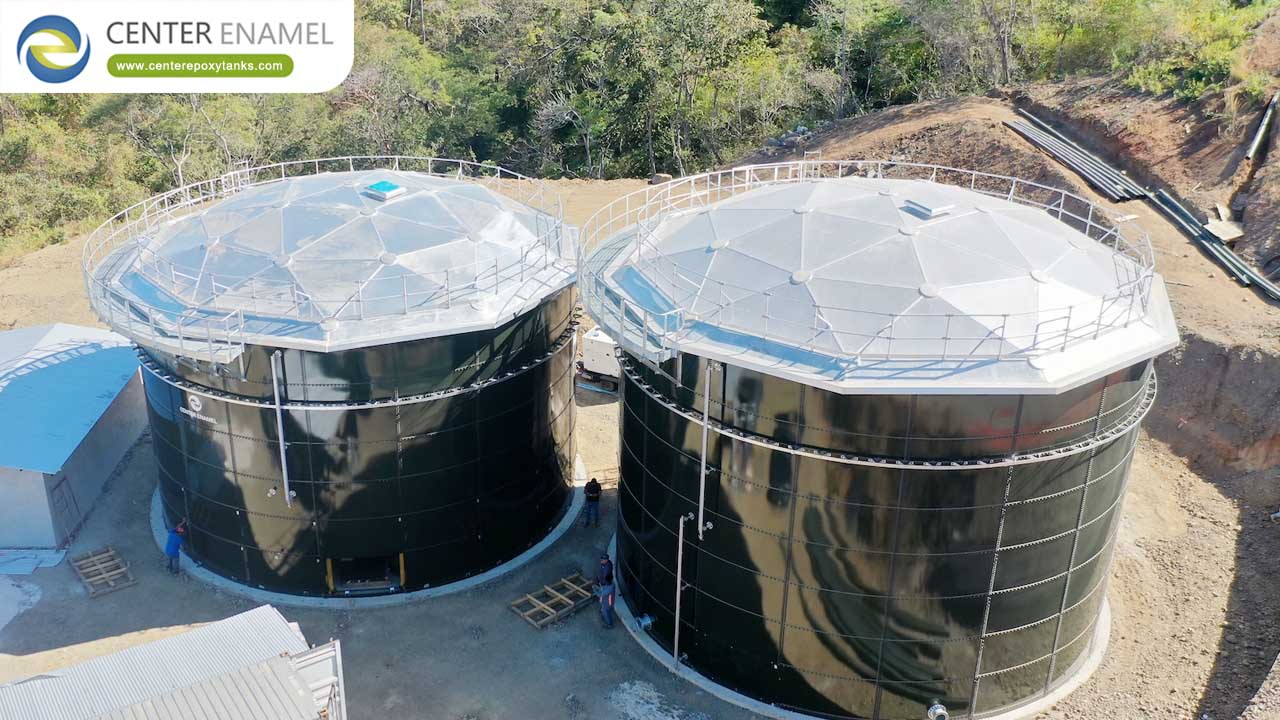
Aluminum Geodesic Dome Roofs for Drinking Water Storage Tanks: Engineering & Procurement Guide
Protecting municipal drinking water reservoirs from external contamination—such as avian pathogens, airborne pollutants, wind-blown debris, and UV-induced algae growth—is a critical public health mandate. Traditional column-supported steel or concrete roofs introduce long-term risks, including internal structural corrosion, paint delamination, and high dead loads on tank foundations.
Aluminum geodesic dome roofs have become the premier global standard for both new installations and retrofits on potable water tanks. Utilizing a self-supporting, clear-span space frame geometry, these domes eliminate internal columns entirely. They provide an uncompromised barrier layer that requires zero structural maintenance over an operational lifecycle exceeding 50 years.
1. Geometric Mechanics & Structural Engineering
The exceptional structural performance of a geodesic dome lies in its spherical triangulated geometry. Unlike conventional roofs that convert vertical loads into bending stresses, a geodesic dome distributes external forces (such as snow, ice, and wind) as axial compressive and tensile forces uniformly across its interconnected space frame.
Clear-Span Design Parameters
Aluminum domes are completely self-supporting and anchor exclusively to the top rim of the tank shell. This clear-span capability easily exceeds diameters of 100 meters without requiring any internal support columns.
● Elimination of Internal Columns: Eliminating internal columns removes a primary failure point in drinking water reservoirs. It eliminates column-to-floor seal leaks, reduces sediment accumulation points, and removes underwater structural steel that would otherwise require periodic underwater inspection and sacrificial anodes.
● Design Code Compliance: Structural calculations must strictly adhere to AWWA D108 (Aluminum Dome Roofs for Water Storage Facilities) and relevant sections of the International Building Code (IBC).
Membrane Stress Modeling
Under uniform environmental loading (such as heavy snow or internal vacuum pressures), the meridional membrane stress within a spherical dome shell structure can be calculated using the following thin-shell equilibrium relation:
is the central angle measured from the vertical apex of the dome to the specific structural point of calculation.
Because aluminum features an exceptionally high strength-to-weight ratio, the dead load of the roof is minimized, drastically reducing the overturning moments and seismic loads transmitted to the underlying tank shell and foundation.
2. Sanitary Engineering & Environmental Protection
Drinking water storage demanding strict compliance with global food safety and public health mandates requires specific material execution.
NSF/ANSI 61 and Safe-Water Compliance
Every component of the dome roof that faces the internal tank atmosphere must be chemically inert and certified to NSF/ANSI 61 (Drinking Water System Components - Health Effects) or equivalent international standards (e.g., WRAS).
● Aluminum Alloys: Domes are typically fabricated using high-strength, marine-grade aluminum alloys such as 6061-T6 for structural extruded struts and hubs, and 3003-H14 or 5052-H32 for the interlocking cladding panels. These alloys form a natural, self-healing aluminum oxide layer that eliminates the need for external paints, primers, or chemical coatings.
● Gasketry and Sealants: To form an absolute water-tight and insect-proof barrier, panel joints are sealed using extruded batten bars fitted with continuous EPDM or silicone gaskets formulated specifically for potable water exposure. These sealants must resist degradation from volatile chlorine or chloramine vapors rising off the treated water surface.
Contamination and Ventilation Controls
To maintain safe interior pressures during rapid tank filling or draining cycles without allowing external contamination inside, aluminum domes incorporate highly specialized venting systems:
● Air Vents: Located at the absolute apex of the dome, sized to handle maximum volumetric fluid displacement rates.
● Pathogen & Insect Screening: Vents must be securely wrapped with heavy-duty, stainless steel or aluminum fine-mesh screens (typically 24-mesh or finer) to completely block birds, bats, insects, and wind-borne contaminants from entering the water stream.
3. Financial & Operational Lifecycle Advantages
While the initial capital expenditure (CapEx) of an aluminum geodesic dome can be higher than a basic carbon steel cone roof, its total cost of ownership (TCO) over a 30-to-50 year horizon makes it the most economically viable choice.
● Zero Coating Maintenance: Carbon steel roofs require abrasive grit blasting and re-coating every 10 to 15 years to combat internal humidity corrosion. Aluminum domes never rust, completely eliminating these recurring maintenance expenses and the associated operational downtime.
● Rapid Field Installation: Component pieces are factory-prefabricated, pre-punched, and delivered as a modular kit. Assembly is completed at ground level using manual tools and specialized radial configurations. The completed dome is then crane-lifted onto the tank rim in a single day, reducing site construction hazards.
● Thermal Expansion Management: Aluminum expands and contracts at a different rate than steel or concrete tanks. Premium dome manufacturers utilize specialized sliding shoe anchor assemblies around the perimeter rim. These shoes allow the dome to expand and contract freely under thermal shifts without transferring dangerous thermal stresses into the tank walls.
4. Technical Procurement Vetting Scorecard
Use this strict scorecard when evaluating aluminum dome manufacturers during the technical bidding phase:
Technical Parameter | Tier-1 Dome Manufacturer | Commodity Fabricator |
Design Standards | Explicitly stamped to AWWA D108 & IBC codes | General architectural metal shop layouts only |
Material Traceability | 100% Mill Test Reports (MTRs) for 6061-T6 alloys | Unverified or commercial-grade aluminum lots |
Sanitary Certification | Documented NSF/ANSI 61 listing for gaskets/sealants | Standard industrial-grade elastomers used |
Joint Engineering | Interlocking batten-bars with dual-seal paths | Simple lap-joints relying heavily on liquid caulk |
Load Testing Logs | Physical destruction test validation records for hub components | Theoretical structural software approximations only |
Frequently Asked Questions (FAQ)
Q: Can an aluminum geodesic dome be installed on an existing concrete water tank?
A: Yes. Domes are regularly used to retrofit aging concrete reservoirs whose original roofs have suffered structural spalling or rebar corrosion. A specialized concrete compression ring beam adapter is anchored to the top of the concrete wall to distribute the dome's radial loads safely.
Q: How do aluminum domes handle extreme wind and heavy snow loads?
A: Because of their aerodynamic spherical shape, wind passes smoothly over the structure, creating far lower drag coefficients than flat or conical roofs. When engineered to AWWA D108 standards, these domes are routinely rated to withstand wind velocities exceeding 250 km/h and heavy snow accumulations up to 400 kg/m².
Q: Is water leakage common at the panel connection points?
A: In high-quality designs, no. While older dome configurations relied heavily on wet silicone caulking, modern Tier-1 designs utilize continuous mechanical interlocking panels secured with heavy-duty batten bars and embedded, tension-fit EPDM gaskets. This mechanical compression ensures a reliable, water-tight seal across decades of thermal cycling.


