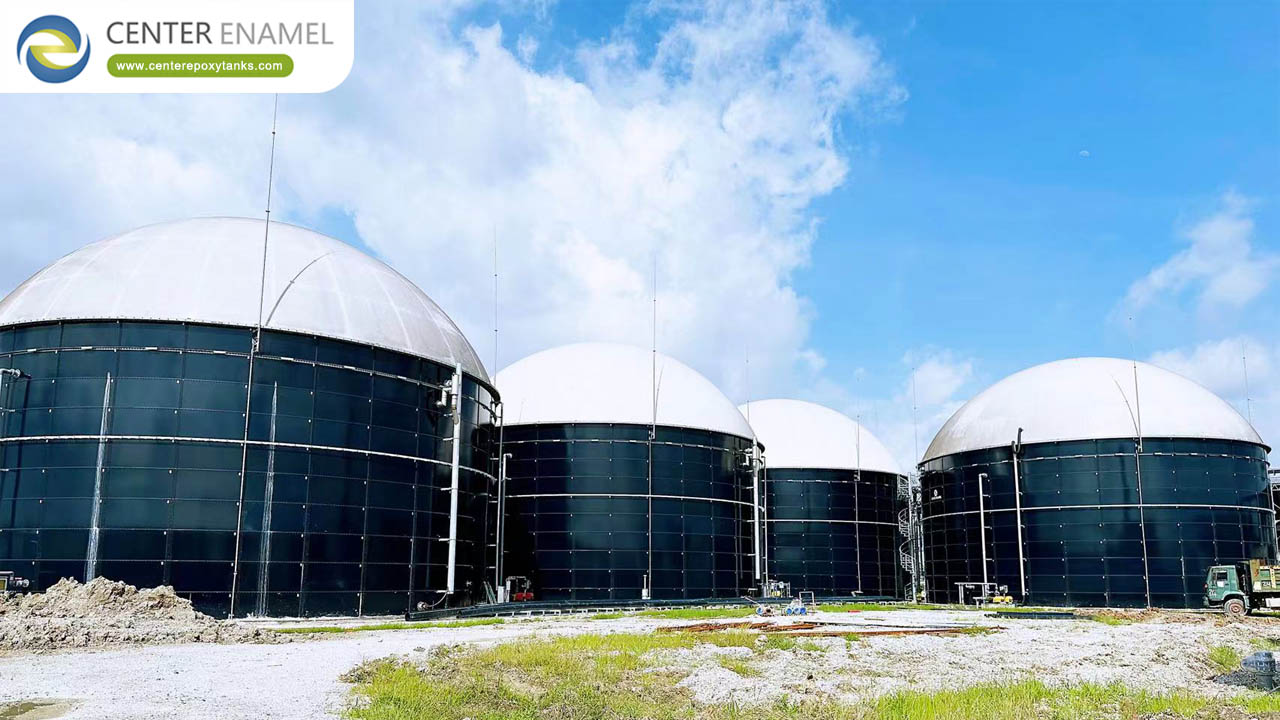
High-Performance Fusion Bonded Epoxy (FBE) Tanks for Biogas Storage
In the global transition to renewable energy, the anaerobic digester (AD) is the heart of every biogas plant. However, this heart is under constant assault. Anaerobic digestion generates a harsh, chemically aggressive internal environment characterized by high-organic loads and, most critically, the production of hydrogen sulfide (H2S).
For biogas facility operators, the containment vessel is not just a tank—it is a mission-critical infrastructure asset. Fusion Bonded Epoxy (FBE) tanks have emerged as the definitive choice for modern biogas plants, offering a superior alternative to traditional concrete or field-welded steel tanks.
The Engineering Challenge: Why Biogas Tanks Fail
Biogas production environments create two distinct threats to traditional storage materials:
Gas-Phase Corrosion: Hydrogen sulfide (H2S) oxidizes in the headspace and above the liquid line, forming sulfuric acid. This acid is notoriously destructive to unprotected steel and porous concrete (often called "concrete rot").
Liquid-Phase Attack: Organic acids produced during the digestion process (VFAs) create a highly corrosive liquid environment that degrades inferior linings and coatings.
Why FBE Technology is the Industry Standard
Fusion Bonded Epoxy (FBE) technology solves these challenges through a factory-controlled thermal bonding process. Unlike field-applied paints or liners, FBE is a thermoset polymer fused to the steel substrate at high temperatures, creating an inert, non-porous shield that is virtually impermeable.
Comparative Overview: Digester Technologies
Feature | Epoxy-Coated Bolted Steel (FBE) | Reinforced Concrete | Field-Welded Steel |
Chemical Resistance | High (Inert Polymer) | Low (Needs Acid-Liner) | Moderate (Needs Recoating) |
Installation Speed | Rapid (Modular) | Very Slow (Curing) | Moderate |
Leakage Risk | Zero (Airtight Gaskets) | High (Micro-cracking) | Moderate (Weld fatigue) |
Maintenance | Minimal | High (Crack repair) | High (Paint cycles) |
Lifespan | 30+ Years | 40+ Years (If sealed) | 15–20 Years |
Advantages of Center Enamel’s FBE Tanks for Biogas
As a leader in industrial storage, Center Enamel provides FBE tanks engineered specifically for the dynamic loads and chemical aggression of AD plants:
Superior H2S Resistance: Our proprietary FBE coating acts as a permanent, non-porous barrier, preventing the pitting and acid-induced thinning that destroys traditional digesters.
Factory-Controlled Consistency: Every panel undergoes a 1500V "Holiday Test" before shipping. This guarantees zero pinholes or microscopic defects, ensuring the corrosive slurry never contacts the steel substrate.
Thermal Resilience: Anaerobic digestion requires consistent temperatures (mesophilic or thermophilic). Our FBE coating remains stable and flexible during thermal expansion, ensuring long-term adhesion.
Modular Agility: The bolted design allows for rapid assembly, reducing commissioning times. Furthermore, these tanks are easily scalable—should your biogas yield increase, the modular nature of the tank allows for capacity expansion without replacing the entire vessel.
Frequently Asked Questions (FAQ)
Q: How long do FBE tanks last in a high-H2S biogas environment?
A: When manufactured to high standards (such as AWWA D103-09), FBE tanks typically offer a service life of 20 to 30 years. The factory-applied FBE barrier prevents sulfuric acid from reaching the steel, eliminating the primary cause of premature tank failure.
Q: Are FBE tanks suitable for CSTR (Continuous Stirred-Tank Reactors)?
A: Yes. The structural design of our bolted steel tanks is specifically calculated to handle the dynamic loads from heavy-duty internal agitators, and the FBE coating protects the interior walls from biomass abrasion.
Q: Does the FBE coating require cathodic protection?
A: No. Because the factory-applied FBE creates a complete, continuous dielectric barrier, there is no need for complex cathodic protection systems, which significantly simplifies your long-term maintenance routines.
Q: Is FBE better than Glass-Fused-to-Steel (GFS)?
A: Both are high-performance options. FBE is often chosen for its high resistance to mechanical impact and abrasion—making it ideal for farms or plants that perform frequent internal maintenance or mix abrasive feedstock—while providing a highly cost-effective alternative to GFS.
Q: Can I use FBE tanks for post-digestion slurry storage?
A: Absolutely. FBE tanks are excellent for raw slurry storage, equalization, and post-digestion effluent containment. Their modular nature allows you to use the same durable technology across every stage of your biogas facility.


