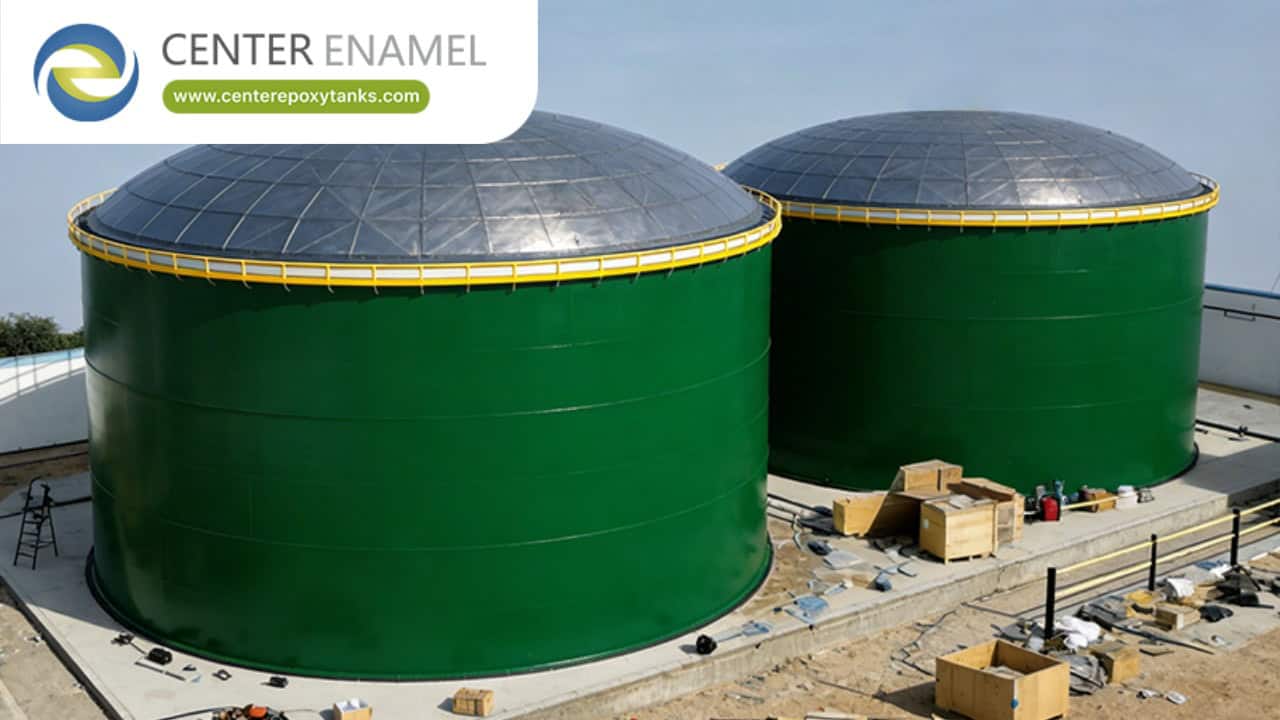
Aluminum Geodesic Dome Roof for Oil Tanks
The geodesic shell is usually explained through its geometry, and the geometry is genuinely remarkable: a triangulated frame that carries load to a perimeter ring with no internal columns, in a material that does not need a coating. But for a tank holding petroleum product, the interesting question is not how the geometry works. It is what the geometry does to the vapour space, the temperature of the product, the movement at the ring and the limits of the application itself. This article works through those gates, and is explicit about the boundary of the evidence available.
What the Triangulated Frame Actually Changes
A geodesic dome approximates a sphere with a network of triangles. Load from the panels passes through the nodes into the struts and thence into a perimeter compression ring, which transfers everything into the shell below. Because the load path is a closed triangular network rather than a radial arrangement of rafters and purlins, the structure is stiff in all directions and can span large diameters without intermediate vertical supports.
The commercially significant consequences are three. There are no internal columns, so the full plan area is usable and there is no column obstruction to internal inspection or to the installation of tank accessories. The self-weight is low relative to a steel equivalent, because aluminium achieves its strength at roughly a third of the weight of steel, which reduces the load imposed on the shell ring and on the foundation. And because the frame is a bolt-together triangulated assembly rather than a field-welded fabrication, installation can be staged from inside the tank or from a temporary central scaffold and then lifted into position.
Published supplier data for this product family places standard spans in the region of 10 to 50 m for conventional aluminium domes, with larger clear spans available to order, and our own company record documents the design, production and export of a 72 m diameter aluminium dome roof in 2023. That 72 m figure is the largest dome scale we can evidence as having been put into production.
The Oil-Service Gates That Have to Be Cleared
Gate | What has to be established | Why oil service makes this specific |
Product compatibility | That neither the stored product nor the vapour atmosphere attacks the aluminium alloy and the sealing materials | Crude, condensate and refined products carry water, salts and hydrogen sulfide in variable proportion |
Vapour space treatment | Whether the tank carries an internal floating deck, and how the dome above it is vented and relieved | The dome seals the tank; the vent and relief path must still handle fill, draw and thermal breathing |
Thermal and solar behaviour | The expected product temperature range and the shielding effect of the dome on the stored product | Stored temperature governs product quality, wax and pour point behaviour and vapour pressure |
Movement at the ring | How the dome accommodates thermal expansion and differential settlement without loading the shell | A large oil tank breathes more than a water tank, and the ring connection must not transmit that movement into the shell |
Fire and explosion considerations | The area classification, ignition source control and the consequence of a dome release | Petroleum service introduces a hazardous area that a water service does not have |
Erection with the tank in or out of service | Whether installation is possible with product present, and the inerting and gas-freeing regime | Decides whether the tank must be emptied and how long the outage is |
These six gates are not peculiar to geodesic geometry; they apply to any dome on an oil service. What the geodesic form contributes is the clear span, the low weight and the assembly method, which is what makes a large-diameter dome on a large oil tank practicable at all. The most commonly overlooked gate is the third: a dome changes the thermal environment of the stored product, and for a product with a temperature-sensitive specification that is a benefit to be quantified rather than an assumption to be made.
Geodesic Versus Structural Framing: Which One Applies
Not every aluminium dome is geodesic. The triangulated space-frame type, in which aluminium struts meet at machined nodes and carry panels between them, is the efficient answer at large diameters. The structural type, using conventional radial rafters and purlins in aluminium, is a simpler and often cheaper arrangement at moderate diameters where cost efficiency matters more than span.
The same 2025 third-party market study that covers the aluminium dome market reports that geodesic domes held roughly 58 percent of the market in 2025 against roughly 31 percent for structural domes, with the geodesic type preferred for large petroleum and water treatment applications and the structural type used where diameters are typically up to around 60 m. That is a market observation, not a technical rule, but it is a useful indicator of where each type is normally applied.
For a specifier the practical test is simple. If the tank is large enough that a column-supported fixed roof would be unattractive, or large enough that an internal column would obstruct operations or inspection, the triangulated frame is the appropriate answer. If the tank is moderate in diameter and the cost of the more efficient frame is not justified by the span it unlocks, the structural framing type is the sensible selection. Both can be executed in aluminium with the same corrosion and maintenance characteristics.
What the Dome Does Not Solve on an Oil Tank
Three limitations should be stated plainly. First, a dome over an oil tank does not by itself reduce emissions: the emission performance of the tank depends on whether there is an internal floating deck and how it is sealed, and the dome's contribution is to shield that deck from wind driven vapour loss and from solar gain. Where a tank has no floating deck, the dome closes the headspace and the vent path must then be designed for the resulting conditions, which is a different engineering problem.
Second, a dome does not remove the need for the tank to be inspected, gauged and maintained. It may improve the conditions for inspection by removing weather exposure, but the access arrangements still have to be designed and the internal fittings still have to be reachable. Third, a dome does not extend the life of a shell whose plate thickness has already reduced below the design basis, and it does not fix a foundation or a settlement problem.
It is worth saying plainly that we do not hold a verified record of a delivered aluminium dome on an oil or petroleum product service. Our verified project library covers aluminium dome roofs on drinking water, on municipal wastewater and on seawater desalination tanks. That is a real limitation on this article, and it is the reason it presents design gates rather than performance figures.
Limited Reference: A Seawater Desalination Installation
The closest related verified record we hold is a Chilean seawater desalination project recorded in March 2025: two fusion-bonded epoxy coated tanks, each 17 m in diameter with a 14.5 m shell height, 6,578 cubic metres in total, with aluminium dome roofs on both.
This reference is offered with an explicit limitation, because the medium differs from the one this article is about. The stored medium in that project was seawater for desalination, not a petroleum product, and the service conditions differ accordingly in vapour behaviour, in settlement and in the corrosive chemistry of the headspace. What the record does evidence is that aluminium dome roofs were designed, fabricated and installed on fusion-bonded epoxy coated shells of that diameter in a marine environment, which is a relevant precedent for the structure-and-material side of the question and not for the petroleum-service side. It should not be presented as an oil tank case study, and it is not presented as one.
For the petroleum side specifically, the honest statement is that the reference point available to any buyer is a manufacturer's own documented project set, and the specification should demand it with the country, date, stored product and project identifier given in full, so that a reference on water can never be mistaken for a reference on oil.
How to Specify an Oil-Service Dome
Start with the tank and the product rather than with the roof. Establish the diameter from the as-built shell, the shell height, the product and its worst-case properties including water content, salt content and hydrogen sulfide, the working and maximum temperature, the normal fill and draw rates, and whether an internal floating deck is present or planned. Then state the site design loads numerically against the applicable standard, the area classification and the fire protection arrangements, and the access constraints including the component delivery route and the available erection window.
Only then specify the roof. For a large tank on an oil service, the specification will normally call for a triangulated aluminium space frame in a stated alloy, a stated panel material, a stated sealing and liner arrangement appropriate to the vapour service, an itemised accessory schedule covering manholes, nozzles, vents and lightning protection, and a documentation package that names the code list and the party responsible for the calculations. Our aluminium dome design basis is documented against AWWA D108 for the dome itself, API 650 for the tank, ADM 2015 for the aluminium structure, ASCE 7-10 for loads and IBC 2012 for building provisions, and specifying against that combination gives the reviewer a defined reference to check.
What to Ask Any Supplier About Oil-Service Evidence
Four questions will sort a supplier quickly. Have you supplied an aluminium dome on a tank holding a petroleum product, and if so, in which country, in which year, for which operator and with what tank diameter. What is the stored product and what were its worst-case properties. Was the tank in service during installation, and if so, what was the inerting and gas-freeing procedure. And what load case was the design verified against, stated as numbers, and does the warranty reference that same case.
Answers that name the code but not the numbers, or that describe the project only in terms of the product family without the country and year, are not adequate for a petroleum service qualification. That is not scepticism for its own sake; it is the same discipline this article has applied to our own record, where the honest position is that we hold aluminium dome evidence on water, wastewater and desalination services and we do not claim an oil-service project.
Case evidence disclosure: the verified project library contains no aluminium dome delivery on a petroleum product service. The limited reference used in this article is the Chile seawater desalination project (2 units, 17 m diameter x 14.5 m height, 6,578 m3, fusion-bonded epoxy coated tanks with aluminium dome roofs, recorded March 2025). The stored medium was seawater for desalination, not a petroleum product, and it is presented as structural and material precedent only, not as an oil service case. No oil-service performance, emission or durability figure is stated in this article.
Conclusion
The geodesic frame is the reason a large oil tank can carry a roof at all: clear span, low weight and an assembly method that does not require heavy field welding. But the gates that decide whether it is appropriate on a given oil service are product compatibility, vapour treatment, thermal behaviour, movement at the ring, fire and explosion arrangements, and the erection window. Clear those, and the specification is straightforward. We do not hold a verified oil-service dome record, and we have said so rather than borrowing a water case to fill the gap. Send us the tank and product data and we will work the gates through with you.
Frequently Asked Questions
Q: What is the maximum span of an aluminium geodesic dome roof?
A: Published supplier data for conventional aluminium domes gives standard spans in the region of 10 to 50 m, with larger clear spans available to order and reported case studies describing spans beyond 100 m. The verified company record for Centre Enamel documents the design, production and export of a 72 m diameter aluminium dome roof in 2023, which is the largest dome scale we can evidence as having been produced. For your project the span capability must be confirmed against the actual design load case, because span capability and load capability are not the same number.
Q: Does an aluminium dome reduce emissions on an oil tank?
A: Not on its own. The dome's contribution is to seal the tank and to shield an internal floating deck from wind-driven vapour loss and from solar gain. If the tank has no floating deck, the dome closes the headspace and the vent and relief design has to be reconsidered for the resulting conditions. Emission performance is determined by the deck, its seal and the operating regime, and no emission figure should be accepted for a dome without the tank configuration stated alongside it.
Q: Can a geodesic dome be installed while the tank still holds product?
A: It can be in some configurations, because the structure is a bolted assembly with a low self-weight and can often be staged from inside the tank or lifted into position. Whether it is safe to do so on a petroleum service depends entirely on the inerting and gas-freeing regime, the area classification and the permit regime at the site. Many operators require the tank to be emptied and gas-free for this work as a matter of policy, so the question should be settled at the planning stage because it drives the outage length.
Q: How does a dome affect the temperature of the stored product?
A: The enclosed headspace shields the product from direct solar gain and from wind-driven surface evaporation, which generally reduces daytime temperature excursions. Whether that is a benefit depends on the product. For a product with a wax or pour-point specification it is usually beneficial; for a product that requires a minimum temperature it may not be. The dome also changes the heat transfer characteristics of the tank, so the thermal case should be assessed rather than assumed.
Q: Is a geodesic dome different from a structural aluminium dome?
A: Yes, and the difference is structural efficiency rather than material. A geodesic dome is a triangulated space frame with machined nodes, which is efficient at large diameters and clear of internal columns. A structural aluminium dome uses conventional radial rafters and purlins, which is simpler and often cheaper at moderate diameters. A 2025 third-party market study reports geodesic domes at roughly 58 percent of the aluminium dome market in 2025 against roughly 31 percent for structural domes, with the geodesic type preferred for large petroleum and water treatment applications.
Q: Why will you not show me an oil tank project?
A: Because we do not hold one in the verified project library. The aluminium dome deliveries we can evidence are on drinking water, municipal wastewater and seawater desalination tanks, and presenting a desalination project as an oil tank case study would misrepresent it. If you need oil-service evidence, ask any supplier for project identifiers, country, date and stored product, and hold them to the same standard we have applied to ourselves here.
Work With Center Enamel
Center Enamel is the trading name of Shijiazhuang Zhengzhong Technology Co., Ltd, established in 2008 and based in Shijiazhuang, Hebei Province, China. The company manufactures glass-fused-to-steel bolted tanks, fusion-bonded epoxy coated tanks, stainless steel and welded steel tanks, pressure vessels, aluminium geodesic dome roofs and floating roof systems. Aluminium dome design work is carried out against AWWA D108, API 650, ADM 2015, ASCE 7-10 and IBC 2012, and the broader product range is covered by ISO 9001, NSF/ANSI 61, CE/EN 1090, ISO 28765, WRAS and FM approvals. The company reports 30,000 installed projects and an annual output of 300,000 enamel steel plates, with technical support delivered through an international distributor network and a stated 24-hour response commitment.
If your project involves tank roofs, floating decks or the shells that carry them, send the tank diameter, shell height, product, operating temperature and site design loads. We will return a preliminary structural concept, the applicable design code basis, and a written scope that separates what is included from what the site contractor must provide.


