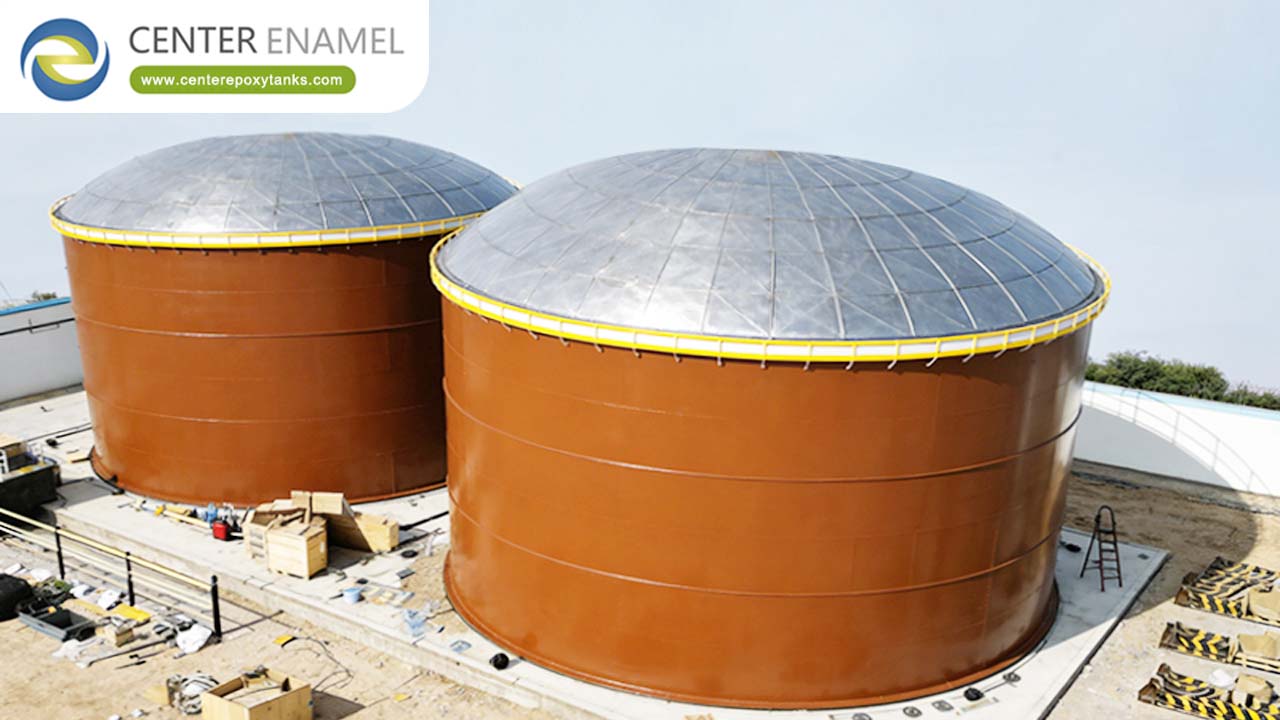
Aluminum Internal Floating Roof Systems
Aluminium is the most widely discussed deck material for internal floating roofs, and the reasons for it are real: it is light, it resists corrosion in a way that steel cannot match without a coating, and it does not produce a spark when struck. But those three advantages have conditions attached to them, and a material recommendation that states the advantages without the conditions is not usable. This article gives the decision honestly, including the cases where aluminium is the wrong answer and what to specify instead.
The Three Properties That Drive the Decision
Aluminium's low density is the property with the most practical consequences. For an internal floating roof, low density means three things at once. The deck requires less buoyancy, so the buoyancy reserve does not have to be designed as tightly, which matters because the buoyancy reserve is the margin that covers contamination, ice, rainwater and sludge. It means the components are light enough to move by hand or with light equipment, which affects both the erection method and the possibility of installing a deck into a tank through existing openings without heavy lifting. And it reduces the load on the guide rails, the landing supports and the column sleeves through the full level range.
The second property is corrosion resistance, and it is the reason aluminium is so strongly favoured in the more aggressive headspaces. Aluminium forms a thin, adherent, self-repairing oxide layer that protects the metal in the way a coating film cannot, and that layer is stable in the hydrogen sulfide and moisture conditions typical of a wastewater or sour service headspace. Where steel would require a maintained coating, aluminium requires inspection. The third property is the absence of sparking. Aluminium will not produce the incandescent particle that struck steel can, which matters in a flammable atmosphere, and it is one of the reasons aluminium is specifically recommended for storage of flammable and hazardous materials.
These three properties are the whole of the case for aluminium. The rest of this article is about the conditions attached to them.
The Material Decision Matrix
Service condition | Aluminium | Steel | GRP or composite | Reason |
Corrosive headspace, for example hydrogen sulfide or saline vapour | Strongly favoured | Requires a maintained coating and a recoating plan | Favourable, subject to chemical compatibility and static control | Aluminium's passive oxide does not depend on a film that can be breached |
Flammable or hazardous product in a classified area | Strongly favoured | Produces sparks when struck | Favoured, with antistatic requirements to be addressed | Non-sparking behaviour is a specific safety requirement in classified areas |
Large tank where the roof area is large and access is difficult | Favoured | Coating quantity and access dominate the lifecycle cost | Material-specific; access still governs | The avoided coating cycle scales with the roof area |
Retrofit into an existing tank with restricted component access | Strongly favoured | Heavier components, more lifting required | Favourable on weight, must be checked for handling | Low weight determines whether the retrofit is physically possible |
Product that attacks aluminium, or strongly alkaline or acidic service | Not suitable | Possibly suitable subject to coating selection | Often the preferred answer, subject to compatibility data | Material compatibility overrides every other consideration |
Product that carries solids, heavy sludge or heavy catalyst | Requires a drainage and cleaning strategy | Requires a drainage and cleaning strategy | Requires a drainage and cleaning strategy | Trapped solids under the deck are a common failure driver in all three materials |
Very large tank where buoyancy reserve is tight and contamination is likely | Usually favourable because the reserve does not have to be as generous | Less favourable | Material-specific | Buoyancy is designed against product density plus a margin, and aluminium needs less of it |
Read this table as a set of conditions rather than as a ranking. The first three rows are where aluminium's advantages are decisive. The fifth row is the disqualifier, and it overrides everything else: no advantage is worth a material that the product destroys. The sixth row is the one most often missed, because it is not a material property at all but it does more damage than material properties do.
Where Aluminium Is the Wrong Answer
Aluminium is wrong in three distinct situations, and they fail for different reasons, so they should not be treated as one category. The first is chemical incompatibility. Strongly alkaline solutions and certain strongly acidic and chloride-bearing conditions attack aluminium, and the attack on a floating deck is particularly unwelcome because the deck is thin and the loss is perforation rather than a gradual reduction in a section. Compatibility has to be established for the actual product at its worst-case composition, including water content and temperature, and it has to come from data rather than from a general statement about corrosion resistance.
The second is where the deck has to carry heavy solids, catalyst or sludge. Such material settles under the deck, and where it settles it isolates the aluminium from the product and creates a corrosion cell under the deck, and where it is disturbed it abrades the deck. This is not a reason to avoid aluminium in particular, but it is a reason to require a drainage and cleaning strategy, and to require the deck geometry to permit it.
The third is the galvanic case, which is not a reason to avoid aluminium but is a reason to design it. An aluminium deck in a steel tank is a large aluminium surface in contact with, or close to, steel fittings and a steel shell. Where moisture is present, the aluminium is the anode. The mitigations are standard: isolate dissimilar metals with a suitable barrier, use compatible or properly coated fasteners, detail trapped-moisture locations so that they drain, and record the details on the drawings so that a site assembler reproduces them. This is a detailing discipline, not a material limitation, but it has to be specified.
Buoyancy Reserve: The Calculation That Is Usually Left Out
A floating deck floats because the volume of displaced product exceeds the weight of the deck. The margin between those two quantities is the buoyancy reserve, and it is the margin that absorbs everything the calculation did not anticipate: rainwater and snow on the deck, contamination with a denser product or sludge, sediment, ice, a person standing on the deck during inspection, and coating or debris accumulation.
The design point for the buoyancy calculation is the product density at the operating temperature, not the nominal density at standard conditions, because a product that is less dense than specified gives less buoyancy than the design assumed. Aluminium changes the balance in the buyer's favour, because the deck's own weight is lower, so the same reserve represents a larger proportion of the total. That is a real advantage in the tank where contamination is likely or the product density varies, and it is worth quantifying rather than asserting.
The reserve should be stated as a number in the enquiry, together with the design density, the assumed contamination allowance and the resulting maximum allowable liquid density on the deck. A roof specification that omits these is a roof specification that can be landed by accident, and a deck landed by accident is an inspection and a product problem rather than a roof problem.
Full Contact and Honeycomb Construction in Aluminium
The most demanding use of aluminium in this family is the full contact deck, in which panel sections rest directly on the product surface. The advantage is that essentially no vapour space exists beneath the deck at all, which makes it the most aggressive emission configuration available. Supplier literature describes this construction as a honeycomb panel arrangement, and the regulatory definitions of internal floating roofs accept the internal floating cover as a qualifying configuration alongside the pontoon and double deck types.
The aluminium version of that construction has two characteristics that matter in a specification. The first is that the panel arrangement and the way the panels join determine whether the deck can be assembled from components that pass through the tank's existing openings, which governs the retrofit question entirely. The second is that a full contact deck has no significant freeboard and sits directly on the product, so the buoyancy reserve concept applies differently and the buoyancy calculation has to reflect the actual construction rather than a nominal deck.
It is worth noting what this configuration costs in inspection terms. Because the deck rests on the product and encloses a space that can accumulate vapour and moisture, the enclosed volumes have to be arranged so that they can be inspected and drained, and any design feature that reduces the number of enclosed volumes improves the maintainability of the whole assembly.
How Aluminium Compares on the Commercial Side
The commercial case for an aluminium deck is straightforward and has three components. The first is the avoided coating cycle, which on a steel deck in a corrosive service is a recurring cost consisting of the coating work, the access equipment, the containment and the production impact of getting onto the tank. The second is the avoided corrosion, which reduces the inspection frequency and the probability of an unplanned intervention. The third is the installation consequence, because a lighter deck widens the range of tanks that can be retrofitted and reduces the lifting and handling requirement.
The counterweight is that aluminium decks are not universally cheaper than the alternative, and that the material specification has to be taken seriously: the alloy, the panel material, the seal material compatibility and the fastening arrangement are all part of the specification and all of them affect the price. A GRP deck is a legitimate alternative in many chemical services and supplier material in this field describes it as being considered where high chemical resistance and low maintenance are required, with antistatic design and regulatory requirements to be addressed. It is a genuine alternative, and it should be evaluated rather than excluded by default.
The commercial comparison therefore has to be made on the specific service rather than on the material in the abstract, and it has to include the inspection and replacement regime, because the regime is where the difference between the materials actually shows up over twenty years.
Case evidence disclosure: the verified Centre Enamel project library contains no internal floating roof delivery, so the material decision in this article rests on published engineering sources and on the publicly listed aluminium internal floating roof product line, cited from its source URL. No installed aluminium deck, no buoyancy verification against an operating tank and no corrosion record are evidenced by a project reference, and none is claimed. Product-compatibility limits stated in the article are engineering principles that require confirmation against the specific product, not findings from a delivered installation.
Conclusion
Aluminium is the right deck material for a corrosive or classified headspace, for a large tank where the coating cycle would be a burden, and for a retrofit where component weight decides feasibility. It is the wrong material where the product attacks it, and it requires explicit detailing discipline where it meets steel. The buoyancy reserve, the compatibility with the worst-case product composition and the enclosed-volume inspection arrangement are the three things a specification must nail down, because they are the three things that a material preference cannot fix. Send us the product data, the headspace atmosphere and the exposure class, and we will give you a straight answer on the material.
Frequently Asked Questions
Q: Why is aluminium preferred for internal floating roofs?
A: Three properties drive it. Low density means less buoyancy is needed for the same reserve margin, lighter components for installation, and lower loads on the guide and landing arrangement. Corrosion resistance means no coating film that can be breached, which matters most in hydrogen sulfide and saline headspaces. And the absence of sparking, which is a specific requirement where the stored product is flammable and the area is classified. Each advantage has a condition attached, and the specification has to reflect it.
Q: Is aluminium always better than steel for a floating roof deck?
A: No. Aluminium wins decisively in a corrosive headspace, in a classified area, on a large tank where the coating cycle is a burden, and in a retrofit where component weight decides feasibility. It loses where the product attacks aluminium, and it needs explicit galvanic detailing where it meets steel in a wet headspace. Steel remains viable in a benign service with good access and a sound coating plan, and the case should be made on the service rather than on the material.
Q: Can an aluminium deck be used with any product?
A: No, and this is the disqualifying condition. Strongly alkaline service and certain acidic and chloride-bearing conditions attack aluminium, and on a floating deck the consequence is perforation rather than a gradual reduction. Compatibility must be established against the actual product at its worst-case composition including water content and operating temperature, using data rather than a general statement about corrosion resistance. Where the product is aggressive, a glass-fibre reinforced polyester deck is frequently the alternative to evaluate.
Q: How does galvanic coupling affect an aluminium deck in a steel tank?
A: It is a detailing discipline rather than a prohibition. The aluminium deck, the steel shell, the column sleeves, the fasteners and the seal brackets form potential galvanic couples wherever moisture is present, with the aluminium as the anode. The mitigations are to isolate dissimilar metals with a suitable barrier, use compatible or properly coated fasteners, detail trapped-moisture locations to drain, and record those details on the fabrication drawings so that the site assembler reproduces them.
Q: What is the buoyancy reserve and how much is enough?
A: The buoyancy reserve is the margin between the deck weight and the displaced product weight, and it is what absorbs rainwater and snow, contamination with denser material or sludge, sediment, ice and personnel during inspection. The design point should be the product density at operating temperature, not the nominal density. The reserve, the design density, the contamination allowance and the resulting maximum allowable liquid density should all be stated in the enquiry, because they determine the level at which the deck can land unintentionally.
Q: Is a full contact aluminium deck worth the extra complexity?
A: It depends on the emission requirement. A full contact deck rests directly on the product and leaves essentially no vapour space beneath it, which makes it the most aggressive configuration available, and in aluminium it combines that with the non-sparking and corrosion-resistance advantages. The costs are the more demanding buoyancy calculation, the enclosed volumes that have to be arranged for inspection and drainage, and the assembly detail that determines whether the deck can be installed through the tank's existing openings.
Work With Center Enamel
Center Enamel is the trading name of Shijiazhuang Zhengzhong Technology Co., Ltd, established in 2008 and based in Shijiazhuang, Hebei Province, China. The company manufactures glass-fused-to-steel bolted tanks, fusion-bonded epoxy coated tanks, stainless steel and welded steel tanks, pressure vessels, aluminium geodesic dome roofs and floating roof systems. Aluminium dome design work is carried out against AWWA D108, API 650, ADM 2015, ASCE 7-10 and IBC 2012, and the broader product range is covered by ISO 9001, NSF/ANSI 61, CE/EN 1090, ISO 28765, WRAS and FM approvals. The company reports 30,000 installed projects and an annual output of 300,000 enamel steel plates, with technical support delivered through an international distributor network and a stated 24-hour response commitment.
If your project involves tank roofs, floating decks or the shells that carry them, send the tank diameter, shell height, product, operating temperature and site design loads. We will return a preliminary structural concept, the applicable design code basis, and a written scope that separates what is included from what the site contractor must provide.


