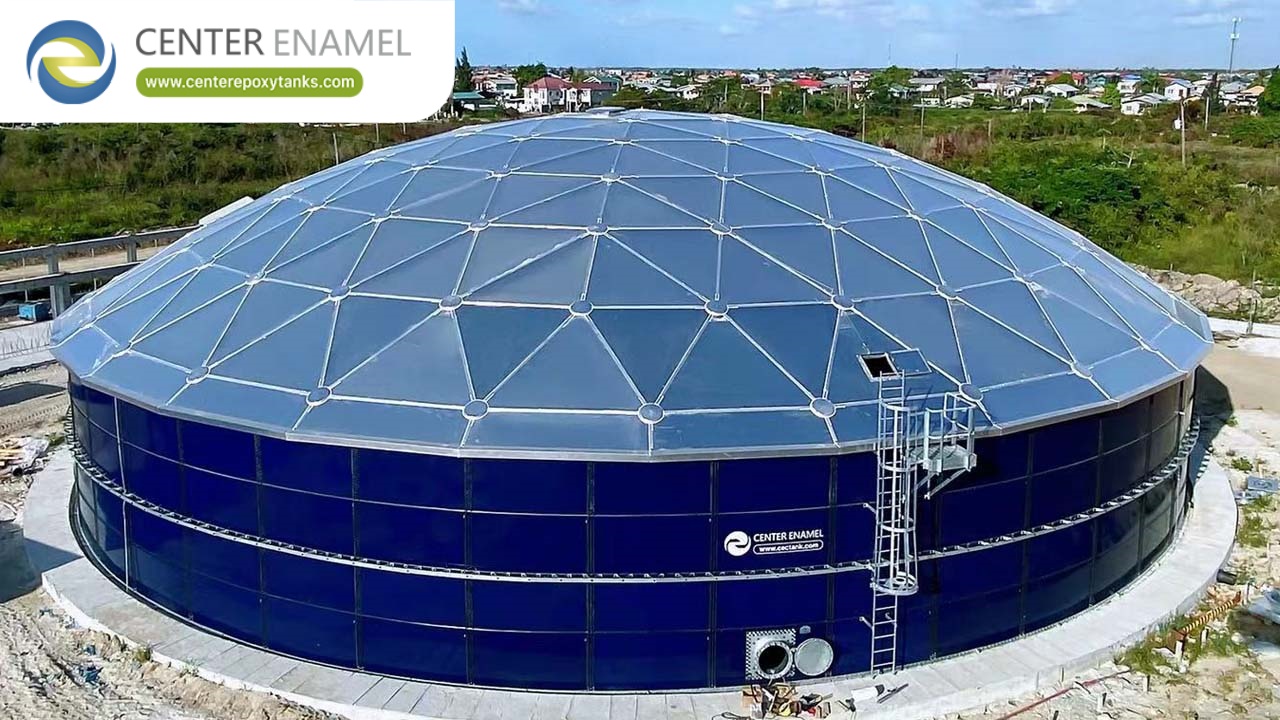
Aluminum Geodesic Dome Roof Engineering: Load Paths, Clear Span And Design Codes
The engineering value of an aluminum geodesic dome roof lies in its triangulated geometry: loads are carried efficiently to the perimeter with no internal columns. This article covers load paths, clear-span behavior and the design codes that govern aluminum domes.
Why Triangulation Matters
A geodesic dome subdivides a spherical surface into triangles. A triangle cannot change shape without changing a side length, so the network is inherently stable and carries load with minimal material.
This lets the dome span large diameters at low weight — the core reason aluminum domes are used on big tanks and reservoirs.
Load Path: From Apex To Rim
Gravity, snow and equipment loads enter the cladding and struts, flow along the triangulation, and concentrate at the perimeter ring. The ring transfers the resultant thrust into the tank shell or foundation.
Because the path is continuous and symmetrical, member forces are predictable and the structure avoids localized bending that plagues flat covers.
Clear-Span Behavior
With no internal columns, the full tank cross-section is usable. This matters for mixing, sludge handling, floating covers and access — and it removes column-penetration leak paths.
Clear span also simplifies tank cleaning and inspection, reducing confined-space entry points.
Governing Design Codes
Aluminum domes are designed to AWWA D108 (aluminum dome roofs for water tanks), API 650 (where the dome interfaces a storage tank), ADM 2015 (Aluminum Design Manual), ASCE 7-10 (minimum design loads) and IBC 2012 (building code).
The applicable set depends on contents, location and whether the dome is on a regulated water or fuel tank.
Environmental Loads
Wind: low profile reduces uplift; ASCE 7-10 wind maps set the pressure. Snow: balanced and unbalanced loads are distributed through the triangulation. Seismic: IBC 2012 / ASCE 7-10 define the lateral demand.
Each load case is combined per the governing code; the perimeter ring is sized for the worst resultant thrust.
Member And Connection Design
Struts are aluminum alloy extrusions sized for axial force; nodes use proprietary extrusions with spun aluminum gusset covers and silicone gaskets for a precision seal.
Connections are the critical detail — aluminum-to-aluminum joints are designed for both strength and long-term seal integrity under thermal cycling.
Thermal And Fatigue Considerations
Aluminum's thermal expansion is addressed in detailing; gaskets accommodate movement. Cyclic wind and thermal loads are reviewed where the dome sees repeated demand.
The no-paint finish removes coating-fatigue concerns that affect steel covers in UV and thermal swing.
Large-Diameter Capability
Center Enamel's R&D record includes designing and exporting an aluminum dome roof of up to 72 m diameter (2023 milestone), and its catalog cites a 72.39 m diesel-storage dome cover among project references.
Larger spans require careful ring and foundation coordination, but the triangulation principle scales without internal columns.
Dome And Tank As One System
Where the dome sits on a tank, the rim reaction is a load on the shell and foundation. The tank designer must include the dome thrust in the shell and base check.
Coordinated calculations prevent over-stressing an existing shell not originally detailed for a dome.
Verification And Stamped Calculations
A qualified supplier provides stamped calculations for the governing codes, including load combinations and the perimeter-ring design.
Procurement should require these before fabrication, especially for regulated water or fuel service.
Common Engineering Pitfalls
Treating the dome and tank as separate when they share the rim, ignoring rim tolerance in fabrication, and under-specifying snow/wind for the actual site.
Resolving the system boundary and the governing code early prevents the most costly rework.
Buckling And Member Sizing
Struts in compression must be checked for axial buckling per ADM 2015; the triangulated layout keeps individual member forces modest, but larger spans increase force and demand careful section selection.
Nodes are checked for the combined forces they transfer. The proprietary extrusion and gusset detail is validated so the connection, not the member, controls the capacity.
Fabrication Quality Verification
Because the dome is assembled from many identical extrusions, fabrication QC focuses on dimensional consistency of struts and the precision of node connectors and gaskets.
Request the supplier's inspection records for a representative batch; consistent nodes are what make the seal plane continuous once the dome is closed on site.
Wind Uplift Resistance
Wind acts as uplift on a dome; the low profile helps, but the resultant must be carried by the perimeter ring into the tank. ASCE 7-10 sets the pressure for the site.
Edge detailing and the ring connection are the critical points where uplift is transferred, so they receive the closest design attention.
Snow And Asymmetric Loads
Unbalanced snow creates asymmetric member forces that differ from the symmetric gravity case. The worst combination - not the largest single load - controls member sizing.
Designers run multiple load cases and size for the governing resultant at the ring.
Design Margins And Safety Factors
Member and connection capacities are evaluated with the applicable safety factors from ADM 2015 and the governing code. The triangulated layout means loads distribute through many members, so the structure is forgiving of local variation but still requires disciplined connection design.
Margins are chosen for the service environment and the consequences of failure; a qualified engineer documents the basis so the owner can verify it independently if the tank or service later changes.
From Calculation To Fabrication
Once calculations are approved, the dome is reduced to a bill of standardized extrusions, nodes and panels. Because the parts are few and repeated, fabrication quality is consistent and field fit-up is predictable.
The engineering deliverable and the fabrication package should cross-reference each other so that what is built matches what was analyzed - a basic but essential control.
Load | Path / standard |
Gravity / snow | Cladding → struts → perimeter ring → shell |
Wind | ASCE 7-10 pressure → ring thrust |
Seismic | IBC 2012 / ASCE 7-10 → rim reaction |
Thermal | Gasket accommodation, detailing |
Code | Governs |
AWWA D108 | Aluminum dome roofs for water tanks |
API 650 | Storage tank interface (where applicable) |
ADM 2015 | Aluminum member design |
ASCE 7-10 | Design loads |
IBC 2012 | Building code adoption |
Frequently Asked Questions
How does a geodesic dome carry load?
Through a triangulated network that routes gravity, snow, wind and seismic forces to the perimeter ring and then the tank shell.
Why no internal columns?
Triangulation is self-supporting, giving a clear span that maximizes usable volume and simplifies access.
Which codes govern aluminum domes?
AWWA D108, API 650 (where applicable), ADM 2015, ASCE 7-10 and IBC 2012, verified per project.
How big can a geodesic dome be?
Center Enamel references domes up to the 72 m class, with a cited 72.39 m diesel-storage cover.
Is the dome analyzed with the tank?
Yes — the rim reaction is a load on the shell and foundation and must be included in the tank design.
What calculations should I require?
Stamped load-combination and perimeter-ring calculations for the governing codes before fabrication.
Work With Center Enamel
Center Enamel (Shijiazhuang Zhengzhong Technology Co., Ltd) is a Chinese manufacturer of bolted storage tanks and aluminum geodesic dome roofs, established in 2008. Its product range covers Glass-Fused-to-Steel (GFS) tanks, Fusion-Bonded Epoxy (FBE) tanks, galvanized and stainless-steel tanks, welded tanks, pressure vessels, and aluminum dome roofs. The company holds ISO 9001, NSF, WRAS, FM, CE/EN 1090 and ISO 28765 certifications for its tank lines and designs aluminum domes to AWWA D108, API 650, ADM 2015, ASCE 7-10 and IBC 2012. It operates automated enamel-plate production and has supplied engineering projects across drinking-water, wastewater, biogas, fire-water and industrial-storage applications.
For aluminum geodesic dome roofs engineered to AWWA D108, API 650, ADM 2015, ASCE 7-10 and IBC 2012, contact Center Enamel to discuss your tank cover, span and site requirements.


