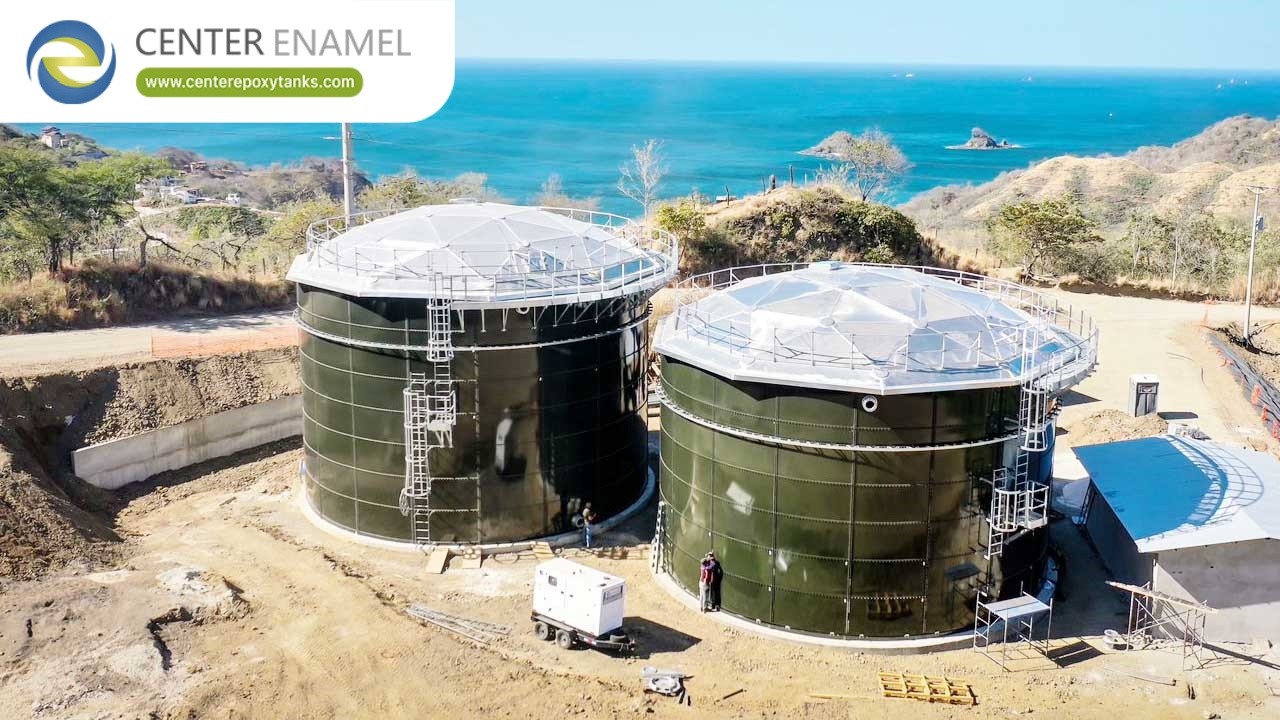
Aluminum Dome Roofs For Wastewater And Municipal Tanks
Wastewater and municipal tanks sit in some of the most corrosive industrial atmospheres, with hydrogen sulfide and sustained moisture attacking conventional covers. This article covers why aluminum domes are suited to wastewater service and a delivered municipal reference.
The Wastewater Corrosion Problem
Anaerobic and settled wastewater generate hydrogen sulfide, which oxidizes to sulfuric acid in the vapor space and attacks steel and concrete covers. Sustained moisture and cleaning chemicals add to the load.
Covers in this service need intrinsic corrosion resistance, not a coating that erodes.
Aluminum In H2S Atmospheres
Aluminum's stable oxide layer resists the sulfide and acid environment better than unprotected steel and avoids the spalling that concrete suffers. Its corrosion resistance is intrinsic — no paint to fail.
This is why aluminum is frequently selected for odor-control and covered municipal tanks.
Odor Containment
A sealed aluminum dome with gasketed nodes and rim forms a continuous barrier that supports odor-collection systems. Penetrations for ducts are framed and sealed in aluminum.
Containing odor at the source reduces neighbor complaints and compliant emissions.
Access For Mixers And Pumps
Clear-span geometry lets mixers, pumps and pipework hang or pass without column conflict. Manways and equipment penetrations are framed into the dome.
Because there are no internal columns, there are no column-seal failure points in the corrosive vapor space.
Biogas Interface (Where Applicable)
For anaerobic tanks, the dome can support biogas collection piping and interfaces with gas holders. Detailing follows the process design and the applicable codes.
The lightweight aluminum keeps the roof load modest on the tank and foundation.
Reference: Saudi Municipal Wastewater (2023)
A Saudi Arabia municipal-wastewater project used GFS tanks with aluminum dome roofs: 5 units at Ø24.06 m × 4.85 m, total 11,020 m³ (2023). The dome was the supplied cover on GFS bolted tanks.
Coordination With Tank And Process
The dome supplier must coordinate with the tank and process engineers on penetrations, loads and any gas collection. The rim reaction is a load on the shell and foundation.
Early coordination prevents field modification of aluminum, which is difficult.
Maintenance In Corrosive Service
Aluminum needs no repainting even in H2S atmospheres, a major advantage over steel that requires ongoing coating programs in the same environment.
Inspection focuses on seal continuity and penetration details.
Specification Checklist
Confirm atmosphere (H2S level), required odor containment, penetrations (mixers/pumps/ducts), access, and the governing code for the dome and tank.
Require stamped calculations that include the corrosive-service context where it affects detailing.
Common Pitfalls
Under-specifying penetrations for process equipment, and treating the dome and tank as separate when they share rim loads.
Resolve process interfaces in design to avoid cutting aluminum on site.
When A Dome Fits Wastewater
For municipal and industrial wastewater where odor, corrosion and access converge, an aluminum dome is a low-maintenance, corrosion-resistant solution.
Pair it with a compatible tank system (GFS/FBE) and process design.
Odor Compliance Context
Many utilities operate under odor or emissions expectations for covered tanks. The dome provides the physical barrier; the odor-control system (ducts, treatment) is designed separately and interfaces through framed penetrations.
Specify the odor pathway early so the dome supports - rather than conflicts with - the treatment train.
Synergy With Tank Lining
On GFS or FBE tanks, the dome complements the corrosion-resistant shell lining; both resist the wastewater atmosphere without ongoing coating programs.
Coordinating the dome penetration seals with the tank's own appurtenances avoids duplicate or conflicting interfaces at the rim.
H2S Concentration And Detailing
The severity of the sulfide atmosphere informs detailing such as penetration sealing and any process interfaces. While aluminum resists the environment, the system design should reflect the actual exposure.
Capture the expected conditions in the specification so the supplier details accordingly.
Mixer And Process Penetrations
Wastewater tanks often carry mixers, pumps and ducts through the roof. Frame these in aluminum and seal them; plan their positions before fabrication to avoid cutting on site.
Clear span simplifies routing of this equipment without column conflict.
Designing For The Vapor Space
In wastewater service the vapor space is where corrosion and odor live. The dome's sealed geometry and inert aluminum keep that space contained and resistant, while process penetrations for mixers, pumps and ducts are framed and gasketed.
Detailing the vapor space as a system - cover plus process interfaces - is what makes the solution durable rather than a cover alone.
Lifecycle In Corrosive Service
Over years in H2S and moisture, steel covers accrue coating and repair cycles; aluminum does not. The maintenance gap is the strongest argument for aluminum in wastewater, where the atmosphere is among the harshest industrial exposures.
Owners should weigh this gap explicitly when comparing alternatives for municipal and industrial tanks.
Long-Term Wastewater Performance
In sustained H2S service, the absence of a coating program is the aluminum dome's defining advantage; inspection stays focused on seals and penetrations rather than corrosion repair.
Document the as-built penetrations so future process changes are added without cutting aluminum in the field, preserving both structure and low-maintenance profile.
Challenge | Aluminum dome response |
H2S / acid vapor | Intrinsic oxide resistance, no paint |
Odor | Sealed gasketed barrier + duct penetrations |
Access | Clear span, framed equipment penetrations |
Maintenance | No repaint in corrosive service |
Project | Config | Total vol | Year |
Saudi municipal wastewater | 5 × Ø24.06 m × 4.85 m (GFS) | 11,020 m³ | 2023 |
Project Case Reference
Saudi Arabia — Municipal wastewater. Tank: GFS (Glass-Fused-to-Steel) bolted tank. Configuration: 5 units, Ø24.06 m × 4.85 m. Total volume: 11,020 m³. Year: 2023.
From case_anchors.py: aluminum dome roof was the supplied cover on these GFS municipal-wastewater tanks (B-grade; dome is cover, tank body GFS).
Frequently Asked Questions
Why aluminum for wastewater?
Its stable oxide resists H2S/acid vapor intrinsically, avoiding the coating failure and concrete spalling seen in this service.
Does it contain odor?
Yes — a sealed gasketed dome supports odor-collection ducting through framed aluminum penetrations.
Can mixers and pumps pass through?
Yes; clear span allows equipment penetrations without column conflict.
What reference exists?
A Saudi Arabia municipal-wastewater project (2023): 5 GFS tanks, Ø24.06 m × 4.85 m, 11,020 m³, with aluminum dome roofs.
How is maintenance different?
No repainting is needed even in H2S atmospheres; inspection focuses on seals and penetrations.
What to coordinate?
Penetrations, rim loads on tank/foundation, and any biogas collection with process engineers.
Work With Center Enamel
Center Enamel (Shijiazhuang Zhengzhong Technology Co., Ltd) is a Chinese manufacturer of bolted storage tanks and aluminum geodesic dome roofs, established in 2008. Its product range covers Glass-Fused-to-Steel (GFS) tanks, Fusion-Bonded Epoxy (FBE) tanks, galvanized and stainless-steel tanks, welded tanks, pressure vessels, and aluminum dome roofs. The company holds ISO 9001, NSF, WRAS, FM, CE/EN 1090 and ISO 28765 certifications for its tank lines and designs aluminum domes to AWWA D108, API 650, ADM 2015, ASCE 7-10 and IBC 2012. It operates automated enamel-plate production and has supplied engineering projects across drinking-water, wastewater, biogas, fire-water and industrial-storage applications.
For aluminum geodesic dome roofs engineered to AWWA D108, API 650, ADM 2015, ASCE 7-10 and IBC 2012, contact Center Enamel to discuss your tank cover, span and site requirements.


