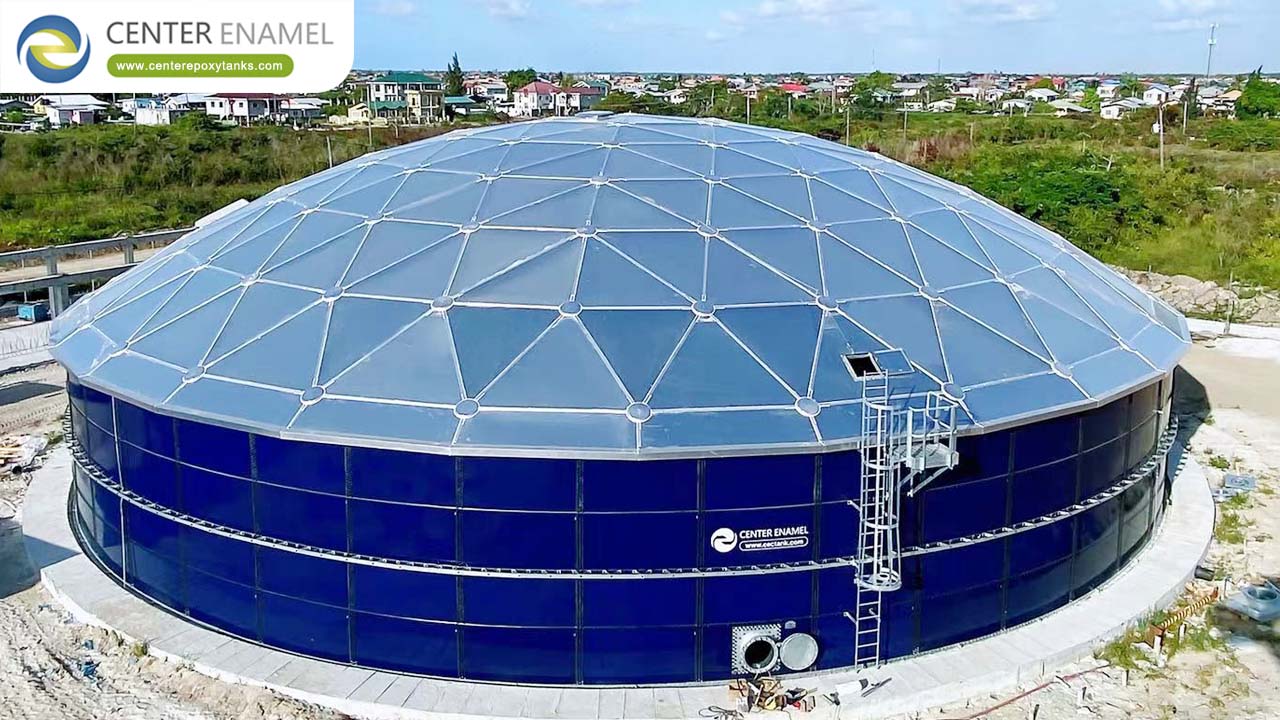
Aluminum Dome Roof Covering Solutions For Potable Water And Wastewater Storage
Water and wastewater storage look like opposite problems. Potable water has to stay clean enough to drink; wastewater has to be contained neatly enough that nobody smells it. Yet both are commonly covered with the same aluminum dome technology — because the structural engineering is shared and only the headspace specification changes.
This article covers the dual duty: what potable service demands of a cover, what wastewater service demands, where the two specifications diverge, and how one supply scope covers both.
One Cover Technology, Two Duties
The aluminum dome is a clear-span, weather-tight, corrosion-resistant structure. Those properties serve potable water storage — where the cover keeps contamination out and light off the water — and wastewater storage — where the cover keeps odors and gases in and weather out. The structure does not care which product is underneath.
What changes between the duties is the specification: the material compatibility set, the headspace management and the inspection regime. The procurement advantage is that a supplier who engineers both can standardize the structure and specialize the details.
Potable Water: The Hygiene Duty
Potable duty is a hygiene specification. The cover excludes windblown dust and debris, bird and insect activity, rainfall ingress and unauthorized access, and it blocks the light that drives algae and biofilm growth. Every opening is a designed, secured penetration — nothing is field-cut.
Material compatibility adds a second layer: components in contact with the stored water or its condensate align with drinking water standards, and the coating system under the cover is specified and documented for potable service.
Hygiene Requirement | Design Response | Verification |
Contamination exclusion | Sealed envelope, gasketed panels | Hatch and seal inspection |
Light exclusion | Opaque cover envelope | Visual check at access |
Material compatibility | NSF/WRAS-aligned components | Documented approvals |
Secure access | Lockable hatches, screened vents | Hardware inspection |
Wastewater: The Odor And Gas Duty
Wastewater duty is a containment specification. The covered headspace carries hydrogen sulfide, moisture and other treatment gases, and the cover is the barrier that keeps them out of the surrounding air. Odor complaints are an operational failure with regulatory consequences, and the cover is the first control.
The headspace also attacks the structure: H2S and moisture are aggressive to steel details, so every component in the headspace — attachment rings, frames, penetration sleeves — is specified for the atmosphere rather than for structural duty alone.
Where The Duties Diverge
The divergence is systematic rather than incidental. Potable duty optimizes for exclusion and compatibility; wastewater duty optimizes for containment and corrosion resistance. The table below sets the two side by side — the structure above both rows is identical.
Design Aspect | Potable Water Service | Wastewater Service |
Primary function | Contamination and light exclusion | Odor and gas containment |
Headspace chemistry | Benign; condensation management | H2S, moisture; corrosion allowance |
Material set | Drinking-water-aligned components | Corrosion-specified details |
Ventilation | Minimal; screened vents | Managed; gas-tight where required |
Inspection focus | Hygiene of access and seals | Corrosion of headspace details |
The Shared Structural Engineering
Both duties carry the same load set: dead load, live and maintenance load, snow, wind and seismic, with the reactions delivered into the tank wall through a designed ring beam. The triangulated geodesic geometry spans the full diameter without internal structure, keeping the volume below completely clear.
The shared engineering is where standardization earns its keep: one structural system, one fabrication line, one erection methodology, with the duty-specific details applied at the interface and the material specification.
Headspace Management In Both Services
The covered headspace behaves differently in each duty, and both have to be managed. Potable headspaces need condensation control and minimal ventilation; wastewater headspaces need ventilation or gas-tight detailing depending on the containment objective, plus drainage where condensate collects.
The management set is specified together — ventilation, drainage and inspection access — because a cover that seals the tank without managing the headspace trades an external problem for an internal one.
Materials: One System, Two Specifications
The aluminum structure is common to both duties: the alloy’s oxide film is stable in atmospheric service, and the connection and fastener specification governs durability. What differs is the material set for the details — drinking-water-aligned gaskets and seals on potable duty, corrosion-specified components in wastewater headspaces.
The specification discipline is to make the duty explicit at procurement, so the material set is ordered for the service rather than defaulted to a standard bill of materials.
Access And Inspection In Both Duties
Both duties need the cover inspectable without removal: hatches for personnel and equipment, positioned for safe entry, with the internal surface and the cover underside visible from the access points. Confined-space procedures govern every entry in either service.
The inspection focus differs — hygiene of seals and access on potable duty, corrosion of headspace details on wastewater duty — but the access design that enables both is the same.
Standards And Certification
Potable duty adds drinking water component standards to the certification set; wastewater duty adds the odor and emission control requirements the installation operates under. In both cases the dossier — material certificates, fabrication records, the as-built survey — is the evidence.
The procurement rule is to require the certification set at award rather than at handover, because it cannot be reconstructed after the fact.
Choosing Between Flat And Dome For Each Duty
The flat-versus-dome decision follows the duty more than the product. Flat roofs are the economical sealed surface where clear-span volume is not the objective; domes add volume gain, rain shedding without ponding and a cleaner inspection geometry, and suit larger diameters where the geometry pays for itself.
On wastewater tanks the flat roof is common because the volume gain is rarely worth the rise; on potable municipal storage the dome is common because the column-free volume and the rain shedding are both valued.
Center Enamel Water And Wastewater Covers
Center Enamel supplies aluminum dome and flat covers across potable water and wastewater services, with the duty-specific specification applied at the interface, the headspace and the material set — and the structure, fabrication and erection standardized across both. Combined tank-and-roof supply keeps the interface engineering under single accountability.
For dual-service covering, the standard we hold is the one each duty demands: hygiene-exclusion detailing on potable projects, corrosion-specified headspace details on wastewater projects, and verified geometry on both.
Project Case Study
A potable water project in Ghana required covered storage with the tank and roof supplied as one engineered package. Center Enamel supplied two glass-fused-to-steel bolted tanks at 12.23 m diameter by 15.6 m height each, totaling 3,656 m3, configured with an aluminum flat roof for the covered potable water duty.
The two-tank configuration matched the project’s storage strategy, allowing one tank to be taken out of service for inspection or cleaning while the other held supply. The combined tank-and-roof scope delivered the interface engineering — attachment, sealing and access — under single accountability. The project was delivered and completed in October 2022.
Project Reference | 01 Ghana Drinking Water 202210 |
Location | Ghana |
Application | Potable Water |
Product / Technology | Glass-Fused-to-Steel (GFS) Bolted Tank |
Tank Count | 2 |
Tank Dimensions | φ12.23*15.6m(H), 2 units |
Total Volume | 3656 m3 |
Completion | Delivered and completed 2022-10 |
Supply Scope Note | A relevance grade to this topic |
About Company
Shijiazhuang Zhengzhong Technology Co.,Ltd(Center Enamel) is a professional manufacturer dedicated to the design and fabrication of bolted storage tanks since 2008. Our products range includes Glass-Fused-to-Steel (GFS) tanks, fusion bonded epoxy tanks, stainless steel tanks, galvanized steel tanks and aluminum geodesic dome roofs. With professional enameling R&D team and nearly 200 enameling patents, Shijiazhuang Zhengzhong Technology Co.,Ltd has become the leader in bolted tanks industry of Asia. Our products are certified to ISO9001, NSF61, EN1090, ISO28765, WRAS ,FM, LFGB, BSCI, IS0 45001 and other international standards.
Shijiazhuang Zhengzhong Technology Co., Ltd is not only the first manufacturer in China which produces Glass-Fused-to-Steel tanks, but also the most experienced professional bolted tanks manufacturer in Asia.The engineering & design, product testing and quality system of Center Enamel Glass-Fused-to-Steel tanks is in strict accordance with AWWA D103-09, OSHA, ISO 28765, NSF/ANSI 61, NFPA and other international standards. Until 2023, Center Enamel bolted tanks have been exported to more than 100 countries including USA, Australia,Canada, Malaysia, Indonesia, Russia, UAE, Panama,Brazil and South Africa etc., the superior tank quality and prompt service gains us worldwide recognition.
As an outstanding containment and cover system provider with decades of industry experience, Shijiazhuang Zhengzhong Technology Co., Ltd sincerely expects to establish long-term cooperation with the local partners throughout the world and make continuous contribution to the development of the industry.
Suggested CTA
Center Enamel delivers aluminum dome engineered for potable and wastewater storage duty, with dome covers across water and wastewater services. Contact our engineering team for engineering guidance on your next aluminum dome roof potable water wastewater project — including sizing, standards compliance and delivery scheduling.
Frequently Asked Questions
Q: Can the same dome technology cover both potable water and wastewater tanks?
A: Yes. The structural engineering is shared; what changes is the specification — contamination exclusion and drinking-water-aligned materials for potable duty, odor and gas containment with corrosion-specified headspace details for wastewater duty.
Q: What does potable service demand of a cover?
A: A sealed exclusion envelope — gasketed panels, secured hatches, screened vents, no field-cut penetrations — plus light exclusion to control algae and biofilm, and material compatibility with drinking water standards for contact components.
Q: What does wastewater service demand of a cover?
A: Odor and gas containment as the primary function, with every steel detail in the headspace specified for the H2S and moisture atmosphere rather than for structural duty alone, plus headspace ventilation or gas-tight detailing as the containment objective requires.
Q: Why is flat covering common on wastewater tanks?
A: Because the clear-span volume gain of a dome is rarely worth the rise on wastewater duty, where containment and corrosion resistance govern. Flat roofs are the economical sealed surface for that objective.
Q: What headspace management does a covered tank need?
A: Ventilation, drainage and inspection access specified together. A cover that seals the tank without managing the headspace trades an external corrosion or odor problem for an internal one.
Q: Why require the certification set at award rather than handover?
A: Because the dossier — material certificates, fabrication records and the as-built survey — cannot be reconstructed after the fact, and both potable compliance and odor control programs depend on it as evidence.


