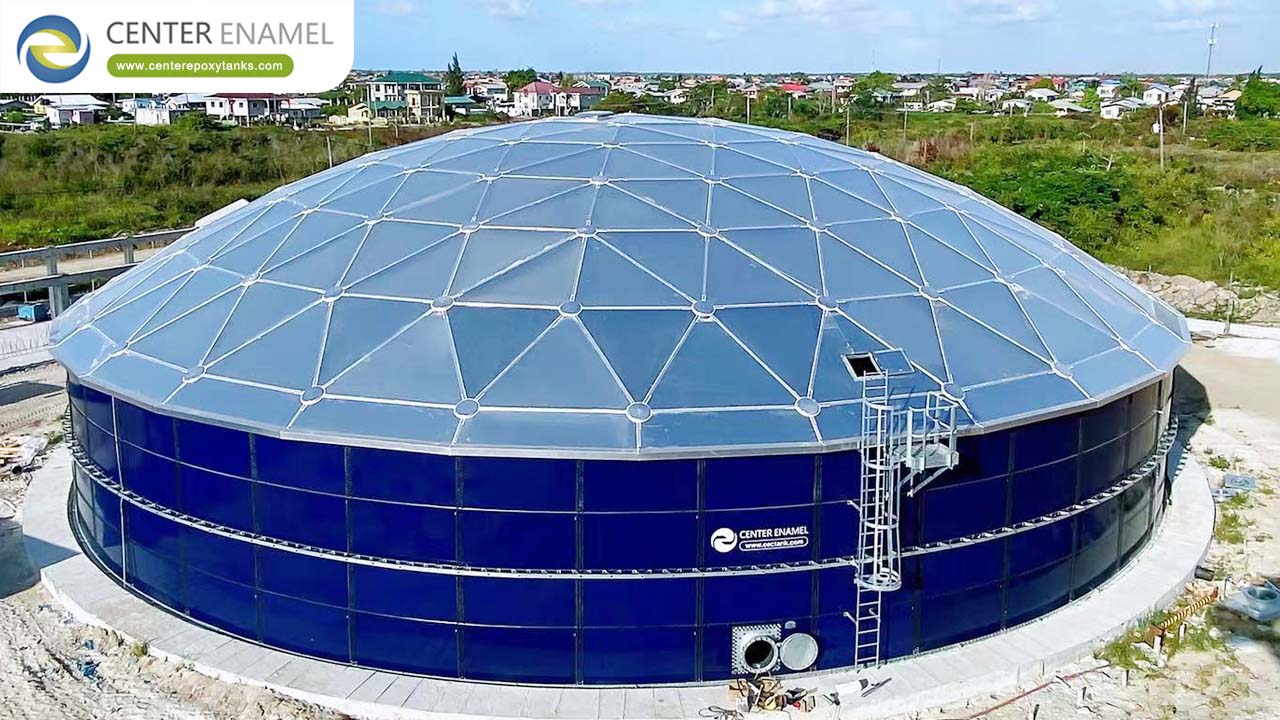
Aluminum Dome Roofs for Tank Terminals and Tank Farms
Tank terminals and refineries specify aluminum geodesic dome roofs over tanks they already operate mainly to gain a column-free fixed cover that protects the tank and any internal floating deck from weather, debris and external ignition sources, while avoiding the downtime and hot work of a welded steel roof replacement. The dome is bought as an operational and risk decision, not as a product upgrade. Its value shows up as lower maintenance on a corrosion-resistant cover, simpler floating-roof inspection access and the option to install over a tank that stays partly in service. The dome is a fixed cover referenced by frameworks such as API 650 Appendix G and API 653 retrofit practice; naming a standard is a designation, not proof of compliance. It does not by itself guarantee any emission reduction, and the terminal still owns the floating-roof and vapor-control responsibility. The right enquiry states diameter, product, atmosphere and the install window before a calculation is returned.
What a terminal is buying when it buys a dome
A terminal buying a dome is buying a fixed, column-free cover for a tank it already runs, and the purchase should be framed as an operational risk decision rather than a materials upgrade. The cover keeps rain, snow and debris out of the product, shields an internal floating deck from ultraviolet light and wind, and removes the internal columns that obstruct mixer, heater and clean-out access. For a terminal with many tanks, the repeatability of a bolted aluminum system across the farm is also part of the value. The buyer should separate the cover benefit from any emission claim, because the dome alone does not manage vapor; that remains the floating roof and the rim seal's job, which the terminal must still specify, inspect and maintain on its own merits.
Protecting floating roofs in active terminals
Many terminal tanks already carry an internal or external floating roof, and the dome is specified as the fixed cover above it. The dome then reduces wind and weather acting on the floating deck, limits debris ingestion and can lower the external ignition exposure compared with an open-top arrangement. It does not replace the floating roof's rim seal or its vapor-control function. The interaction matters at inspection: a dome can make visual access to the deck easier or harder depending on the access hatches and walkway design, so the submittal should show how the deck is reached for the API 653 inspection cadence. Treating the dome as a floating-roof substitute is a specification error the terminal should avoid by writing the two scopes separately.
Single-source turnkey versus split supply
A terminal can buy the dome as a single package that includes design, modules and erection, or split the supply so the tank fabricator, the dome supplier and the installer are separate contracts. Single-source simplifies the interface and the responsibility for the load transfer at the shell, but it concentrates schedule risk on one party. Split supply can lower cost and let the terminal reuse an existing erector, but it forces the terminal to own the connection detail between the dome thrust and the tank shell. Neither is universally right; the choice should follow the terminal's own engineering capacity and the contract strategy, and the submittal should name who verifies the ring-beam transfer.
Retrofit without taking the tank out of service
A practical reason terminals choose the dome is the retrofit envelope. Because the members are bolted and light, many domes are assembled inside the tank or lowered over the shell, which can reduce the hot work and the outage compared with cutting off a welded roof. Whether the tank can stay in service depends on the product, the access and the site safety case, and no universal claim applies. The erection plan should state the sequence, the confined-space and hot-work controls, and the isolation required. The terminal should confirm the outage estimate in writing before committing, because a wrong assumption here affects the whole product movement plan for the farm.
Emission and weather consequence, stated honestly
The dome contributes to vapor management only indirectly, by protecting the floating roof and sealing the fixed cover. It is not itself a vapor-control device, and any emission reduction belongs to the floating roof, rim seal and vent system. A terminal should not credit the dome with a reduction percentage it cannot document for the specific tank. What the dome does change is weather ingress, external debris and the corrosion load on the cover, which reduce operating annoyance and repainting. Stating this boundary clearly keeps the environmental case honest and avoids a regulatory misstatement if the dome is later cited in a permit or a reporting record for the site.
Inspection access and the API 653 cadence
Terminals plan around inspection intervals, and the dome must not block them. API 653 sets the external inspection cadence for storage tanks, and the floating deck still needs access for its own checks. The dome submittal should show permanent access hatches, a walkway if needed, lighting provisions and a safe route to the deck, so the inspection does not become a separate shutdown event. The terminal should ask the supplier to map the access against the deck inspection points, because a cover that is easy to build but hard to inspect shifts cost to every future turnaround. Access is a design input, not an afterthought, for a tank that stays in service for decades.
How codes name the terminal dome (designation, not compliance)
For terminal work the dome is usually discussed under API 650 Appendix G for the roof form and API 653 for the in-service context, with AWWA D108 relevant where the tank is a water or fire-water service. These are designations that point to a method, not certificates of compliance for a specific tank. Compliance requires the actual calculation, the edition cited, the load combinations and the engineer's acceptance. A terminal engineer should record the edition and request the calculated outputs, because the same standard name can cover different editions and different acceptance criteria, and the permit file should show which one actually applies to the tank being covered.
What the terminal must put in the enquiry
The enquiry should state the tank diameter, the stored product and its vapor class, the site atmosphere and corrosion exposure, whether the tank must remain in service during install, and any roof-hung equipment with its loads. It should ask the supplier to return the code basis and edition, the aluminum alloy, the jointing method and a load calculation covering wind, snow and seismic. It should also ask for the access layout and the erection sequence with the outage estimate. Writing these lines turns a vague cover request into a submittal the terminal can check as a defined geometry rather than accept on the strength of a brochure claim about maintenance freedom.
Terminal dome specification decision
Use this to frame the dome as a terminal risk and operations decision before requesting a calculation.
Terminal driver | What the dome changes | What to put in the enquiry | Watch-out |
Floating deck protection | Shields deck from weather and debris | State deck type and access needs | Dome is not the vapor control |
Outage avoidance | Bolted retrofit, lower hot work | Ask for outage estimate in writing | Service-installed only if safe |
Farm repeatability | Same bolted system across tanks | Request standard module sizes | Confirm interface ownership |
Inspection cadence | Must not block API 653 access | Require access hatch and walkway map | Access is a design input |
Terminal enquiry input checklist
These inputs convert a cover request into a verifiable submittal.
Input | Why the terminal needs it | Record to request |
Tank diameter and product | Drives span and load case | Tank data sheet |
Atmosphere and corrosion class | Sets alloy and coating logic | Site corrosion survey |
Install window and in-service state | Defines erection sequence | Erection plan with outage |
Roof-hung equipment loads | Must enter the calculation | Load schedule |
Project Case Study
The batch allocation register assigns CE-R299 (match grade A) to this page as its single formal project reference. The source row records a Glass-Fused-to-Steel (GFS) Bolted Tank supply for a tank in Saudi Arabia, with completion recorded as 2023-12. The row lists 5 tank(s) and a recorded capacity of 11020; roof type is recorded as Aluminum Dome and supply scope as Tank + Roof. These values are transcribed from the supplied project case library and are not supplemented with inferred dimensions, per-tank volumes or outcomes.
Evidence boundary. Row CE-R299 records a GFS + Roof supply in Saudi Arabia (11,020 m3, 5 tanks, completion 2023-12) - a multi-tank terminal/farm-scale reference. Used to illustrate terminal-scale dome supply; no per-tank volumes inferred.
Recorded data gaps for this row: None recorded. The case row does not include certificate numbers, test reports, commissioning results, contract values or client names, so none are claimed here. This Project ID is the formal case for this page only; it is not used as project evidence, an anchor-text summary or an image caption on any other article in this batch.
Frequently Asked Questions
Q1. What does a terminal actually buy when it specifies a dome?
It buys a fixed, column-free cover for a tank it already runs, framed as an operational risk decision rather than a materials upgrade. The cover keeps weather and debris out and removes internal columns that block access. The terminal still owns the floating roof and vapor control, which the dome does not replace or credit for emission reduction on its own.
Q2. Which document proves a terminal dome meets API 650 Appendix G?
No page proves it. The submittal should name the API 650 edition, show the Appendix G dome calculation, list the load combinations and carry the reviewing engineer's acceptance. A code name in a proposal is a designation, not compliance evidence for the tank. Request the calculation and the exact edition cited before acceptance.
Q3. Can a dome be installed without taking the tank out of service?
Sometimes, because the bolted aluminum members can be assembled inside or lowered over the shell, but it depends on the product, access and site safety case. No universal claim applies. The erection plan should state the sequence, the hot-work and confined-space controls, and the outage required, and the terminal should confirm that estimate in writing first.
Q4. Why is floating-roof access a hold point rather than a note?
The internal floating deck still needs inspection under the API 653 cadence, and a dome that blocks access shifts cost to every future turnaround. The submittal should map hatches, walkways and a safe route to the deck against the inspection points, so the cover is built around the decades of service the tank will see.
Q5. How does the dome change the emission evidence a terminal must keep?
It changes it only by protecting the floating roof; the dome is not a vapor-control device and should not be credited with a reduction figure the tank cannot document. The terminal should record the floating roof, rim seal and vents as the emission control, and keep the dome's role limited to weather and debris protection in the permit file.
Q6. What is deliberately out of scope on this terminal page?
This page frames the dome as a terminal operations decision. It does not quote a price, perform a design for a named tank, certify compliance, or claim a measured emission reduction. Cost and a worked design belong to the project submittal and to separate topics, not to this specification page.
Q7. Which source supports the retrofit and inspection references?
The retrofit and API 653 inspection context reflects standard terminal practice referenced by API 650 Appendix G and API 653 designations, observed at snippet level in the 2026-11-14 SERP sample. The standards are referenced here; the specific editions and any site-specific safety case are not provided by this page.
Q8. How should the enquiry be written to avoid a vague cover request?
State diameter, product and vapor class, atmosphere, in-service state during install, and any roof-hung loads. Ask for the code basis and edition, alloy, jointing method, a wind-snow-seismic calculation, the access layout and the erection outage. Those lines turn a brochure comparison into a submittal the terminal can check as a defined geometry.
Conclusion
For a terminal or tank farm, the aluminum dome is most usefully bought as a fixed, column-free cover that protects the tank and any internal floating deck, eases inspection access and can be installed with less hot work than a welded roof replacement. It is referenced, not certified, by API 650 Appendix G and API 653, and the terminal should record the edition and the calculated outputs rather than accept a code name. The dome does not manage vapor and should not be credited with an emission figure the tank cannot document. A terminal that leaves this page should be able to write an enquiry that returns a verifiable submittal instead of a maintenance claim.
Talk to an Engineer
To scope a terminal dome properly, send the tank diameter, stored product and vapor class, site atmosphere, whether the tank must stay in service during install, and any roof-hung equipment with its loads. Ask each supplier for the code basis and edition, the aluminum alloy and temper, the jointing method, a load calculation for wind, snow and seismic, the access layout and the erection outage estimate. With those inputs the dome can be checked as a defined cover for the actual tank and weighed against a welded roof on lifecycle cost and turnaround impact, rather than accepted on a maintenance or emission claim that the submittal does not actually support.
About Center Enamel
Shijiazhuang Zhengzhong Technology Co., Ltd (Center Enamel) has designed and fabricated bolted storage tanks since its registration in 2008; the founding team's enamelling work dates to 1989. The product range covers Glass-Fused-to-Steel (GFS), Fusion Bonded Epoxy (FBE), stainless steel and hot-dip galvanized tanks, and aluminum geodesic dome roofs. Certifications and standard references in the supplied fact base are scoped per product line, not held as a blanket claim for every product. No performance, service life or project outcome beyond the cited sources is claimed here.


