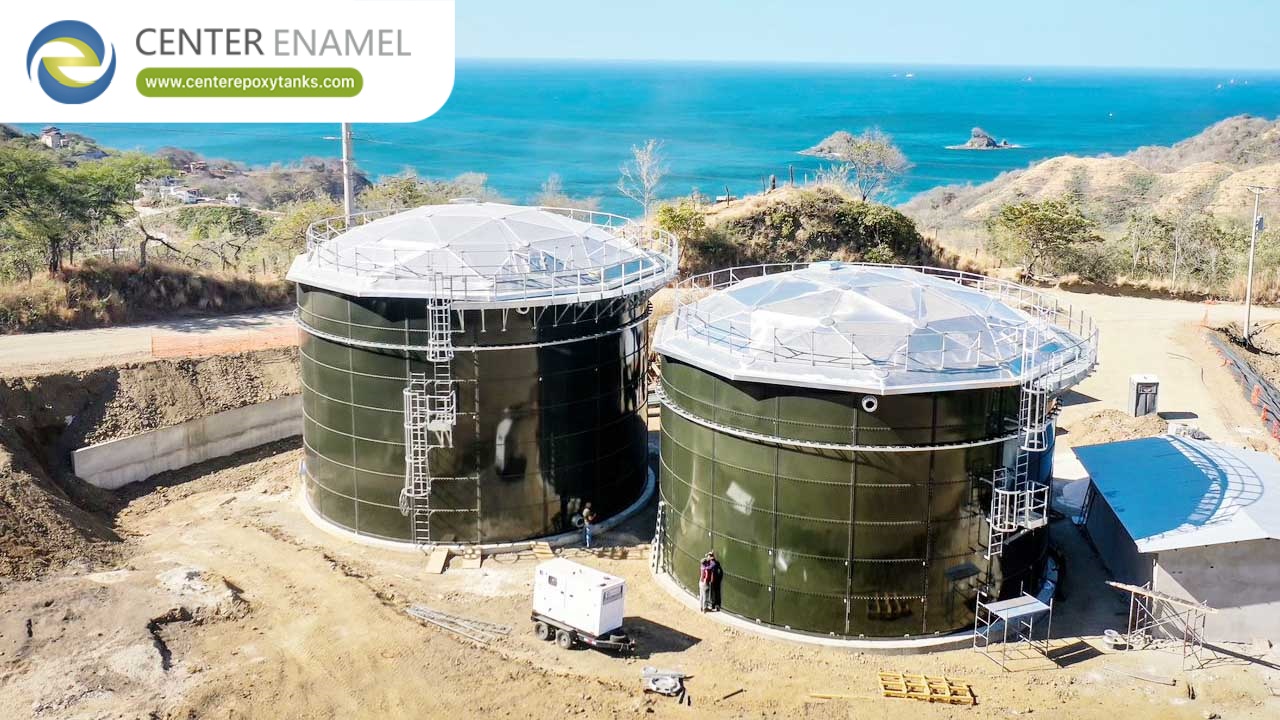
Aluminum Dome Roofs For Petroleum And Fuel Storage Tanks
Fuel storage demands covers that control flammable vapor, avoid ignition sources and meet tank codes. This article covers aluminum geodesic domes on petroleum and fuel tanks: vapor management, API 650 context, explosion venting and spark prevention, with a large diesel-storage reference.
Fuel-Storage Cover Requirements
On fuel tanks the cover must control vapor loss, exclude ignition sources, and integrate with the tank's pressure/vacuum and fire systems. Weight on the shell and foundation also matters.
Aluminum's light weight and non-sparking character are relevant advantages in this service.
Flammable-Vapor Control
A sealed aluminum dome with gasketed nodes and rim restricts vapor escape and supports the tank's vapor-recovery or blanket-gas interface. Penetrations for vents and instruments are framed and sealed.
Vapor control is a system feature — the dome is one element coordinated with the tank's breathing and relief design.
API 650 Context
Where the dome sits on a storage tank, API 650 governs the tank; the dome is designed to AWWA D108 with ADM 2015 members, and the interface follows the project's applicable codes.
The governing code set is confirmed per project; the dome supplier must coordinate the rim reaction with the tank design.
Explosion Venting And Pressure Relief
Relief and venting are provided by the tank's designated devices, not the dome structure alone. The dome accommodates these penetrations with framed aluminum curbs and seals.
Detailing follows the process safety design; the dome is the weather and vapor barrier, not the primary relief device.
Spark Prevention And Grounding
Aluminum is non-sparking in normal handling. Electrical bonding and grounding follow the tank's cathodic-protection and static-control design, coordinated with the overall system.
Tool and access procedures on flammable sites follow site safety rules regardless of roof material.
Reference: Diesel-Storage Dome (Cover-Only)
A Mozambique diesel-tank project is cited in the manufacturer's dome listing at 72.39 m diameter — among the largest referenced dome covers. This is a COVER-ONLY reference (diameter and application only; no tank material or volume is provided in the source), used here to illustrate large-diameter fuel-service capability.
Because the source gives only diameter and application, it is disclosed as a cover-only reference, not a full tank case.
Reference: Seawater Desalination (FBE Tank)
A Chile seawater-desalination project used FBE-coated tanks with aluminum dome roofs: 2 units at Ø17 m × 14.5 m, total 6,578 m³ (2025). The dome was the supplied cover on FBE bolted tanks.
Coordination With Tank And Safety Systems
The dome supplier coordinates penetrations, loads and relief interfaces with the tank and process-safety engineers. The rim reaction loads the shell and foundation.
Early coordination prevents field modification of aluminum on a live or classified site.
Specification Checklist
Confirm applicable codes (API 650 tank + dome standards), vapor/relief interface, penetration schedule, bonding/grounding, and the site's safety classification.
Require stamped calculations and a method statement aligned with fuel-site safety.
Common Pitfalls
Treating the dome as the relief device, omitting penetration coordination, and ignoring rim loads on an existing tank not detailed for a dome.
Resolve safety interfaces in design, not at installation.
When A Dome Fits Fuel Service
For fixed-roof fuel tanks needing vapor control, low weight and a non-sparking, low-maintenance cover, an aluminum dome is a strong candidate within the project's code framework.
It must be engineered as part of the tank's pressure, relief and grounding system.
Static Electricity And Bonding Detail
Aluminum is non-sparking in normal handling, but electrical continuity, bonding and grounding follow the tank's static-control and cathodic-protection design.
All metallic appurtenances on the dome are included in the bonding scheme so no isolated conductive path can accumulate charge on a flammable site.
Interface With Containment
Where secondary containment or spill control applies, the dome and its penetrations are detailed to remain compatible with the bund or dike design.
The lightweight aluminum keeps roof load modest on tank and foundation, an advantage where containment structures were not originally sized for heavy covers.
Vent And Relief Sizing Interface
The tank's pressure-vacuum and relief devices are sized by the process design; the dome accommodates them through framed penetrations. The dome is not the relief device itself.
Coordinate sizes and locations early so the cover supports - rather than constrains - the safety system.
Hot-Work And Site Safety
On fuel sites, any hot work follows strict permits regardless of roof material. Aluminum's non-sparking character helps but does not replace procedural safety controls.
The method statement aligns dome work with the site's flammable-atmosphere rules.
Process Safety Integration
On fuel tanks the dome is one element of a process-safety system that includes relief, vapor recovery or blanket gas, bonding and grounding. The dome accommodates these through framed penetrations and supports the system rather than replacing any part of it.
The supplier coordinates with the process-safety engineer so every penetration serves a defined safety function and is sealed appropriately.
Working On A Live Site
Fuel-site rules govern hot work, access and ignition control regardless of roof material. Aluminum's non-sparking nature is helpful but never a substitute for procedural safety, and the method statement reflects that.
Planning dome work around the site's flammable-atmosphere controls keeps the project safe and compliant.
Requirement | Dome role |
Vapor control | Sealed gasketed barrier + vent penetrations |
Relief / venting | Accommodates tank devices (not primary relief) |
Spark prevention | Non-sparking aluminum + bonding/grounding |
Weight | Light load on shell/foundation |
Reference | Note |
Mozambique diesel (72.39 m) | Cover-only (diameter+app); no tank vol |
Chile desalination (2025) | 2 × Ø17 m × 14.5 m FBE, 6,578 m³ |
Project Case Reference
Mozambique — Diesel / Petroleum (cover-only reference). Tank: Not specified in source (cover-only dome reference). Configuration: Diameter 72.39 m. Total volume: Not specified (cover-only) m³. Year: Cited in catalog.
COVER-ONLY reference from brand_facts DOME_PROJECT_REFERENCES: only diameter (72.39 m) and application (diesel) are given; no tank material or volume. Disclosed as not a full tank case. A Chile FBE desalination anchor (2025, 6,578 m³) is also referenced in this article.
Frequently Asked Questions
Can aluminum domes be used on fuel tanks?
Yes, as part of the tank system — controlling vapor and accommodating relief/vent penetrations within the project's codes.
Is the dome the explosion relief?
No. Relief is provided by the tank's designated devices; the dome accommodates them with framed penetrations.
Why aluminum for fuel service?
Light weight, non-sparking character and no repaint maintenance.
What is the diesel reference?
A Mozambique diesel-tank project cited at 72.39 m diameter — a COVER-ONLY reference (no tank material/volume in source), disclosed as such.
Any FBE-tank reference?
Yes — a Chile seawater-desalination project (2025): 2 FBE tanks, Ø17 m × 14.5 m, 6,578 m³, with aluminum dome roofs.
What to coordinate?
Codes (API 650 + dome), vapor/relief interface, bonding/grounding, penetrations and rim loads.
Work With Center Enamel
Center Enamel (Shijiazhuang Zhengzhong Technology Co., Ltd) is a Chinese manufacturer of bolted storage tanks and aluminum geodesic dome roofs, established in 2008. Its product range covers Glass-Fused-to-Steel (GFS) tanks, Fusion-Bonded Epoxy (FBE) tanks, galvanized and stainless-steel tanks, welded tanks, pressure vessels, and aluminum dome roofs. The company holds ISO 9001, NSF, WRAS, FM, CE/EN 1090 and ISO 28765 certifications for its tank lines and designs aluminum domes to AWWA D108, API 650, ADM 2015, ASCE 7-10 and IBC 2012. It operates automated enamel-plate production and has supplied engineering projects across drinking-water, wastewater, biogas, fire-water and industrial-storage applications.
For aluminum geodesic dome roofs engineered to AWWA D108, API 650, ADM 2015, ASCE 7-10 and IBC 2012, contact Center Enamel to discuss your tank cover, span and site requirements.


