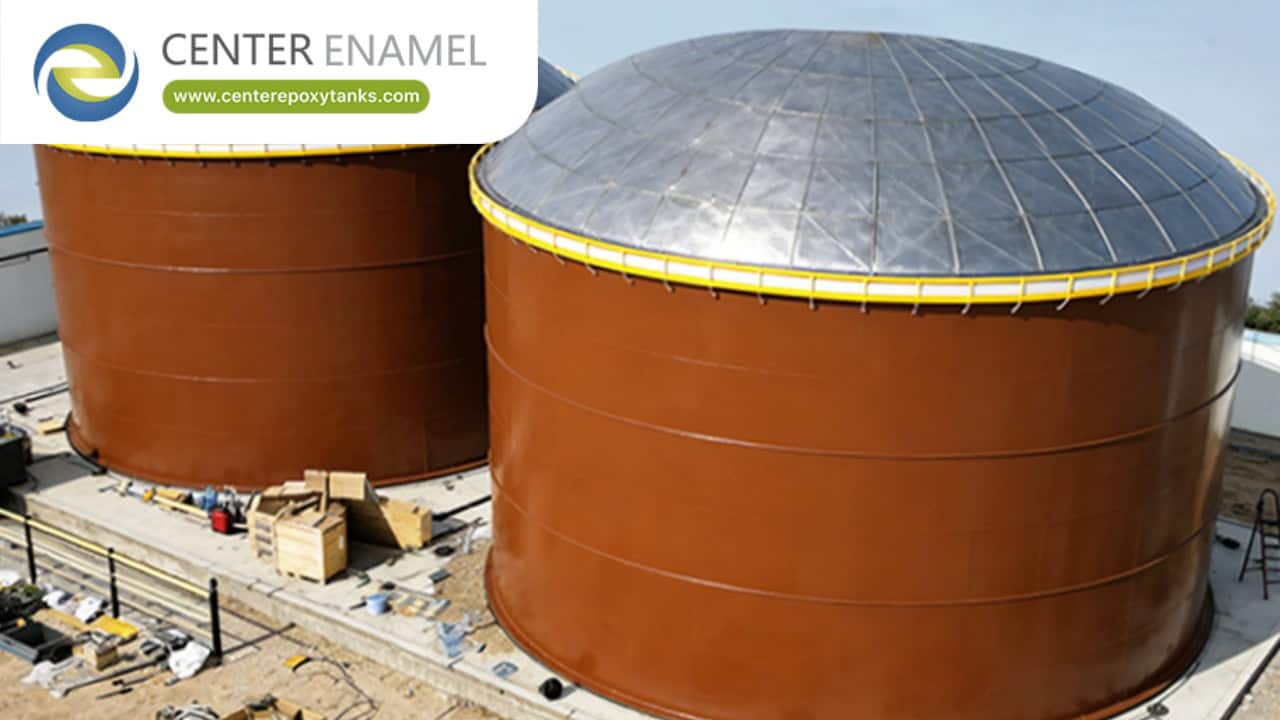
Aluminum Dome Roofs for Oil Storage Tanks - How the Roof Choice Shapes Tank Life
Ask an operator what fails first on an oil tank and the answer is rarely the shell. It is the roof: the underside corrodes where the vapour space is wettest, the coating breaks down where nobody can inspect it, and the internal columns rust at the floor line where water and sediment collect. The roof is also the component whose repair costs the most downtime, because you cannot reload the tank until it is finished. Yet at specification stage the roof is usually the least considered part of the tank - chosen by default rather than by life-cycle argument.
A life-cycle view changes the decision. Engineered by Shijiazhuang Zhengzhong Technology Co., Ltd. (Center Enamel), an aluminium geodesic dome costs more per tonne than a painted steel cone and far less over thirty years, because it removes the two costs that dominate: recoating campaigns and the production deferment that goes with them. The dome is the rare capital decision that reduces both opex and outage exposure.
1. What Fails First on a Conventional Oil Tank Roof?
In practice: the underside coating, the column bases, and the roof-to-shell joint - in that order. All three are driven by the same mechanism: condensation and vapour-space corrosion on steel that cannot be inspected from inside without emptying the tank.
· Underside Coating Breakdown: Condensation forms on the cool roof plate above warm oil and breaks down the internal coating long before the shell lining fails.
· Column Base Corrosion: Columns standing in water-bottom and sediment corrode at the floor line, where the section loss is hardest to detect.
· Roof-to-Shell Joint: The compression ring and top angle collect water and debris, and are the first place an inspector looks for section loss.
· Seal and Penetration Wear: Every column boot and roof penetration is a seal that ages and a vapour path that grows.
· Inspection Blind Spots: Columns and rafters hide the very plate most at risk, so failures are found late and repaired expensively.
2. How Does a Clear-Span Dome Change the 30-Year Cost?
It removes the recoating cycles, shortens every inspection and cleaning campaign, and eliminates column-related repairs. Once the avoided outages are counted, the dome is usually the lower-cost option even before the steel weight saving is considered.
· No Recoating Campaigns: Aluminium never needs blast-and-recoat, removing two to three full-roof maintenance events over a 30-year life.
· Shorter Outages: Unobstructed interiors make cleaning, sediment removal and inspection faster, so the tank returns to service sooner.
· Fewer Repairs: No columns means no column bases, no column boots and no floating-roof penetrations to maintain.
· Lower Shell Load: The lighter roof reduces shell and foundation demand, which matters most on retrofit projects with limited shell capacity.
· Predictable Spend: Maintenance becomes small, scheduled inspections rather than periodic large capital events.
3. What Does a Dome Retrofit Actually Involve?
Survey, strengthen if needed, remove or retain the old roof, then assemble the dome. The critical path is not the dome itself but the shell compression ring assessment and the tank's cleaning and gas-free certification.
· Shell Survey: Plate thickness, roundness and top-angle condition are surveyed to confirm the shell can take the dome's thrust.
· Compression Ring Upgrade: Where needed, a new ring or local reinforcement is fitted before the dome is landed.
· Old Roof Strategy: The existing roof is either removed or retained as an erection platform, depending on its condition and the outage window.
· Ground or In-Place Build: Small domes are assembled at grade and lifted; large spans are built on the tank using the structure's own geometry.
· Handover Package: Load calculations, material certificates, erection records and an inspection and maintenance manual are issued with the dome.
Evaluation Criterion | Aluminum Geodesic Dome | Painted Steel Cone Roof |
Roof recoating over 30 years | Not required | Two to three campaigns |
Inspection access | Unobstructed | Blocked by columns and rafters |
Typical outage per roof repair | Days for seal work | Weeks for blasting and recoating |
Roof weight | Low - aluminium structure | High - steel plate and rafters |
Predictability of cost | High | Low - driven by coating condition |
Engineering Assurance and Project Support
Every welded oil tank delivered by Shijiazhuang Zhengzhong Technology Co., Ltd. (Center Enamel) is designed to API 650 with shell courses sized by the one-foot method and checked for wind, seismic and hydrostatic load cases, or to EN 14015 and the Eurocodes where the site is European. Shell plate is shot-blasted to Sa 2.5 and coated to a documented dry film thickness, longitudinal and annular plate welds are examined by radiography or ultrasonic testing to the acceptance level written into the purchase order, and every tank is hydrostatically tested and dimensionally surveyed before hand-over. Retrofit projects begin with a shell and compression-ring survey, and we supply the strengthening design, the dome, the ancillary steelwork and the erection supervision as one package to keep a single point of responsibility.
Frequently Asked Questions (FAQ)
Can a dome be retrofitted without taking the tank out of service for months?
Usually yes. The long-lead items are the shell survey and any compression-ring strengthening, while the dome itself is factory-prepared so site work is assembly. The outage length is dominated by cleaning, gas-freeing and the old roof strategy, not by the dome erection.
Will the existing shell carry an aluminium dome?
In most cases yes, because an aluminium dome is substantially lighter than the steel roof it replaces. The governing check is the horizontal thrust at the compression ring and the condition of the top shell course, both of which are assessed in the pre-order survey.
Does an aluminium dome meet fire and lightning requirements?
The dome is designed with bonding and grounding continuity to the tank shell, and lightning protection, air terminals and down conductors are included in the supply scope where the project specification requires them. Shunts and bonding straps are sized with the tank's earthing philosophy.
Can the dome design be customised?
Yes. Span, rise, panel section, alloy, gasket material, insulation, vents, manways, platforms, handrails, lightning protection and internal floating-roof suspension loads are all engineered to your tank dimensions, product and site loads.


