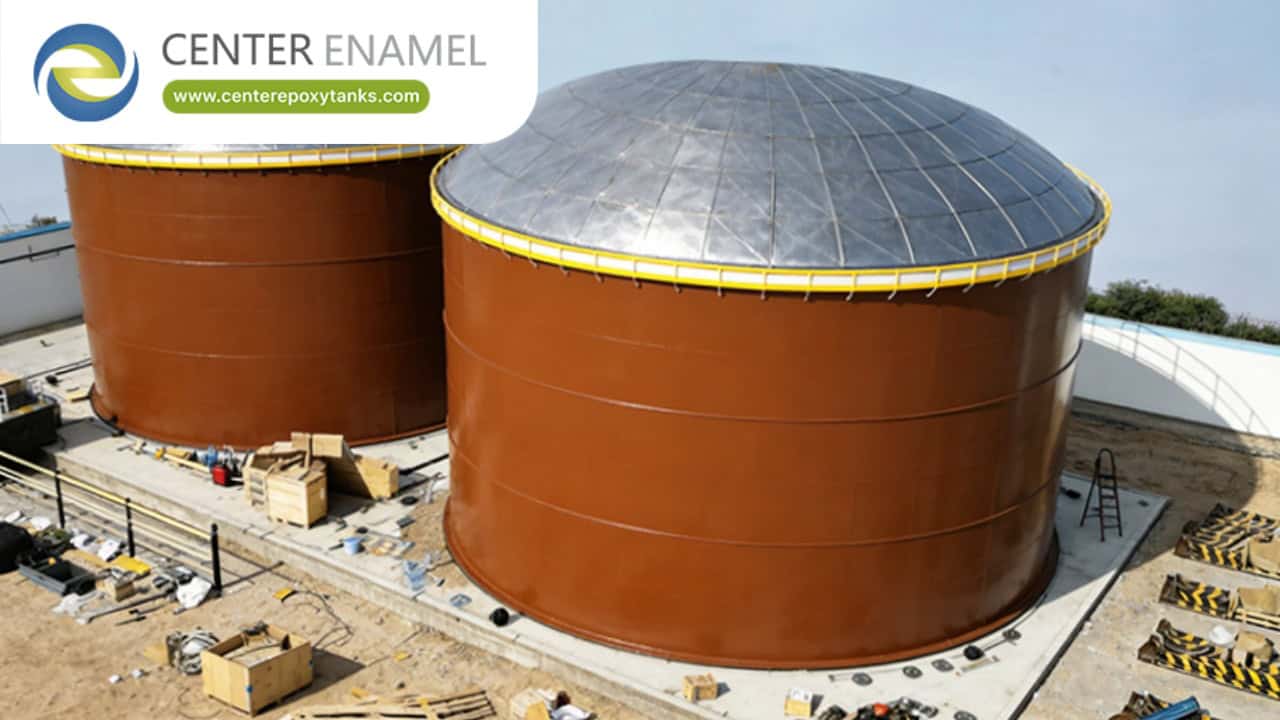
Aluminum Dome Roofs for Oil Storage - Self-Supporting Covers for Refined and Crude Service
Oil terminals inherit their roof problems from the product itself. Crude carries hydrogen sulphide and water; refined products carry vapour that finds every gap; slop oil carries both. A carbon steel roof over that atmosphere corrodes from the underside, where nobody can see it and nobody can repaint it without taking the tank out of service. Internal columns make it worse - each one is a penetration through the floating roof deck, a seal that wears, and a corrosion site standing in the product. When the roof finally needs attention, the tank is down for weeks.
To break that cycle, operators specify self-supporting aluminium geodesic domes. Engineered by Shijiazhuang Zhengzhong Technology Co., Ltd. (Center Enamel), the triangulated aluminium frame spans the full tank diameter from the shell compression ring, removes every internal column, and resists the humid, sulphide-bearing atmosphere of an oil terminal without coating. Where vapour control is required, the same dome becomes the fixed roof over an internal floating roof deck.
1. Why Choose an Aluminum Dome Over a Steel Roof for Oil?
Because the dome removes the roof as a maintenance item. Aluminium does not rust in a sulphide-bearing tank atmosphere, the clear span removes internal columns and their floating-roof penetrations, and the structure never needs blast-and-recoat during the life of the tank.
· Atmospheric Corrosion Resistance: Aluminium resists the H2S and humid hydrocarbon atmosphere that attacks the underside of carbon steel roofs in crude and slop service.
· No Internal Columns: Removing columns eliminates floating-roof penetrations, seal wear points and corrosion sites standing in the product.
· Zero Repainting: The dome is never blast-cleaned or recoated, so the roof does not drive future shutdowns at the terminal.
· Weight Advantage: An aluminium dome weighs a fraction of an equivalent steel roof, which reduces shell loading and can avoid shell strengthening on retrofit work.
· Fast Erection: Factory-cut, factory-drilled members mean the dome is assembled rather than welded, shortening the outage.
2. Which Oil Services Suit an Aluminum Dome Best?
The dome pays off wherever the roof atmosphere is corrosive or where column-free interior space has operational value. That covers crude, slop oil, refined products with an internal floating roof, and any tank that will be inspected or cleaned frequently.
· Crude Oil: The dome resists under-roof H2S corrosion while the clear span simplifies sediment removal and bottom inspection.
· Refined Products: Paired with an internal floating roof, the dome acts as the fixed roof and protects the deck from rain, wind and sunlight.
· Slop and Recovered Oil: Variable, aggressive streams are exactly where a coated steel roof fails first and an aluminium dome lasts longest.
· Fire Water and Raw Water at Terminals: The same clear-span benefit applies, with no coating maintenance over a 30-year horizon.
· High-Inspection-Frequency Tanks: Unobstructed interiors shorten API 653 inspections and cleaning campaigns.
3. How Does a Dome Interact With an Internal Floating Roof?
Very well, provided the interfaces are designed together. The dome carries the fixed-roof role, the deck floats inside, and the dome's internal structure can support the deck's suspension cables, gauging pole guide and anti-rotation system - but only if the loads were declared before fabrication.
· Suspension and Guide Loads: Deck hanger cables, guide poles and anti-rotation devices impose point loads on the frame; these must be modelled, not added later.
· Vent Sizing: Fixed-roof space above the deck must be vented to API 2000 for both normal breathing and emergency fire exposure.
· Static Grounding: The floating deck needs shunts and grounding continuity to the shell; the dome must not interrupt that path.
· Access for Deck Inspection: Hatches and platforms are positioned so the deck seal and rim can be examined without dismantling the dome.
· Gauging and Sampling: Through-deck hatches and sampling points are coordinated with the deck layout before either item is manufactured.
Evaluation Criterion | Aluminum Geodesic Dome | Columned Steel Cone Roof |
Internal columns | None | Required on larger diameters |
Roof underside corrosion | None - aluminium | Progressive; hidden until advanced |
Repainting over 30 years | Not required | Two to three full recoats |
Floating roof penetrations | None | One per column |
Erection method | Bolted assembly, no hot work | Welded, requires hot-work permit |
Engineering Assurance and Project Support
Every welded oil tank delivered by Shijiazhuang Zhengzhong Technology Co., Ltd. (Center Enamel) is designed to API 650 with shell courses sized by the one-foot method and checked for wind, seismic and hydrostatic load cases, or to EN 14015 and the Eurocodes where the site is European. Shell plate is shot-blasted to Sa 2.5 and coated to a documented dry film thickness, longitudinal and annular plate welds are examined by radiography or ultrasonic testing to the acceptance level written into the purchase order, and every tank is hydrostatically tested and dimensionally surveyed before hand-over. For oil service we model the dome and the floating deck as one system, declare every suspension and access load before fabrication, and supply the hatch, vent, grounding and platform package as a single scope.
Frequently Asked Questions (FAQ)
Can an aluminium dome be used on a crude oil tank?
Yes. Crude storage is one of the strongest applications, because the under-roof atmosphere is corrosive and the clear span makes sediment and bottom inspection far easier. The dome is checked against API 650 Appendix G for site wind, snow and seismic loads, and the shell compression ring is verified for the dome's thrust.
How long does an aluminium dome last on an oil tank?
Thirty years or more is a normal expectation with routine inspection. Aluminium forms a stable, self-healing oxide film, so there is no progressive corrosion allowance to consume. The maintenance items are the joint gaskets, fastener torque and sealant, all of which are inspected and renewed individually rather than by recoating the whole structure.
Does the dome meet API 650?
Domes are designed to API 650 Appendix G, which covers structurally supported aluminium dome roofs on steel tanks. Site wind, snow, seismic and maintenance loads are applied from project data. Where a project is European, the roof can also be checked to the relevant Eurocode load combinations.
Can the dome be customised for our tank?
Yes. Diameter, rise, panel section, alloy and temper, gasket material, insulation, vents, manways, gauging platforms, walkways, handrails, tie-off points and internal floating-roof suspension loads are all engineered to the tank and the site before any member is cut.
·


