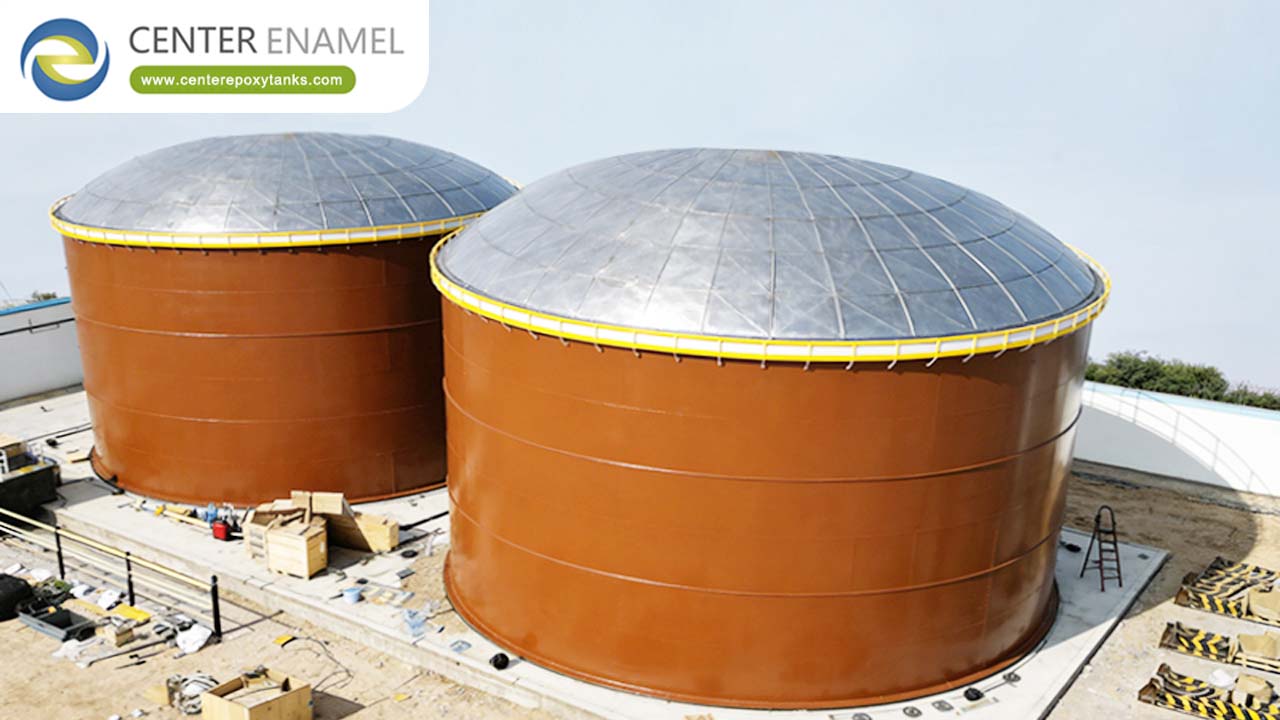
Aluminum Dome Roofs for Oil Reserves - Long-Life Covers for Strategic Storage
A strategic reserve tank has an unusual duty: it must sit, often full, for years and then perform on demand. That duty punishes roofs. Coatings age while the tank is idle, columns corrode unseen in settled water bottom, and the first sign of trouble often arrives as debris in a product that has to move quickly. Worse, the maintenance that would prevent all this requires an outage - and an outage is exactly what a reserve cannot schedule, because the tank has to be available when the market or the government calls.
This is why reserve operators increasingly specify aluminium geodesic domes. Engineered by Shijiazhuang Zhengzhong Technology Co., Ltd. (Center Enamel), the clear-span aluminium structure carries no coating to age, no columns to corrode, and no repainting campaign to schedule across a service life measured in decades. Readiness becomes a function of the mechanical systems, not of the roof.
1. What Makes a Roof Suitable for Strategic Oil Reserves?
A reserve roof must stay structurally sound with minimal intervention, must not shed debris into the stored product, and must allow inspection and remediation without a long outage. Aluminium meets all three; coated carbon steel meets none of them comfortably.
· Indefinite Idle Tolerance: Aluminium does not require coating maintenance while the tank sits full, so long idle periods do not degrade the roof.
· No Debris Generation: No rust scale and no coating flakes means no contamination of a product that may be called forward without warning.
· Inspection Without Outage: Much of a dome's condition can be assessed from outside and from the roof walkway, without emptying the tank.
· Corrosion Allowance Not Required: Aluminium's oxide film removes the consumable corrosion allowance that limits steel roof life.
· Sealed Envelope: Gasketed joints keep out rain, dust and airborne salts, protecting the vapour space and any floating deck beneath.
2. Why Do Reserves Prefer Clear-Span Roofs?
Because the operational value of unobstructed interior space compounds over decades. Every inspection, cleaning, sediment removal and bottom survey is faster and cheaper, and the tank returns to ready status sooner.
· Faster Turnaround: Without columns, cleaning machines coverage-spray the whole interior and inspectors can see every plate.
· Simpler Sediment Management: Heavy ends that settle over years of storage can be removed without working around obstacles.
· Floating Roof Compatibility: No column penetrations means no column boots to leak and no deck seals to wear at each column.
· Reduced Confined-Space Work: Better visibility and access reduce the time personnel spend inside the tank.
· Flexible Future Use: A column-free tank can be repurposed between crude, product and intermediate service without roof modification.
3. How Is a Reserve Dome Inspected Over Decades?
Through a scheduled regime of external visual inspection, joint and fastener checks, and periodic structural review - none of which requires the tank to be emptied. Internal access is only needed if an anomaly is found.
· Roof Walkway Survey: Gasket condition, sealant, fastener torque and panel alignment are checked from the supplied walkway and handrail system.
· External Visual Check: The dome's exterior is inspected for impact damage, loose members and drainage problems without taking the tank out of service.
· Drainage and Ponding Review: Roof drainage is confirmed free so that water cannot pond and load the frame beyond design.
· Periodic Structural Review: A design-review against current codes is recommended after major code revisions or following an extreme weather event.
· Record Keeping: Inspection findings are logged against the tank file to support API 653 and the operator's own asset integrity programme.
Evaluation Criterion | Aluminum Dome for Reserves | Coated Steel Roof for Reserves |
Behaviour during long idle periods | No degradation | Coating ages; inspection deferred |
Debris risk to product | None from the roof | Rust scale and coating flakes |
Inspection without emptying | Largely possible | Internal inspection required |
Repainting requirement | None | Scheduled campaigns over the life |
Return-to-ready after maintenance | Days | Weeks |
Engineering Assurance and Project Support
Every welded oil tank delivered by Shijiazhuang Zhengzhong Technology Co., Ltd. (Center Enamel) is designed to API 650 with shell courses sized by the one-foot method and checked for wind, seismic and hydrostatic load cases, or to EN 14015 and the Eurocodes where the site is European. Shell plate is shot-blasted to Sa 2.5 and coated to a documented dry film thickness, longitudinal and annular plate welds are examined by radiography or ultrasonic testing to the acceptance level written into the purchase order, and every tank is hydrostatically tested and dimensionally surveyed before hand-over. Reserve projects are supplied with a full documentation package - load calculations, material certificates, erection and torque records, and a lifetime inspection schedule - so the roof can be managed inside the operator's asset integrity system.
Frequently Asked Questions (FAQ)
How long can an aluminium dome remain in service on a reserve tank?
Thirty years and beyond is a normal expectation. Aluminium's protective oxide film means there is no corrosion allowance to consume and no coating system to renew. Service life is governed by inspection and by the condition of the gaskets and fasteners, both of which are individually renewable.
Can the dome be inspected without emptying the reserve tank?
Most of it. Gaskets, sealant, fasteners, panel alignment, drainage and external condition are all checked from the roof walkway and from outside. Internal access is only needed if an inspection finds an anomaly, which is precisely the advantage a reserve operator is buying.
Does the dome handle extreme weather?
The dome is engineered to the project's own wind, snow and seismic values under API 650 Appendix G, not to a generic load table. Where a site has cyclone, heavy snow or seismic exposure, those values are applied directly to the frame and the shell compression ring is checked for the resulting thrust.
Can the dome be customised for reserve service?
Yes. Span, rise, alloy and temper, panel section, gasket material, insulation, vents, manways, walkways, handrails, lightning protection and internal floating-roof suspension loads are all engineered to the tank, the product and the site before fabrication begins.
·


