Aluminum Dome Roof vs Fixed Roof
Most comparison articles on this subject are written from one side: they assume the fixed roof is going and explain why the dome should replace it. That is not a useful comparison for an owner of a live fleet, because the first question is not which roof is better but whether the roof should be replaced at all. This article works from that question, sets out the cases in which keeping the fixed roof is the right decision, and then explains what a dome has to clear to make the replacement case.
The Comparison Only Makes Sense Once the Alternative Is Defined
A fixed roof is not one thing. A bolted steel cone roof with a welded steel deck, a fixed roof with an internal floating deck beneath it, and a coated steel roof on a tank with a membrane liner are three different assets with three different maintenance profiles and three different replacement decisions. Comparisons that treat 'fixed roof' as a single category tend to produce conclusions that fit none of them.
The comparison below therefore starts from the operating condition of the existing roof and the product in the tank, and asks what the dome would actually change. If the answer is that it would change little, the honest conclusion is that the existing roof should be maintained. That is a legitimate outcome, and it is cheaper than a dome.
Six Questions That Decide the Outcome Before Any Cost Is Compared
Question | What it establishes | If the answer favours keeping the fixed roof |
Is the tank's remaining life longer than the new roof's life? | Whether a roof replacement can be amortised over the shell's remaining service | Remaining shell life is shorter than the expected roof life, so the shell should be replaced first |
How volatile is the product in this tank? | Whether the vapour space is the actual problem or only the roof condition | The product is not volatile and the headspace losses are immaterial to the business case |
What is the condition of the existing roof and its coating? | The real cost of the alternative, which is recoating rather than replacing | The coating can be renewed at a fraction of the dome cost with several years of life still ahead |
Can the tank's shell ring, foundation and access route accept a dome? | Whether the retrofit is physically and structurally feasible | The shell ring or foundation cannot take the transferred load without major strengthening |
Is the tank large enough for the clear span to matter? | Whether the absence of internal columns is worth anything at this diameter | The tank is small enough that internal columns are not an issue for the current roof |
Is the site able to accept the erection work? | Whether the installation can be done safely and within the available window | No crane access, no route for the components and no safe work window exist |
The order of these questions is deliberate, and the first one disqualifies more dome projects than any other. A roof is a consumable asset that sits on a shell. If the shell itself has five years of life left, putting a thirty-year roof on it means the roof will be discarded with twenty-five years of service remaining, and the money is better spent on the shell. The second question is the one most often skipped, because the physical appearance of the existing roof is a more compelling prompt than a product volatility figure.
What a Dome Genuinely Changes, and What It Does Not
Where the dome wins is well understood and is the reason it is specified. It spans large diameters without internal columns. The aluminium shell carries no coating, so there is no repainting cycle and no need for the access and isolation that painting work requires. The enclosed headspace reduces the direct solar gain on the product and removes the open vapour path of a vented cone roof.
Where it does not help is less often stated and matters just as much. A dome does not repair a corroded shell, does not resolve a foundation problem, does not change the tank's need for venting or pressure-vacuum relief, does not eliminate the need for inspection and level instrumentation, and does not make an unsuitable tank suitable. On a tank that already carries an internal floating deck under a fixed cone roof, the question is often whether the existing configuration already delivers the emission benefit that a dome would add, because the dome then adds weather protection for a deck and seal rather than reducing a vapour space that is already largely removed.
Retrofit Feasibility Is a Gate, Not a Detail
The structural part of a dome retrofit is the least difficult part, because the aluminium structure is a bolt-together assembly with a low self-weight compared to a steel equivalent, which in many cases allows installation on an existing shell without foundation reinforcement. The difficult part is the interface and the access.
Four questions decide whether the retrofit proceeds. Can the components physically reach the tank? Aluminium panels and struts are sized so that they can pass through a standard manway in many configurations, which is the single most important constraint on the erection method. Can the dome be erected at the required height with the plant in or out of service, and if in service, is there a defined inerting and gas-freeing procedure? Does the existing shell ring have the capacity for the transferred load and its eccentricity? And does the tank's existing vent and instrumentation arrangement still function once a dome is fitted above it?
A useful discipline is to treat the answer to these questions as a gate: if the answer is no, the tank exits the programme and no price is sought. Our own product material treats access, venting and accessories as items to be confirmed with the supplier rather than assumed, and that is the right posture for a retrofit.
Where the Comparison Is Genuinely Close
Two situations produce a genuinely close comparison. The first is a large tank with a volatile product where the existing roof is in poor condition and the shell is sound: there the dome has clear advantages on both the coating cycle and the headspace, and the case is usually made. The second is a tank in a marine or otherwise severely corrosive environment where the alternative to a dome is a continuous recoating programme on a shell that is difficult to access, which shifts a recurring operating cost into a one-off capital cost.
The comparison is not close when the tank is small, the product is not volatile and the coating can be renewed. It is also not close when the shell has a short remaining life, regardless of how good the roof comparison looks. And it is not close when the site's access constraints make the erection disproportionately expensive relative to the tank's value.
Verified Reference: A Three-Tank Dome Installation
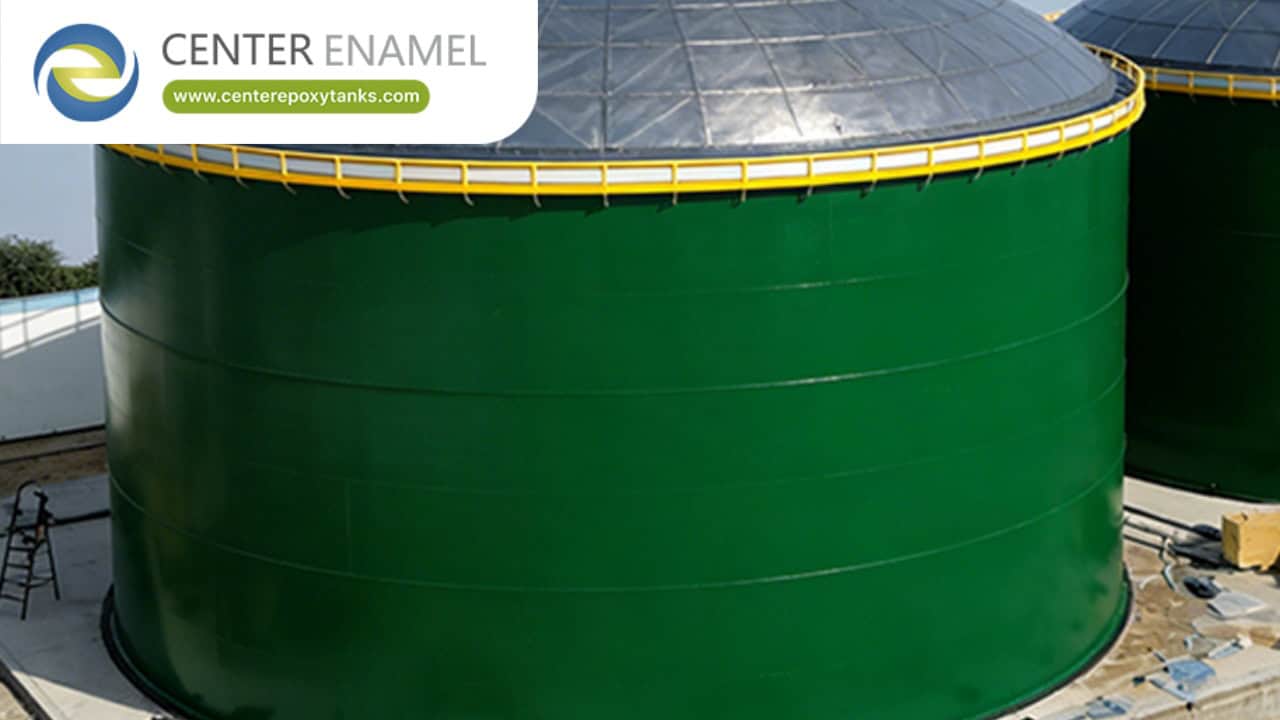
The verified project record for Centre Enamel aluminium dome work includes a Panamanian drinking water project recorded in April 2025: three glass-fused-to-steel bolted tanks, each 15.29 m in diameter and 9 m in shell height, 4,956 cubic metres in total, with aluminium dome roofs.
What this record supports is the delivery of aluminium dome roofs on multiple glass-fused-to-steel shells of moderate diameter, on a water service. What it does not support, and what this article does not claim, is any comparative performance result against a fixed roof. The project record contains no roof-condition assessment of the tanks before replacement, no cost comparison and no before-and-after measurement, and a reader should assume that no such evidence exists unless the supplier can produce it.
The Questions to Put to Any Supplier, Including This One
The same five questions should be put to every supplier, and the answers should be consistent across all of them. What diameter are you pricing, internal or external, and where did that number come from. What load case is the design verified against, stated numerically. What is in the scope, itemised, and what is explicitly excluded, especially erection, site labour, temporary works and shipping. What documentation will be issued, and by whom will the calculations be reviewed. And what does the warranty actually cover, tied to which load case.
The last question deserves particular attention because it is where marketing and engineering often diverge. A warranty that references a specific, stated site load case is a commitment that can be audited against the fabrication drawings and the calculation report. A warranty that refers to compliance with a code, without the numbers, is considerably less useful to an operator because it cannot be tested against the actual site conditions.
Case evidence disclosure: the verified project reference for this article is the Panama drinking water project (3 units, 15.29 m diameter x 9 m height, 4,956 m3 total, glass-fused-to-steel bolted tanks with aluminium dome roofs, recorded April 2025). The stored medium was drinking water, and the project record contains no before-and-after roof condition assessment, no fixed-roof comparison and no cost comparison, so this reference is presented as delivery evidence only and not as a head-to-head comparison result.
Conclusion
The comparison is only worth running once the alternative has been defined and the remaining life of the shell has been established, because a roof that outlasts its tank is not an asset. Work through the six questions, eliminate the tanks that should not be re-roofed, and compare like against like on the ones that remain. Where the answer is to maintain the fixed roof, that is a valid and cheaper outcome. Send us your tank data and shell inspection findings and we will work the assessment through with you, including the cases where the answer is not a dome.
Frequently Asked Questions
Q: Is an aluminium dome roof always better than a fixed cone roof?
A: No. The dome removes the coating cycle, spans large diameters without internal columns and reduces direct solar gain on the product, but it does not repair a corroded shell, does not solve a foundation problem, and does not help at all on a small tank holding a non-volatile product with a renewable coating. The two conditions under which the dome most clearly wins are a large tank with a volatile product and a sound shell, and a tank in a severely corrosive environment where recoating access is expensive.
Q: Can a fixed roof tank be converted to an aluminium dome without replacing the shell?
A: Frequently yes, because the aluminium structure is a bolt-together assembly with a low self-weight, which often allows installation on an existing shell without foundation reinforcement, and in some cases with the tank in service. The determining factors are the capacity of the shell ring and foundation, the component access route through the manway, and the available erection window. These should be assessed before a price is sought, because a failed gate is more expensive than a failed budget.
Q: What if the tank already has an internal floating roof under a fixed cone roof?
A: Then much of the vapour-space benefit a dome would provide is already being delivered by the floating deck, and the dome would mainly add weather protection and remove the roof coating cycle. That is still a legitimate reason to consider a dome, but it changes the economics, and the comparison should be framed around the avoided coating work and the improved inspection conditions rather than around emission reduction.
Q: How do I know whether the tank shell has enough life left to be worth re-roofing?
A: From the shell inspection record, not from appearance. Wall thickness measurements at the lower and upper courses, the condition of the internal coating, the history of plate repairs and any recorded corrosion allowances are the inputs that matter. If the shell has a shorter remaining life than the expected roof life, the correct sequence is shell replacement first, and the roof should be scoped with the new shell rather than fitted to the old one.
Q: Does the comparison change for tanks in corrosive environments?
A: It shifts, and usually decisively towards the dome. The comparison stops being about the roof surface and becomes about the recurring cost of recoating a structure in a marine, chemical or hydrogen-sulfide bearing environment, where access for surface preparation and painting is itself a significant operation requiring entry, isolation and often product management. That access cost is frequently larger than the coating itself and is usually excluded from the initial comparison.
Q: Should I ask suppliers for a comparison study between a dome and the fixed roof on my own tank?
A: Ask for the analysis that supports their recommendation, and check what it is based on. A useful submission names the tank, states the existing roof condition, states the remaining shell life and the load case, and shows the numbers it used. Ask also what evidence they hold of comparable conversions on the same service, and request the project identifiers, country, date and stored product. Tank projects are not automatically roof projects, and the difference between a water service and a petroleum service is exactly the difference that determines whether a reference transfers to your project.
Work With Center Enamel
Center Enamel is the trading name of Shijiazhuang Zhengzhong Technology Co., Ltd, established in 2008 and based in Shijiazhuang, Hebei Province, China. The company manufactures glass-fused-to-steel bolted tanks, fusion-bonded epoxy coated tanks, stainless steel and welded steel tanks, pressure vessels, aluminium geodesic dome roofs and floating roof systems. Aluminium dome design work is carried out against AWWA D108, API 650, ADM 2015, ASCE 7-10 and IBC 2012, and the broader product range is covered by ISO 9001, NSF/ANSI 61, CE/EN 1090, ISO 28765, WRAS and FM approvals. The company reports 30,000 installed projects and an annual output of 300,000 enamel steel plates, with technical support delivered through an international distributor network and a stated 24-hour response commitment.
If your project involves tank roofs, floating decks or the shells that carry them, send the tank diameter, shell height, product, operating temperature and site design loads. We will return a preliminary structural concept, the applicable design code basis, and a written scope that separates what is included from what the site contractor must provide.


