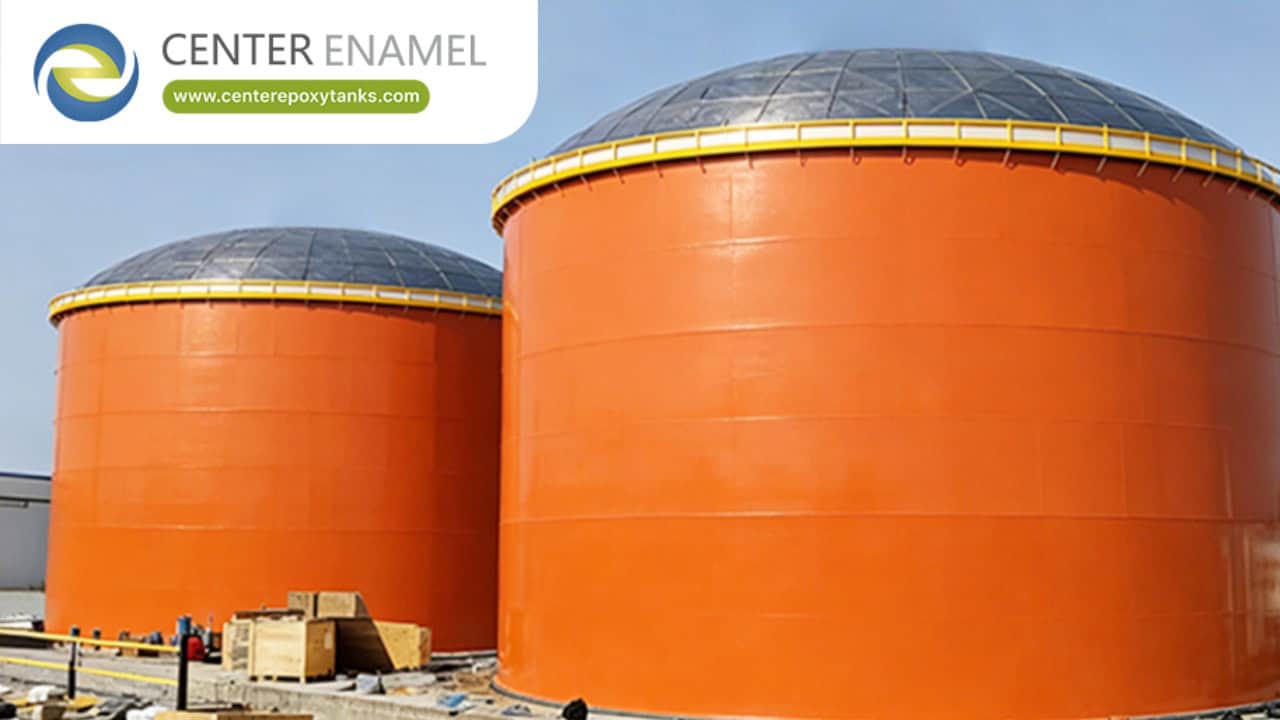
Aluminum Dome Roof for Tank Farm
A tank farm roof programme is not a series of purchases. It is a sequencing problem with a budget constraint, a shutdown constraint and a common-cause constraint, and the mistake most owners make is to start with the tanks that look worst rather than with the tanks that will deliver the most value per unit of disruption. This article sets out a way to rank a farm, a way to sequence the work, and the specific conditions under which a tank should be excluded from the programme entirely.
Start With a Ranked List, Not With a Purchase Order
A farm programme usually begins with a visual survey, and visual survey produces a list of condition problems rather than a list of priorities. Those are different things. A tank with visible coating breakdown on a fixed cone roof may be a poor candidate for a dome if it has only two years of economic life left in its shell; a tank that looks acceptable but carries a volatile product may be the strongest candidate on the farm, because the dome addresses the vapour space that the product is actually losing through.
The ranking should be produced by scoring each tank against a small number of factors that can actually be established from records rather than from impressions: remaining shell life, the product stored and its volatility, the tank diameter and dome cost per unit of benefit, the availability of a turnaround window, and whether the site can accept a dome on that shell at all. The score exists to make the reasoning visible and reviewable, not to produce a number that looks objective.
The Five Factors That Actually Move a Tank Up or Down the List
Factor | What it measures | Where the data comes from | Direction of effect |
Remaining shell life | How long the tank under the roof will still be in service | Shell inspection records, construction records, internal inspection history | Short remaining life pushes the tank down |
Product volatility | How much vapour the headspace loses or emits when the tank is at working level | Product data sheet and operating temperature | Higher volatility pushes the tank up |
Roof area per unit of cost | How efficiently the budget is spent across the farm | Diameter and height from the tank schedule, cost per dome from the quotation | Better ratio pushes the tank up |
Turnaround availability | Whether the tank can be taken out of service without displacing product | Operations planning and inventory review | A clear window pushes the tank up |
Retrofit feasibility | Whether the shell, ring and foundation can accept a dome at all | Shell ring assessment, foundation record, delivery route survey | Infeasible pushes the tank down and out |
The order of these factors matters more than the weighting. Product volatility and retrofit feasibility are filters: a tank that fails either test should not appear on the programme at all, because it will consume budget and shutdown window without delivering a roof decision. Remaining life, cost efficiency and turnaround availability are the ranking factors among the tanks that survive the filters. Writing this down before the quotes arrive prevents the common failure mode in which the supplier with the earliest delivery date effectively sets the programme sequence.
Sequencing Is a Common-Cause Problem
On a farm, the order of installation matters for reasons that have nothing to do with any single tank. Installing every dome in one berm in the same campaign concentrates construction risk, inspection resource and commissioning workload into a short window. Spreading the work across several campaigns keeps the site operable and keeps the failure of one contractor or one crane booking from stopping the programme.
There is also a spares argument. A farm-wide programme justifies holding spare panels, node hardware and seal components for the installed population, whereas a one-off replacement does not. The spares decision is a programme-level decision and should be taken at programme level, which is another reason not to procure tank by tank.
A workable sequence groups tanks by berm and by product family, places the largest single-tank scope where the erection route is most tolerant, and reserves the tanks with the tightest windows for a later campaign once the site has learned the routine. Each group should have its own acceptance criteria and its own handover documentation, so that a partially completed programme still leaves the site in a defensible condition.
Where a Dome Is the Wrong Answer for a Farm
A farm programme should explicitly record the tanks that are excluded and why, because the exclusions are what make the programme credible. A tank whose shell has a short remaining life should be scheduled for shell replacement rather than roof replacement, since a dome on a shell that will be replaced in five years is a poor allocation of money. A tank in a severe marine corrosion environment whose shell coating is already compromised may be better served by a recoating strategy. And a small tank whose headspace losses are immaterial will never justify the erection effort of a dome.
There is also a case that is specific to farms: a tank with a very large diameter relative to its volume, often a squat tank, may have a dome cost that is disproportionate to the benefit. The clear-span advantage of a dome is most valuable on large tanks where an internal column would otherwise be needed or where the roof area is large. On a squat tank with modest diameter, a well-maintained cone roof is often the more economical answer, and a farm programme that includes such tanks on principle rather than on analysis will look like a policy decision rather than an engineering one.
Verified Reference: A Four-Tank Installation on One Site
The verified project record for Centre Enamel aluminium dome work includes a Malaysian drinking water project recorded in October 2025: four glass-fused-to-steel bolted tanks, each 17.58 m in diameter and 21 m in shell height, 20,380 cubic metres in total, with aluminium dome roofs on all four. The Indonesia drinking water project from June 2025 adds a single tank of 42.04 m diameter and 15.2 m height with 21,099 cubic metres and an aluminium dome.
These two records are useful references for farm-scale planning because they show a multi-unit delivery and a single large-diameter delivery inside the same verified record, and they show exactly what the record contains: country, date, stored application, quantity, diameter, height, volume, shell material and roof type. The stored medium in both cases was drinking water. Neither record is a petroleum farm, so neither should be presented as evidence of petroleum service performance; they are evidence of aluminium dome fabrication, delivery and multi-tank execution.
Programme-Level Documentation Should Match the Programme Scope
A farm programme deserves a different documentation package from a single-tank purchase, and this is where suppliers most often fall short. At single-tank scale the useful deliverables are a design calculation, a general arrangement drawing and a fabrication package. At farm scale the operator also needs a consistent structural basis statement, an interface responsibility matrix covering every tank in the programme, a spare-parts recommendation sized for the installed population, a maintenance and inspection regime that applies uniformly, and a handover record per tank.
Our own published dome material is explicit that a warranty must reference the verified snow and wind case for the site rather than a generic promise, and that the fabrication drawings and load reports should back the coverage so the operator can audit it. Applied to a farm, that means the load case statement is a site document, not a per-tank document, and the inspection regime should be written once. In our experience of enquiry handling, the documents that cause the most friction at programme level are the ones nobody asked for at the start: a common accessory schedule and a common spare-parts list.
How Programmes Fail, and What to Do About It
Three failure modes recur. The first is a programme built from an unverified tank schedule, where the diameter used for pricing differs from the diameter on the drawing, and the discrepancy surfaces during fabrication. The second is a programme that treats every tank as identical, so the shop drawings are fine but the site interface is not. The third is a programme with no acceptance gate, which means that the first tank installed sets the quality standard for all the rest whether or not that standard was agreed.
Each has a simple countermeasure. Verify the tank schedule against as-built drawings and site measurement before pricing. Zone the programme so that site interfaces are resolved per zone rather than per farm. And define an acceptance gate per tank or per campaign, covering geometric fit-up, sealing continuity and the documentation package, before the first installation starts. None of these are complex, but all three are much cheaper to settle at programme level than at installation level.
Case evidence disclosure: the verified project record for this article is the Malaysia drinking water project (4 units, 17.58 m diameter x 21 m height, 20,380 m3 total, glass-fused-to-steel bolted tanks with aluminium dome roofs, recorded October 2025), with the Indonesia drinking water project (1 unit, 42.04 m x 15.2 m, 21,099 m3, June 2025) as a single large-diameter reference. Both stored drinking water rather than petroleum, so they support aluminium dome fabrication and multi-unit delivery, not petroleum farm performance. No petroleum tank farm project is on file in the verified project library.
Conclusion
A tank farm dome programme succeeds or fails on the ranking and the sequencing, not on the roof. Filter the tanks that should not be in the programme, score the rest against remaining life, volatility, cost efficiency, window availability and retrofit feasibility, then sequence the survivors by berm and by product family with acceptance criteria defined before the first erection. If you send us the tank schedule with diameters, heights, products, ages and inspection history, we will return a prioritised programme with the exclusions stated and the reasons for each ranking.
Frequently Asked Questions
Q: How many tanks in a farm should be re-roofed at once?
A: Fewer than is convenient, in most cases. Concentrating a whole farm into one campaign concentrates construction risk, inspection workload and commissioning strain, and leaves the site exposed if one activity stops. Grouping tanks by berm and by product family across several campaigns keeps the site operable and lets each group establish its own acceptance criteria before the next begins.
Q: Should the worst-looking tanks be done first?
A: Not necessarily, and often not. Appearance reflects the roof, but the decision is about the whole asset. A tank with a compromised roof but a shell with five years of life left should go into a shell replacement plan rather than a dome programme. Ranking on remaining shell life, product volatility, cost efficiency, window availability and retrofit feasibility gives a more defensible order than appearance.
Q: How do you decide whether a tank is worth a dome?
A: Compare the dome against the realistic alternative for that tank, which is recoating or replacing the fixed roof, over the remaining life of the shell. On a large tank with a volatile product the dome usually wins because it removes the vapour space and the coating cycle together. On a small or squat tank with a modest product, a maintained cone roof is frequently the more economical answer, and the programme should record that decision rather than quietly including the tank.
Q: Can one dome supplier handle a whole farm programme?
A: A farm programme benefits from a single structural basis, a common accessory schedule and uniform spares, which argues for one supplier across the campaign set. It does not require a single purchase order. Splitting the programme into campaigns with one supplier per campaign, or with one supplier for design and another for installation, is a commercial decision that should be made on capability and price rather than assumed.
Q: What spare parts should a farm hold?
A: The spares that match the installed population: closure panels, node hardware, gaskets and the seal components for the specific seal type in service. Because a bolted aluminium panel can be replaced without draining the tank, holding a small stock of panels and fixings materially shortens repair downtime. The correct quantity is a function of the installed population and the failure history, and it should be decided once at programme level rather than tank by tank.
Q: How long does a farm dome campaign take?
A: Erection duration scales with diameter and with the erection method. A 2025 third-party market study on aluminium dome covers reports that a 90 m diameter geodesic aluminium dome is typically installed by a crew of 15 to 20 technicians over six to ten weeks, and that aluminium panels are around 60 to 70 percent lighter per square metre than the steel equivalent, which is what allows many installations to proceed without heavy lifting equipment. Those figures describe dome erection, not the surrounding site work, which normally governs the campaign length.
Work With Center Enamel
Center Enamel is the trading name of Shijiazhuang Zhengzhong Technology Co., Ltd, established in 2008 and based in Shijiazhuang, Hebei Province, China. The company manufactures glass-fused-to-steel bolted tanks, fusion-bonded epoxy coated tanks, stainless steel and welded steel tanks, pressure vessels, aluminium geodesic dome roofs and floating roof systems. Aluminium dome design work is carried out against AWWA D108, API 650, ADM 2015, ASCE 7-10 and IBC 2012, and the broader product range is covered by ISO 9001, NSF/ANSI 61, CE/EN 1090, ISO 28765, WRAS and FM approvals. The company reports 30,000 installed projects and an annual output of 300,000 enamel steel plates, with technical support delivered through an international distributor network and a stated 24-hour response commitment.
If your project involves tank roofs, floating decks or the shells that carry them, send the tank diameter, shell height, product, operating temperature and site design loads. We will return a preliminary structural concept, the applicable design code basis, and a written scope that separates what is included from what the site contractor must provide.


