Grain Storage Solutions: Engineering Steel Silos For Safe, Dry, Pest-Controlled Storage
Grain in storage is a living system: it respires, it generates heat and moisture, and it invites infestation the moment conditions allow. The silo is not a container but a climate-control device — its aeration, sealing and monitoring systems determine whether the grain keeps its grade or becomes a discount product. This matters more every year as post-harvest losses draw regulatory and commercial attention.
This article covers grain silo engineering: aeration and moisture management, fumigation and pest control, bottom configuration and discharge, and the bolted-versus-welded comparison that drives procurement.
Aeration: The Core Silo System
Aeration moves ambient air through the grain mass at low flow rates — fractions of a cubic meter per minute per tonne — to equalize temperature and prevent moisture migration. It is not drying: drying moves much larger air volumes at elevated temperature. The distinction matters because under-designed aeration is the most common cause of self-heating and crusting in silos.
Aeration design starts from the grain: target airflow rate per tonne, duct layout (perforated floor, lateral ducts or vertical systems), fan selection against static pressure, and controls that run fans on temperature-humidity differentials rather than a fixed schedule.
Attribute | Aeration | Drying |
Airflow rate | 0.1-0.3 m3/min per tonne | 10-30+ m3/min per tonne |
Air temperature | Ambient (differential-controlled) | Heated 5-20 C above ambient |
Purpose | Equalize temperature, prevent migration | Remove moisture to target content |
Energy demand | Low — fan power only | High — heating plus fans |
Moisture removal | Minimal (0.5-1%) | Several percentage points |
Moisture Management And Self-Heating
Stored grain respires, and respiration generates heat and moisture. If the heat cannot escape, the grain mass becomes a convection cell: warm air rises, condenses on the cool surface layer under the roof, and the wetted crust becomes the first spoilage site. The pattern is so consistent that crusting near the top center of a silo is a diagnostic, not a coincidence.
The engineering response is layered: cool the grain to safe storage temperature at intake, aerate on differential rather than schedule, monitor temperature at multiple depths with cables or wireless sensors, and intervene — turn the mass or move it — before the front progresses.
Fumigation And Pest Control
Pest management in sealed silos uses fumigation (phosphine is the standard) under gas-tight construction, which is why sealing is a structural requirement and not a detail. Aeration openings, hatches and eaves must be gasketed and sealed to hold the gas concentration long enough to be lethal at every point in the mass.
Sealing integrity is tested and maintained: pressure-decay tests after erection, gasket replacement on schedule, and discipline about which openings are left unsealed after inspection. The fumigation is only as good as the worst gasket in the silo.
Bottom Configuration: Conical Vs Flat
Conical-bottom silos discharge by gravity — no machinery in the grain, complete emptying, but a tall structure and higher steel intensity per tonne of capacity. Flat-bottom silos use sweep augers to move residual grain to a central or peripheral sump, trading machinery and maintenance for structural economy. The choice usually follows capacity: conical below a few thousand tonnes, flat above it.
The bottom choice cascades into the aeration design: conical bottoms integrate ducting naturally into the cone structure; flat bottoms route aeration ducts beneath the floor, which complicates cleaning and inspection but keeps the floor walkable.
Attribute | Conical Bottom | Flat Bottom + Sweep |
Discharge | Gravity — complete emptying | Sweep auger to sump |
Machinery in grain | None | Sweep auger, drive and controls |
Steel per tonne | Higher (cone structure) | Lower |
Aeration integration | Ducting in cone structure | Ducts beneath floor |
Typical scale | Below ~3,000 tonnes | Above ~3,000 tonnes |
Residual grain | Minimal heel | Sweep-dependent heel |
Bolted Vs Welded Silo Construction
Bolted silos — factory-coated panels bolted on site with gasketed joints — compress erection to weeks, relocate with the operation, and carry the coating quality of a plant environment. Welded silos offer larger diameters, lower cost per tonne at scale and mature field practice. The crossover is driven by capacity, labor and schedule rather than by any technical ceiling.
For the agricultural and commercial grain band — hundreds to a few thousand tonnes — bolted coated silos dominate because they can be added in phases as storage economics evolve, and they can move when the facility layout does.
Intake Moisture And Pre-Storage Conditioning
Storage success is decided at intake. Grain entering the silo above safe moisture content will spoil regardless of aeration quality, so intake testing — and where necessary, pre-drying — is the first quality gate. The safe threshold varies by commodity and climate, but the engineering principle is fixed: the aeration system preserves grain condition, it does not repair it.
Intake design supports this: receiving pits with moisture sampling before elevation, spouting that limits breakage and segregation, and fill strategies that distribute fines evenly rather than concentrating them in the annulus where airflow is poorest.
Safety Systems: Dust, Explosion And Confined Space
Grain dust is an explosion hazard, and the conveying and elevator structures that feed silos are the classic exposure. Explosion venting, suppression and isolation are engineered for the gallery and elevator, while the silos themselves are designed to withstand the credible internal pressure event. Housekeeping is part of the safety system — accumulated dust in the wrong location defeats the best venting design.
Confined-space rules govern every internal entry: atmosphere testing before entry and continuously during work, rescue planning, and lockout of conveying and aeration equipment. Silo entry procedures are written, trained and audited — not improvised.
Level Monitoring And Inventory
Inventory accuracy in silos is a measurement problem, not a calculation: level sensors (radar, ultrasonic or guided-wave) report the fill surface, and temperature cables report the mass condition. Together they turn the silo from a black box into a managed inventory, and they are the data source that fumigation and aeration decisions should reference.
For terminals, the level and temperature data feed the inventory system directly; for farm-scale silos, the minimum viable version is a roof-mounted level indicator plus periodic manual temperature probing.
Handling, Conveying And Intake
Intake and discharge systems are sized for the peak harvest rate, not the average: receiving pits, belt or chain conveyors, elevators and distribution galleries all scale to the days when combines run and trucks queue. Silo fill must distribute grain to limit breakage and segregation — spouting that drops grain into a cone creates a size-graded mass that aerates unevenly.
The conveying layout also determines dust generation and explosion venting requirements for the gallery and elevator structures — a safety-system design task that runs in parallel with the silo engineering.
Inspection And Maintenance
Silo maintenance is inspection discipline: gasket condition and sealing integrity on a schedule, aeration fan and duct checks before each storage season, temperature cable calibration, and coating touch-up where handling has worn the interior. None of it is expensive; all of it is deferred until it becomes expensive.
Bolted silos make this discipline practical — panels, gaskets and fasteners are inspectable from outside, and the coating record from fabrication gives the repair team a known baseline.
Center Enamel Grain Storage Capability
Center Enamel fabricates bolted GFS grain silos with galvanized and coated panel options, aeration integration and sealed-construction detailing for fumigation regimes. Our silos are erected in weeks, documented per panel, and sized from hundreds to several thousand tonnes in phased configurations.
From aeration design through commissioning, our engineering team treats the silo as a storage-climate system — because that is what keeps the grain worth what it was at harvest.
Project Case Study
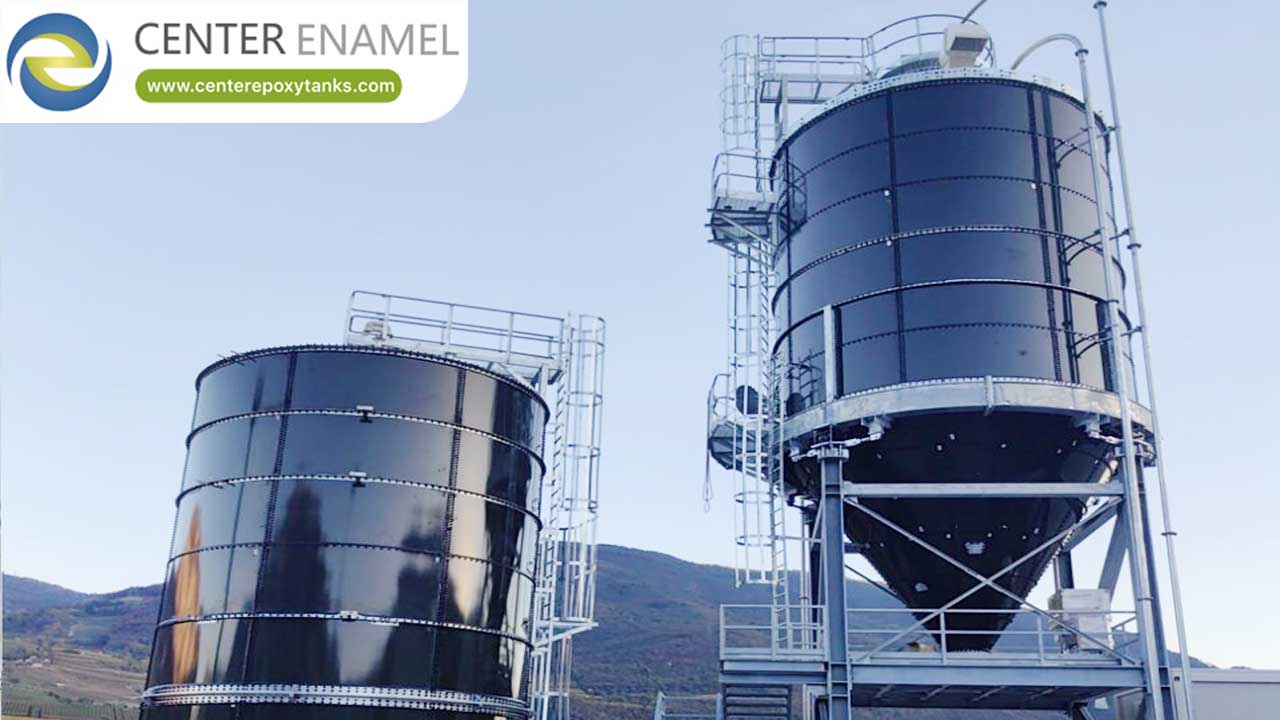
An Italian bulk dry goods project required sealed, aerated storage for grain-class commodities with complete discharge and relocatable capacity. Center Enamel supplied four glass-fused-to-steel bolted tanks totaling 1,082 m3: two units at 6.12 m diameter by 10.7 m height and two at 5.32 m diameter by 10.2 m height.
The GFS panel system provided the vitreous enamel interior that dry bulk storage demands — smooth, abrasion-resistant and cleanable — with gasketed panel joints supporting the sealing regime. Tanks were bolted on site against the project schedule and delivered complete in November 2024 with coating inspection records for the operating baseline.
Project Reference | 01 Italy Bulk Dry Goods 202411 |
Location | Italy |
Application | Bulk Dry Goods |
Product / Technology | Glass-Fused-to-Steel (GFS) Bolted Tank |
Tank Count | 4 |
Tank Dimensions | φ6.12*10.7m(H), 2 units; φ5.32*10.2m(H), 2 units |
Total Volume | 1082 m3 |
Completion | Delivered and completed 2024-11 |
Supply Scope Note | A relevance grade to this topic |
About Company
Shijiazhuang Zhengzhong Technology Co.,Ltd(Center Enamel) is a professional manufacturer dedicated to the design and fabrication of bolted storage tanks since 2008. Our products range includes Glass-Fused-to-Steel (GFS) tanks, fusion bonded epoxy tanks, stainless steel tanks, galvanized steel tanks and aluminum geodesic dome roofs. With professional enameling R&D team and nearly 200 enameling patents, Shijiazhuang Zhengzhong Technology Co.,Ltd has become the leader in bolted tanks industry of Asia. Our products are certified to ISO9001, NSF61, EN1090, ISO28765, WRAS ,FM, LFGB, BSCI, IS0 45001 and other international standards.
Shijiazhuang Zhengzhong Technology Co., Ltd is not only the first manufacturer in China which produces Glass-Fused-to-Steel tanks, but also the most experienced professional bolted tanks manufacturer in Asia.The engineering & design, product testing and quality system of Center Enamel Glass-Fused-to-Steel tanks is in strict accordance with AWWA D103-09, OSHA, ISO 28765, NSF/ANSI 61, NFPA and other international standards. Until 2023, Center Enamel bolted tanks have been exported to more than 100 countries including USA, Australia,Canada, Malaysia, Indonesia, Russia, UAE, Panama,Brazil and South Africa etc., the superior tank quality and prompt service gains us worldwide recognition.
As an outstanding containment and cover system provider with decades of industry experience, Shijiazhuang Zhengzhong Technology Co., Ltd sincerely expects to establish long-term cooperation with the local partners throughout the world and make continuous contribution to the development of the industry.
Suggested CTA
Center Enamel delivers welded steel silos / galvanized engineered for grain and dry bulk storage duty, with silo fabrication, bolted and welded configurations, aeration integration. Contact our engineering team for selection and procurement guidance on your next grain storage silo project — including sizing, standards compliance and delivery scheduling.
Frequently Asked Questions
Q: What is the difference between aeration and drying in grain storage?
A: Aeration moves low volumes of ambient air to equalize temperature and prevent moisture migration; drying moves large volumes of heated air to remove moisture. Aeration is a preservation system; drying is a processing system with much higher airflow and energy demand.
Q: Why do conical-bottom silos cost more per tonne?
A: The cone structure uses more steel and creates a taller building than a flat bottom with a sweep auger. Below a few thousand tonnes the complete-discharge and no-machinery advantages usually justify the premium; above that scale, flat bottoms dominate.
Q: What makes a silo gas-tight for fumigation?
A: Gasketed and sealed construction throughout — eaves, hatches, aeration openings and eaves lines — verified by pressure-decay testing after erection and maintained through scheduled gasket replacement. The fumigation is only as effective as the worst seal in the silo.
Q: How is self-heating detected before spoilage spreads?
A: Through temperature monitoring at multiple depths — cables or wireless sensors — read against intake temperature and ambient conditions. Crusting near the top center is the classic late-stage symptom; the intervention decision belongs at the first temperature trend, not the crust.
Q: Are bolted silos suitable for commercial grain storage?
A: Yes. Factory-coated bolted silos serve the agricultural and commercial band from hundreds to several thousand tonnes, offering erection speed, relocatability and documented coating quality. Very large terminals above that band remain welded-silo territory.
Q: What monitoring should a grain silo have as a minimum?
A: Level measurement for inventory, temperature monitoring at multiple depths for condition, and differential-driven aeration controls. For terminals these feed the inventory and quality systems directly; for farm silos, a roof level indicator plus periodic manual probing is the minimum.