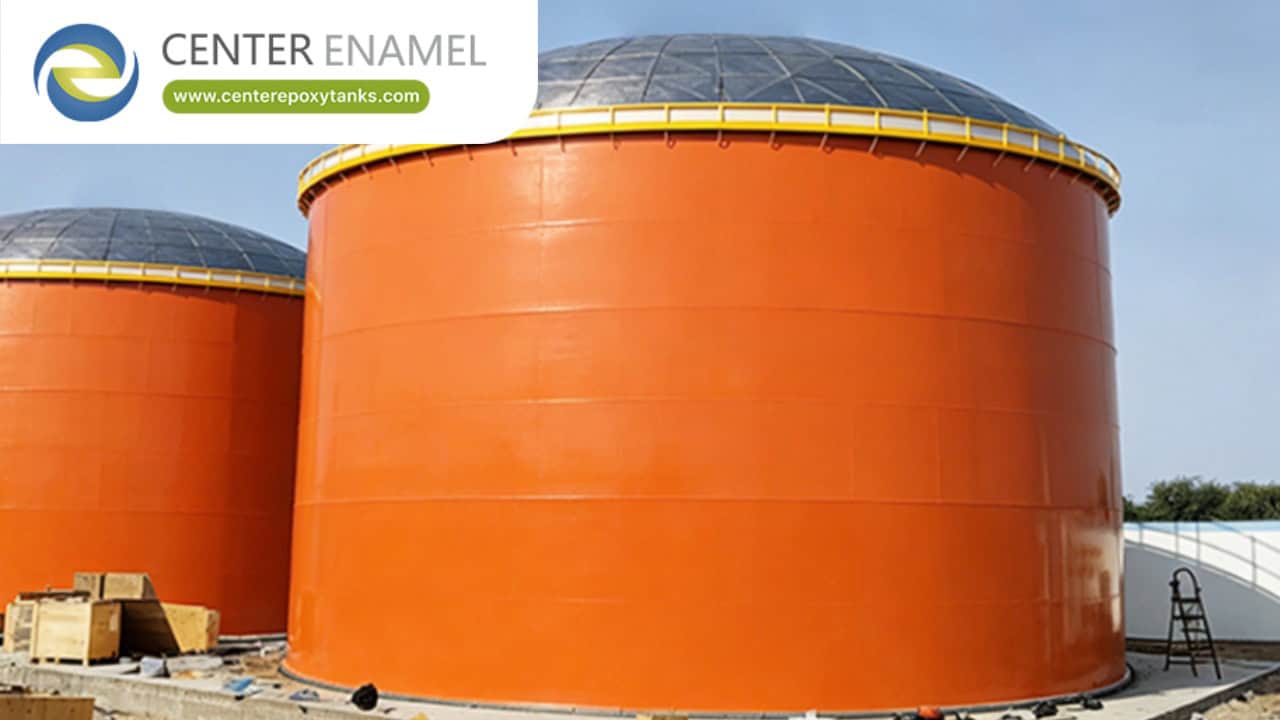
20000 m3 Olive Oil Storage - Engineering a Large Edible Oil Terminal
Twenty thousand cubic metres is terminal scale for edible oil - the kind of capacity a bottler, a blending operation or a national reserve would hold. At that scale the engineering question is no longer simply how to store oil; it is how to store oil of different grades and origins, keep each lot identifiable, protect quality over long residence, and maintain the flexibility to blend and ship without cross-contamination.
Engineered by Shijiazhuang Zhengzhong Technology Co., Ltd. (Center Enamel), large edible oil terminals are designed as manifolded groups of tanks rather than as single vessels, with the material, blanketing and temperature control specified per tank and the manifold designed to keep lots separate.
1. One Large Tank or Several?
Several. A single twenty-thousand cubic metre tank would store oil, but a terminal needs segregation by grade and origin, the ability to clean one tank while others stay in service, and operational flexibility. Manifolded groups deliver all three.
· Grade Segregation: Extra virgin, virgin, refined and pomace oils are kept separate.
· Operational Flexibility: One tank can be cleaned or maintained without stopping the terminal.
· Lot Identity: Separate tanks keep traceability intact for blending and certification.
· Blending Capability: Multiple tanks make controlled blending possible.
· Risk Spread: A quality problem in one tank does not affect the whole inventory.
2. What Material Suits Bulk Edible Oil Storage?
Stainless for smaller tanks and for the highest grades; glass-fused-to-steel or a food-grade lining for larger volumes where the economics favour it. All three provide an inert, cleanable contact surface - the choice is economic and operational.
· Stainless: The premium choice, used for smaller tanks and the highest grades.
· Glass-Fused-to-Steel: A hard, inert, cleanable surface at lower cost for large volumes.
· Food-Grade Lining: Used where a coating is acceptable, with verified preparation and holiday testing.
· Gasket and Fitting Compatibility: Food-grade throughout, with copper and brass excluded.
· Cleanability: Chosen so tanks can be verified clean between lots.
3. How Is Quality Managed at Terminal Scale?
By controlling headspace and temperature in every tank, segregating lots, and sampling on a schedule. At this scale, quality management is a systems problem: the manifold and the procedures matter as much as the tanks.
· Blanketing at Scale: Nitrogen distribution to every tank, with pressure and oxygen monitoring.
· Temperature Control: Insulation and, where needed, cooling to hold the oil in its target range.
· Manifold Design: Routing that allows transfer between tanks without cross-contamination.
· Sampling Regime: Scheduled sampling tracks free acidity and peroxide value per tank.
· Cleaning Between Lots: Access and procedures designed so a tank can be verified clean before a new lot.
Evaluation Criterion | Manifolded Tank Group | Single Large Tank |
Grade segregation | Yes | No |
Maintenance without shutdown | Yes | No |
Lot traceability | Preserved | Lost when blended |
Blending capability | Controlled | Limited |
Quality risk concentration | Spread across tanks | Concentrated |
Engineering Assurance and Project Support
Every welded oil tank delivered by Shijiazhuang Zhengzhong Technology Co., Ltd. (Center Enamel) is designed to API 650 with shell courses sized by the one-foot method and checked for wind, seismic and hydrostatic load cases, or to EN 14015 and the Eurocodes where the site is European. Shell plate is shot-blasted to Sa 2.5 and coated to a documented dry film thickness, longitudinal and annular plate welds are examined by radiography or ultrasonic testing to the acceptance level written into the purchase order, and every tank is hydrostatically tested and dimensionally surveyed before hand-over. Terminal packages include the tank group, manifold and valve arrangement, blanketing distribution, insulation and temperature control, sampling points, cleaning access and the documentation to support traceability.
Frequently Asked Questions (FAQ)
Is a single 20,000 m3 tank practical for olive oil?
It is buildable, but it is rarely the right answer. A terminal needs to segregate grades and origins, clean one tank while others stay in service, and preserve lot traceability for certification. A manifolded group of tanks delivers all of that, whereas a single vessel blends everything and stops operations whenever it needs attention.
What material is used for very large edible oil tanks?
Stainless is the premium choice and is used for smaller tanks and the highest grades. For large volumes, glass-fused-to-steel gives a hard, inert, cleanable surface at substantially lower cost, and food-grade linings are used where a coating is acceptable. Food-grade gaskets and the exclusion of copper and brass apply in every case.
How is olive oil quality protected over long storage at this scale?
Through headspace and temperature control in every tank, segregation of lots, and scheduled sampling. Blanketing is distributed to each tank with pressure and oxygen monitoring, insulation and cooling hold the oil in its target range, and free acidity and peroxide value are tracked per tank so a problem is caught early.
Can the terminal be customised for our operation?
Yes. Tank number and sizes, material per tank, blanketing distribution, insulation and cooling, manifold and valve arrangement, blending provision, sampling points, cleaning access and instrumentation are all engineered to your grades, throughput and traceability requirements.


