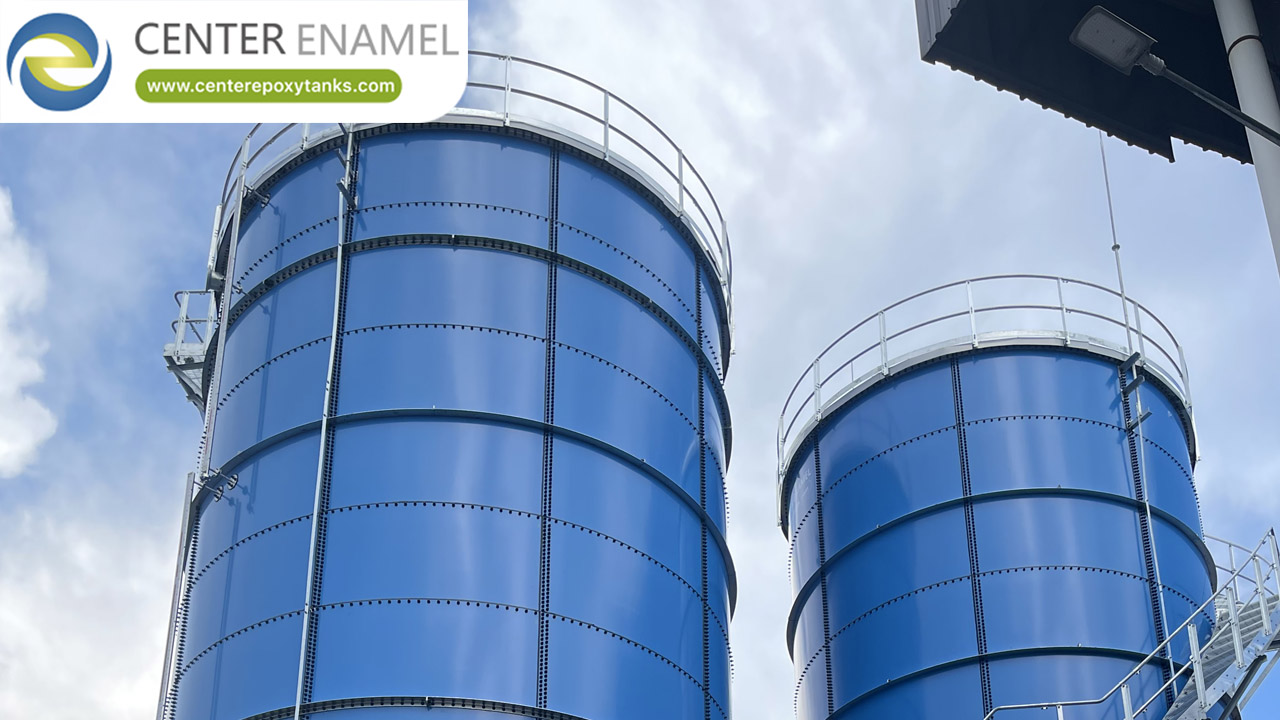
What is a Sludge Storage Tank?
A sludge storage tank is a process buffer vessel at a wastewater treatment plant or industrial facility that stores concentrated sludge — the solids-rich by-product of biological and chemical treatment — between thickening, stabilization, dewatering, and disposal.
Sludge is punishing storage media. Solids content of two to eight percent creates continuous abrasion, anaerobic conditions generate H2S and methane, and mixers impose constant structural loads on walls and roofs. Epoxy coated bolted steel sludge tanks combine the structural strength to carry mixers, bridge covers, and dense liquid loads with a factory-fused FBE lining that resists both the abrasion and the chemical attack.
Why Sludge Storage Tanks Fail Early
Sludge storage is where unlined concrete and field-welded steel tanks deteriorate fastest — the combination of abrasion, gas, and constant agitation strips coatings and exposes structure within years rather than decades.
l Grit and solids abrade site-applied coatings down to bare steel.
l Anaerobic pockets generate H2S that converts to sulfuric acid on walls and roof undersides.
l Mixer loads and torque cracking damage concrete basins that were never designed as process vessels.
The Engineering and Fusion-Bonding Process
Every panel of an epoxy coated sludge storage tank passes through an automated, factory-controlled protection sequence:
1. Surface Preparation (Shot Blasting): Premium structural steel plates undergo automated grit or shot blasting to achieve a pristine anchor profile, removing all rust, mill scale, oils, and surface impurities.
2. Electrostatic Powder Application: Specialized thermoset epoxy powder is applied uniformly across both sides of the steel panels using automated electrostatic spray equipment.
3. Thermal Cross-Link Curing: The coated sheets pass through precision tunnel ovens (150°C to 250°C), where the epoxy powder melts, flows, and chemically cross-links into a dense, continuous protective polymer film.
4. Rigorous Quality Control & Holiday Testing: Every individual panel undergoes strict dry film thickness verification and high-voltage holiday spark testing (typically at 1,100V to 1,500V) to guarantee absolute zero pinholes or micro-discontinuities.
Technical Performance Matrix: Sludge Storage Technologies
Technical Parameter | Epoxy Coated Bolted Steel Sludge Tanks | Cast-in-Place Concrete Basins | Open Sludge Lagoons |
Abrasion & Corrosion Resistance | Dense FBE film withstands grit abrasion and H2S attack | Surface erodes; acid attack on rebar and concrete matrix | Unlined; liner damage and bank erosion common |
Structural Capability | High-strength steel carries mixers, bridges, and roof loads | Mixer torque cracks walls; structural retrofit expensive | No mounted equipment; no process capability |
Sealing & Emissions | Gasketed gas-tight construction with covered roof options | Cracks leak odor and leachate into groundwater | Open surface; odor, methane slip, and rainwater ingress |
Lifespan & Maintenance | 30+ year service life with minimal intervention | Ongoing crack repair and relining programs | Dredging, liner repair, and eventual closure liability |
Sludge Storage Tank Applications
l Thickened sludge holding ahead of dewatering centrifuges or belt presses
l Digester feed sludge buffering and blending
l Digested sludge and biosolids storage prior to land application
l Truck loading and haul-out buffer storage
l Sludge blending and concentration equalization
l Chemical sludge storage from industrial water treatment plants
Key Advantages of Epoxy Coated Sludge Storage Tanks
1. Built to Carry Process Loads
Bolted steel tank walls are engineered for the bending moments and vibration of top-entry or side-entry mixers, jet mixing systems, and heavy bridge covers — loads that crack concrete basins designed for static water only.
2. Dual Defense Against Abrasion and Corrosion
The factory-fused, cross-linked epoxy film resists the grit abrasion of concentrated sludge while blocking the H2S and moisture that generate sulfuric acid on tank surfaces.
3. Covered, Sealed, and Expandable
Gas-tight roofs capture odor and methane, and modular panels let storage capacity grow with sludge production — a common requirement as plants upgrade from secondary to tertiary treatment.
Quality Standards and Proven References
Center Enamel's epoxy coated and glass-fused-to-steel tanks are engineered in strict accordance with AWWA D103-09, OSHA, ISO 28765, and EN 1090, and manufactured under ISO 9001 and ISO 45001 certified quality systems. As the first manufacturer of glass-fused-to-steel tanks in China — holding nearly 200 enameling patents — Center Enamel has delivered bolted tank projects to more than 100 countries, including a 16,760 m³ biogas project in Inner Mongolia and wastewater and biogas references for global environmental leaders such as Paques and Veolia.
Frequently Asked Questions (FAQ)
Q: What solids content can a bolted sludge tank store?
A: Epoxy coated bolted tanks routinely store sludge from one to eight percent dry solids, with structural design adapted for higher density loads and continuous mixing duty.
Q: Can mixers and other equipment be mounted on these tanks?
A: Yes. Tank walls and roofs are structurally engineered for mixer bridges, davit cranes, pump decks, and access walkways as part of the design process.
Q: Can sludge tanks be covered to control odor?
A: Yes. Options include flat bolted covers, membrane roofs, and aluminum geodesic domes that contain odor and, where required, collect off-gas for treatment.
Q: What is the expected lifespan of an epoxy coated sludge storage tank?
A: When manufactured in strict compliance with international design codes (such as AWWA D103) and properly maintained, an epoxy coated sludge storage tank is engineered for a dependable operational lifespan exceeding 30 years.


