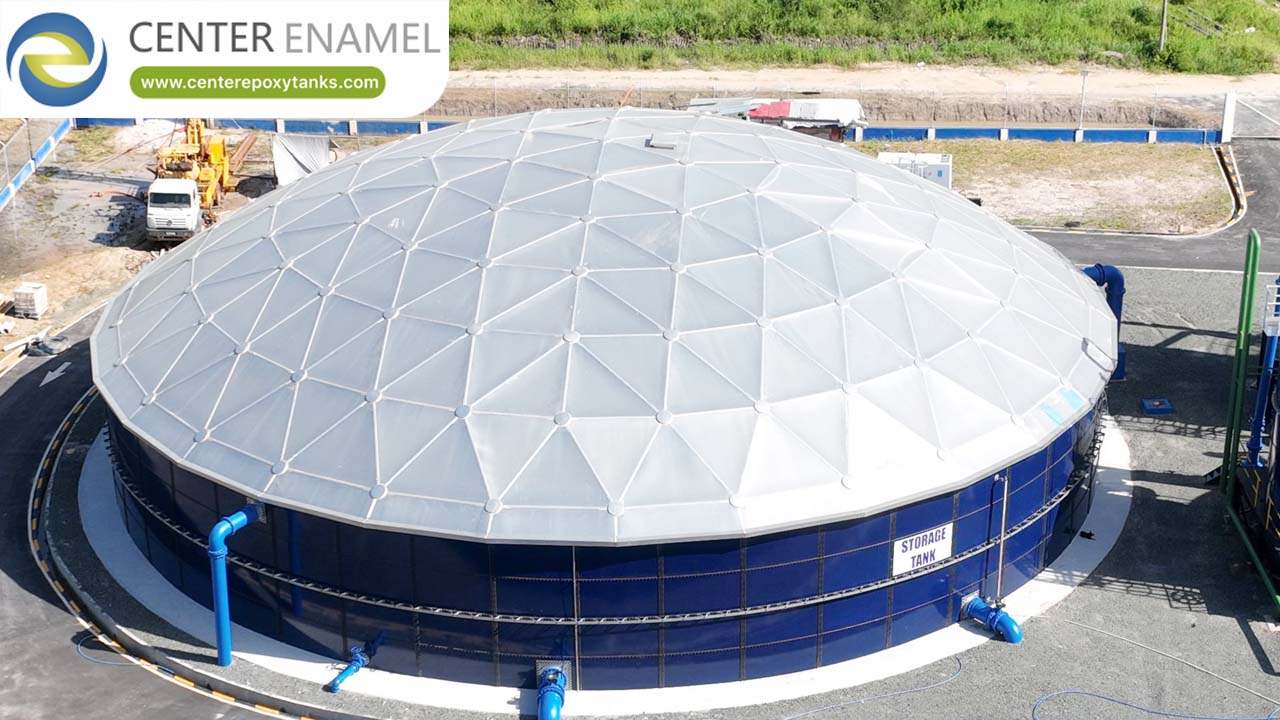
Why Are Industries Choosing Aluminum Geodesic Dome Roofs?
The global storage tank industry is witnessing a strategic shift in infrastructure design. As facility managers, EPC contractors, and municipal engineers seek to minimize lifecycle costs while maximizing structural safety, the preference for Aluminum Geodesic Dome Roofs over traditional fixed carbon steel roofs has become definitive.
As a premier global innovator in the bolted tank sector since 2008, Shijiazhuang Zhengzhong Technology Co., Ltd (Center Enamel) has observed this transition firsthand. From wastewater treatment plants to high-capacity crude oil storage, the industry’s willingness to adopt aluminum dome technology is driven by four critical pillars: material science, operational safety, logistical efficiency, and total cost of ownership.
1. Material Superiority: Corrosion Resistance and Purity
Unlike carbon steel roofs, which act as a constant maintenance liability due to oxidation and scaling, aluminum offers inherent chemical and atmospheric resilience.
● Self-Passivating Barrier: Aluminum naturally develops a stable, self-healing oxide layer when exposed to air. This makes it immune to the rust and corrosion that typically plagues fixed steel roofs in humid or aggressive industrial environments.
● Contamination Control: Because aluminum does not rust, there is zero risk of iron oxide scale falling into the stored medium. This is a critical advantage for industries where product purity is paramount, such as potable water storage or refined chemical processing.
2. Operational Safety: The "Zero Hot-Work" Advantage
Refineries and chemical plants operate in environments where safety is the highest priority. The ability to install a roof without risking site safety is a major driver for industry adoption.
● Mechanical Assembly: Aluminum geodesic domes are assembled using structural bolts, gaskets, and sealants. This cold-work process completely eliminates the need for on-site welding or grinding, significantly reducing fire hazards during installation.
● Operational Continuity: Because no hot-work permits are required, these roofs can be installed or retrofitted on tanks that are located within active, high-risk industrial zones, allowing facilities to maintain uptime during upgrades.
3. Structural Efficiency and Foundation Savings
Structural engineering dictates that the weight of the roof impacts the entire tank design, from the shell thickness down to the concrete foundation.
● Lightweight Geometry: Aluminum domes are significantly lighter than their steel counterparts. This reduction in dead load allows for more efficient steel shell design and reduces the structural requirements of the concrete foundation.
● Clear-Span Capabilities: Through geodesic triangulation, these roofs provide a self-supporting structure that eliminates the need for internal vertical support columns. This removes potential friction points and interior obstructions, facilitating easier tank cleaning and maintenance.
4. Economic and Logistical Optimization
Global infrastructure projects require components that are easy to transport and quick to assemble.
● Flat-Pack Shipping: Dome components are designed for modular, flat-pack logistics. This enables the entire structure to be shipped in standard containers, drastically reducing international ocean freight costs and simplifying delivery to remote project sites.
● Long-Term Value: While aluminum domes may represent a specific capital expenditure, the total cost of ownership (TCO) is significantly lower than steel roofs. The elimination of periodic blasting, painting, and corrosion monitoring makes these domes a superior long-term asset.
Technical Comparison at a Glance
Feature | Aluminum Geodesic Dome | Fixed Carbon Steel Roof |
Corrosion | Inherently resistant (no painting) | High (requires frequent maintenance) |
Weight | Lightweight (optimized load) | Heavy (requires reinforcement) |
Installation | Modular, cold-work (safe) | Intensive, welding-heavy (risk) |
Internal Span | Clear-span (no columns) | Column-supported |
Service Life | 30+ years | 20–25 years (variable) |
Engineering for the Future
The industry’s willingness to choose Aluminum Geodesic Dome Roofs is a response to the demand for smarter, safer, and more cost-effective infrastructure. By leveraging advanced manufacturing automation and rigorous quality control—competencies that define Center Enamel’s operations—facility managers can secure their assets for a 30+ year service life while minimizing ongoing operational risks.
Are you evaluating roof options for your next storage infrastructure project? Contact Center Enamel to consult with our specialized engineering team regarding the structural, logistical, and economic benefits of implementing an API 650/AWWA D108 compliant aluminum dome roof.


