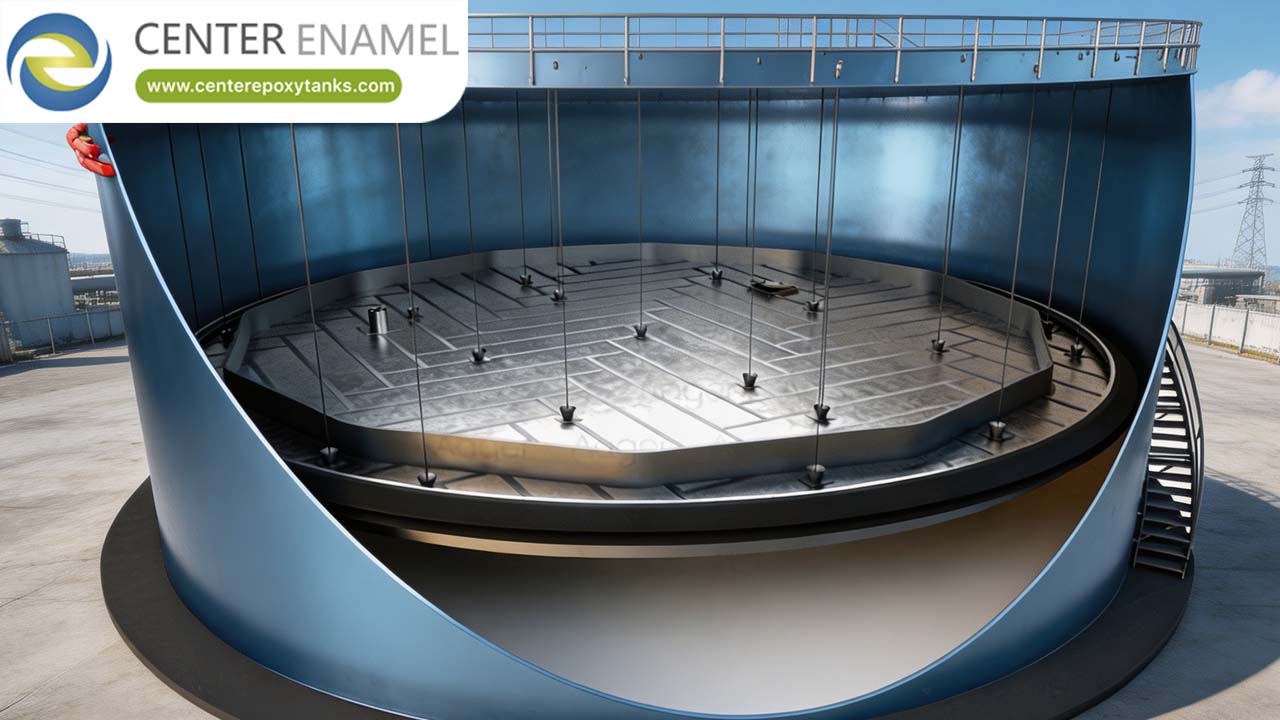
What Is an Internal Floating Roof Tank
An internal floating roof tank is a fixed-roof storage tank with a buoyant deck that sits on the stored liquid, which removes most of the vapor space above the product and cuts the evaporation a fixed cone roof alone would allow. The assembly is governed by API 650 Annex H and described by EPA AP-42, and it is a standard storage-tank technology rather than a proprietary product. The deck-and-seal arrangement is the practical part a buyer specifies, and the cover roof, where one is used, is a separate supply such as an aluminum geodesic dome. The working mechanism - how the deck floats, seals and moves through fill and drawdown - is covered by the separate how-it-works page. This page defines the assembly, its parts and where it is used so a buyer can name the technology and scope an enquiry. It does not describe any Center Enamel internal floating roof supply, because that technology is not part of the documented product range drawn on for this batch.
What the assembly actually is
The assembly is a tank with two roofs: a conventional fixed roof at the top, and a deck that floats on the liquid below it. The floating deck may be a pontoon-type non-contact deck that rides on tubular pontoons above the liquid, or a full-contact honeycomb or sandwich deck that sits in contact with the surface. Between the deck edge and the tank wall sits a rim seal that moves with the deck. The space between the floating deck and the fixed roof is kept small and vented. The defining feature is that the deck follows the liquid, so there is almost no exposed liquid surface for vapor to come from, which is what reduces evaporation compared with a fixed roof alone.
Why the fixed roof above it is vented
The fixed roof above the floating deck is intentionally vented to atmosphere. Because the deck has removed almost all the vapor space, what little remains above the deck is kept at near-atmospheric pressure through vents, so the fixed roof is not asked to be a pressure envelope. This is what distinguishes an internal floating roof tank from a pressurized or blanketed system. The buyer should understand that the emission control lives at the liquid surface, and the fixed roof's job is weather protection and safe venting, not vapor containment.
Where internal floating roofs are used
Internal floating roofs are specified wherever a stored volatile liquid would otherwise lose product to evaporation from a fixed cone roof, so the typical duties are crude oil, gasoline and other light refined products, and some chemical and petrochemical services. They are less common on non-volatile or heavily contaminating products, where a fixed roof or a different cover is the simpler choice. The duty decides the deck and seal, not habit, which is why the product and its volatility belong in the enquiry before the roof type is fixed. A buyer should match the technology to the product rather than assume it fits every tank.
Deck types in brief (pontoon and full-contact)
Two deck families appear in practice. A pontoon or non-contact deck uses annular pontoons with a deck plate held slightly above the liquid, leaving a thin vapor gap under the plate; it is lighter and tolerant of product level changes. A full-contact honeycomb or foam sandwich deck rests on the liquid and leaves essentially no vapor pocket, which can lower emissions further but is more sensitive to product and to deck damage. The choice depends on the product volatility, purity and the service. This page only frames the distinction so a buyer can scope an enquiry; the deck-and-seal selection is covered in more depth by the deck-type topic.
The wind-gap effect and the domed-EFR note
A related point from EPA AP-42 is that a domed external floating roof, where a fixed aluminum dome covers an external floating deck, blocks wind across the deck so the wind-dependent loss component drops to near zero. An internal floating roof already removes the vapor space by floating on the liquid; the wind effect is a separate external-roof consideration. A buyer comparing options should keep the internal and external floating roof mechanisms distinct rather than merge their loss claims. The cover roof, where one is used, is addressed by the cover-roof relationship below.
How an IFR relates to a separate cover roof
An internal floating roof is the deck inside the tank; it is frequently paired with a fixed or domed cover roof above it. Where a project needs that cover roof, the aluminum geodesic dome is the Center Enamel supplied product in this batch's range, while the floating deck itself is a complementary technology drawn from the standard API 650 Annex H practice. The two are separate supplies, and a buyer should scope them as two items - the deck and the cover - rather than one roof. Conflating them is a common source of a mis-stated supply scope in an enquiry.
Scope note on the covered IFR and this page
Scope note: this definition page treats the internal floating roof as a standard storage-tank technology governed by API 650 Annex H, not as a Center Enamel product line. The Center Enamel range drawn on for this batch covers Glass-Fused-to-Steel, Fusion Bonded Epoxy, stainless steel, hot-dip galvanized tanks and aluminum geodesic dome roofs, but internal floating roofs are not among them. No Center Enamel internal floating roof case or supply is claimed here; the floating deck is a complementary technology and any cover dome is the CE supply where one is used.
What this page does and does not claim
This page defines the internal floating roof assembly, its parts, the vented fixed roof above, the typical duties and the cover-roof relationship. It does not quote an emission reduction percentage, because any such figure depends on the product, seal, deck and fill pattern and must come from a tested submittal. It does not describe a Center Enamel internal floating roof, because that is not a documented product line. The working mechanism and the deck-and-seal selection belong to the how-it-works and deck-type topics, not to a definition page.
Internal floating roof assembly map
Use this to separate the components and their real roles.
Component | What it does | Where the control lives | Watch-out |
Floating deck | Removes vapor space | At the liquid surface | Not a pressure envelope |
Rim seal | Closes wall gap | Primary emission control | Seal suits the product |
Fixed roof above | Weather and venting cover | Vented, not pressurized | Vents must be maintained |
Cover roof (if used) | Separate supply | Often an Al geodesic dome | Scope deck and cover apart |
What this page lets a reader verify
These are the points a buyer should take into an IFR enquiry.
Claim | What the page states | Record to request |
Technology | Standard API 650 Annex H | Annex H edition cited |
Product fit | Seal and deck suit product | Material compatibility note |
Supply scope | No CE IFR product line | Confirm cover roof separately |
Mechanism | Covered by how-it-works page | Ask for buoyancy basis |
Frequently Asked Questions
Q1. What is an internal floating roof tank in one sentence?
It is a fixed-roof tank with a deck that floats on the stored liquid, removing almost all the vapor space above the product and cutting evaporation compared with a fixed cone roof alone. The deck is sealed at the wall by a rim seal, and the fixed roof above is kept vented. It is a standard technology governed by API 650 Annex H, not a proprietary product.
Q2. What are the two roofs in the assembly?
There is a conventional fixed roof at the top and a buoyant deck that floats on the liquid below it. The deck removes the vapor space, and the fixed roof above stays vented as a weather and access cover, not a pressure envelope. The rim seal closes the narrow gap at the wall that the deck cannot fully cover, which is where the residual emission lives.
Q3. Where are internal floating roofs used?
They are specified wherever a volatile liquid would otherwise lose product to evaporation from a fixed cone roof, so the typical duties are crude oil, gasoline and other light refined products, and some chemical services. They are less common on non-volatile or contaminating products, where a fixed roof is the simpler choice. The product and its volatility decide the fit.
Q4. What deck types appear in practice?
Two families: a pontoon or non-contact deck that rides on tubular pontoons above the liquid, and a full-contact honeycomb or sandwich deck that rests on the liquid. The pontoon deck is lighter and tolerant of level changes; the full-contact deck can lower emissions further but is more sensitive to product and damage. The deck-and-seal selection is covered in depth by the deck-type topic.
Q5. Is an internal floating roof a Center Enamel product?
No. The documented Center Enamel range drawn on for this batch lists Glass-Fused-to-Steel, Fusion Bonded Epoxy, stainless steel, hot-dip galvanized tanks and aluminum geodesic dome roofs, but not internal floating roofs. Where a covered IFR tank is referenced, the aluminum geodesic dome is the cover roof supplied; the floating deck is a complementary technology, and no CE IFR case or supply is claimed here.
Q6. How does an internal floating roof relate to a cover roof?
The internal floating roof is the deck inside the tank; it is often paired with a fixed or domed cover roof above it. Where a cover roof is needed, the aluminum geodesic dome is the Center Enamel supplied item in this batch's range, while the floating deck is a complementary technology. A buyer should scope the deck and the cover as two separate supplies, not one roof.
Q7. What is deliberately out of scope on this definition page?
This page defines the assembly, its parts and where it is used. It does not quote an emission reduction percentage, certify compliance, describe a Center Enamel IFR supply, or explain the float-seal mechanism in depth. The mechanism belongs to the how-it-works page and the deck selection to the deck-type topic, not to a definition page.
Q8. How should an IFR enquiry be written from this page?
State the product and its volatility, the tank diameter, the fill pattern, and whether a cover roof is also needed. Ask suppliers for the deck and seal type, the material compatibility, the API 650 Annex H edition, and a test basis for any emission figure rather than a bare percentage. Those lines turn the definition into a scopable enquiry.
Conclusion
An internal floating roof tank is a fixed-roof tank with a buoyant deck that sits on the stored liquid, removing almost all the vapor space above the product and cutting the evaporation a fixed cone roof alone would allow. The fixed roof above is vented and acts as a weather cover, not a pressure envelope, and the assembly is the standard API 650 Annex H technology it is. This page defines the assembly, its parts, the duties and the cover-roof relationship, and points the mechanism to the how-it-works page. It does not describe a Center Enamel internal floating roof, because that is not a documented line; where an aluminum geodesic dome is the cover roof, that is the Center Enamel supplied item. A reader should name the technology and scope an IFR enquiry.
Talk to an Engineer
To scope an internal floating roof enquiry, send the stored product and its volatility, the tank diameter, the expected fill and drawdown pattern, and whether a separate cover roof is also required. Ask each supplier for the deck and seal type, the material compatibility with the product, the API 650 Annex H edition referenced, and a test basis for any emission figure rather than a bare percentage. Note that if an aluminum geodesic dome is needed as the cover roof, that is a separate Center Enamel supply from the floating deck itself. With those inputs the internal floating roof can be specified as a verifiable technology rather than accepted on a marketing claim that conflates the deck, the seal and the cover roof.
About Center Enamel
Shijiazhuang Zhengzhong Technology Co., Ltd (Center Enamel) has designed and fabricated bolted storage tanks since its registration in 2008; the founding team's enamelling work dates to 1989. The product range covers Glass-Fused-to-Steel (GFS), Fusion Bonded Epoxy (FBE), stainless steel and hot-dip galvanized tanks, and aluminum geodesic dome roofs. Certifications and standard references in the supplied fact base are scoped per product line, not held as a blanket claim for every product. No performance, service life or project outcome beyond the cited sources is claimed here.


