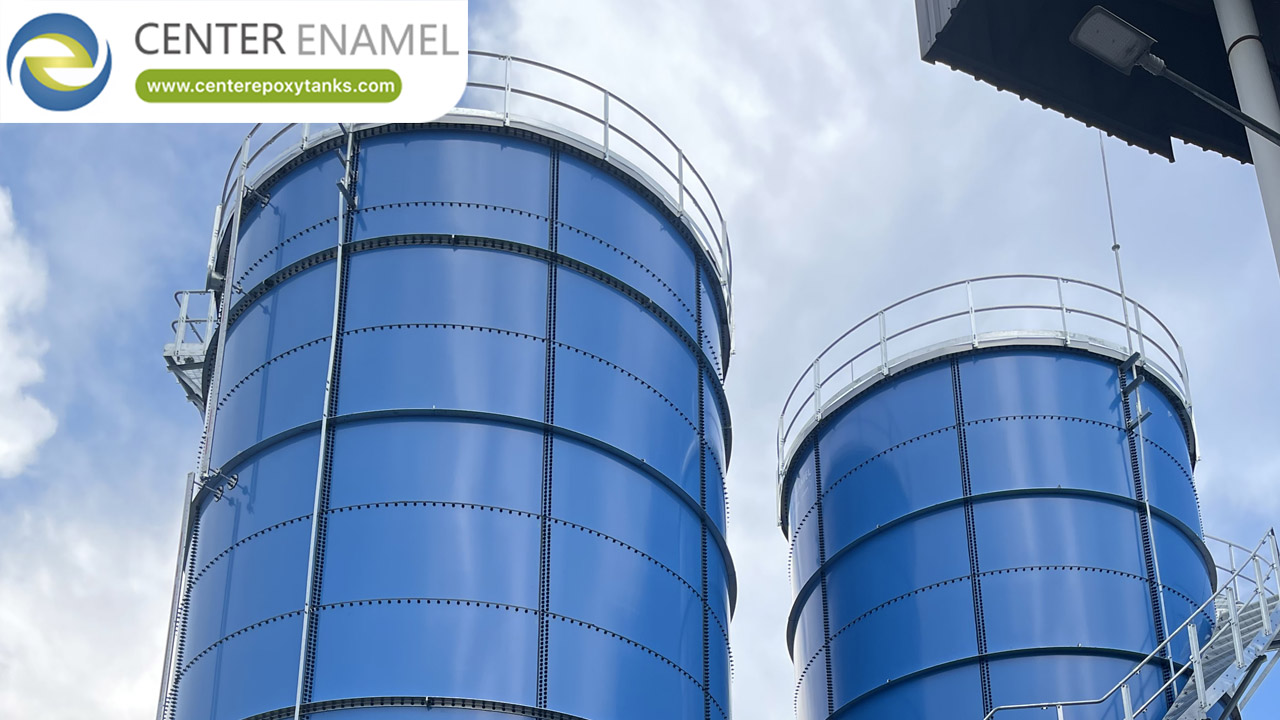
What is an FBE Grain and Grain Byproduct Storage Tank?
An FBE (Fusion Bonded Epoxy) grain and grain byproduct storage tank is an advanced modular, bolted steel industrial container engineered specifically to securely store bulk cereal grains, corn, wheat, soybeans, flour, starch, milling residues, and feed byproducts (such as DDGS and meal) under strictly controlled, sanitary, and moisture-resistant conditions.
In the agricultural processing, feed manufacturing, and biofuel production sectors, storing organic grain materials and moisture-sensitive byproducts presents unique engineering challenges. Byproducts like animal feed meals and wet-distiller residues can be sticky, slightly acidic, or prone to microbial spoilage and wall friction if stored in rough or unsealed containers. FBE grain storage tanks combine the exceptional structural tensile strength of carbon steel panels with a factory-applied thermoset epoxy powder coating that is thermally fused to the substrate. This creates an ultra-smooth, impermeable, and chemically inert interior barrier designed to safeguard product quality, prevent bridging, and ensure long-term structural integrity over decades of service.
The Engineering and Fusion-Bonding Process
The reliability, surface smoothness, and protective endurance of an FBE grain and byproduct storage tank depend on a precise, factory-controlled manufacturing workflow:
1.
Substrate Surface Preparation (Shot Blasting): Premium structural steel plates undergo automated grit or shot blasting to achieve an optimal anchor profile (conforming to rigorous industrial standards like SSPC-SP 10), removing all surface oxidation, mill scale, and residual oils.
2.
3.
Electrostatic Powder Application: Specially formulated, high-performance thermoset epoxy powder is applied uniformly across both sides of the steel panels using automated electrostatic spray equipment.
4.
5.
Thermal Cross-Link Firing: The coated sheets enter high-performance thermal ovens (ranging from 150°C to 250°C), where the epoxy powder melts, flows, and chemically cross-links into a dense, continuous protective polymer film.
6.
7.
Rigorous Quality Control & Holiday Testing: Every individual panel undergoes strict dry film thickness verification and high-voltage holiday spark testing (typically at 1,100V to 1,500V) to guarantee absolute zero pinholes or micro-discontinuities.
8.
Technical Performance Matrix: Grain Storage Technologies
Technical Parameter | FBE Bolted Steel Grain Tanks | Traditional Galvanized Steel Silos | Cast-in-Place Concrete Silos |
Interior Friction & Flow | Ultra-smooth FBE surface minimizes wall friction, preventing material bridging and hang-ups | Standard galvanized panels feature moderate friction; prone to corrosion pitting over time | Rough concrete walls can trap organic dust and create high friction for sticky byproducts |
Moisture & Pest Protection | Impermeable, sealed bolted design blocks moisture ingress and pest infiltration | Joints and corrugations require careful sealing to prevent moisture leaks | Prone to concrete micro-cracking, moisture seepage, and mold growth |
Installation Velocity | Rapid modular bolted assembly; significantly reduces project lead times on-site | Rapid erection, though sheet alignment requires precise gasket placement | Extremely slow; requires extensive formwork, pouring, and multi-week curing |
Modularity & Scalability | Easily expanded, modified, or relocated as agricultural facility demands grow | Rigid cylindrical footprint; difficult to modify or expand once erected | Permanent civil structure; expansion or relocation is virtually impossible |
Key Advantages in Agricultural and Feed Processing Facilities
1. Ultra-Smooth Interior Prevents Bridging and Material Hang-ups
Grain byproducts, meals, and sticky milling residues often suffer from poor flow characteristics, leading to bridging and channeling inside traditional silos. The glass-like, non-porous finish of an FBE coating significantly reduces friction against the tank walls, promoting smooth "mass flow" discharge and complete cleanout during emptying operations.
2. Superior Resistance to Moisture and Microbial Spoilage
Organic grains and feed ingredients are highly susceptible to spoilage if exposed to moisture or corrosion-induced leaks. The dense, cross-linked polymer barrier of an FBE tank prevents water infiltration and shields the stored product from metallic contact, maintaining feed hygiene and safety.
3. Rapid Modular Erection and Long-Term Durability
Agricultural processing plants require reliable bulk storage that can be installed quickly without disrupting operations. FBE grain tanks utilize prefabricated, bolted panel assemblies that eliminate hazardous field welding while delivering a robust structural lifespan exceeding 30 years.
Frequently Asked Questions (FAQ)
Q: What is an FBE grain and grain byproduct storage tank used for?
A: An FBE grain and grain byproduct storage tank is used to securely store bulk grains, corn, wheat, soybeans, flour, starch, and feed milling byproducts like DDGS and meal under hygienic, moisture-resistant conditions.
Q: How does an FBE coating help with sticky grain byproducts?
A: The high-temperature thermoset epoxy coating creates an ultra-smooth, non-porous interior surface that dramatically reduces wall friction, preventing agricultural byproducts from sticking, bridging, or hanging up during discharge.
Q: How are the panels of an FBE grain tank joined together to maintain a seal?
A: The modular steel panels are assembled using high-tensile structural bolts and specialized agricultural-grade elastomeric or polyurethane sealants designed to maintain a 100% moisture-tight, airtight seal.
Q: What is the expected service life of an FBE grain storage tank?
A: When manufactured in strict compliance with international industrial design codes (such as AWWA D103 or relevant agricultural structural standards) and properly maintained, an FBE storage tank is engineered for a dependable operational lifespan exceeding 30 years.


