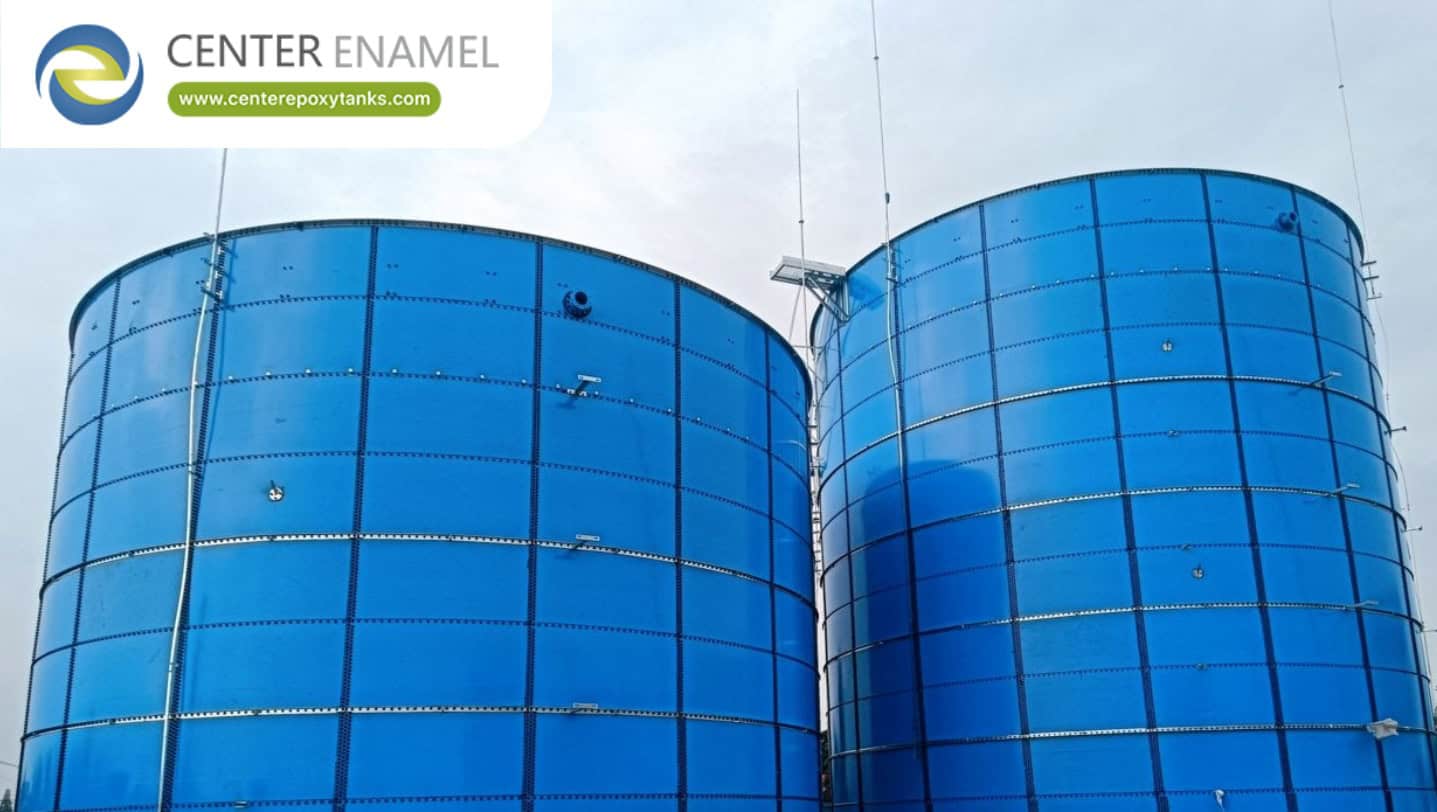
What is an FBE Fertilizer Storage Tank?
An FBE (Fusion Bonded Epoxy) fertilizer storage tank is a specialized modular bolted steel container engineered specifically to safely hold concentrated agricultural chemicals, liquid fertilizers (such as Urea Ammonium Nitrate, liquid nitrogen, and phosphates), and micronutrients.
Unlike standard water storage vessels, liquid fertilizers present unique engineering challenges: they feature higher densities (elevated specific gravity), aggressive chemical profiles, and corrosive properties that rapidly degrade conventional carbon steel or weaken untreated plastic structures. FBE tanks combine high-strength structural steel sheets with a factory-applied thermoset epoxy coating that is electrostatically sprayed and thermally fused. This creates an impenetrable, chemically inert, and corrosion-resistant barrier designed to withstand aggressive fertilizer chemistry for decades.
The Engineering and Coating Manufacturing Process
The long-term durability of an FBE fertilizer tank relies on a strict, automated factory-controlled manufacturing workflow:
1.
Surface Preparation (Shot Blasting): Premium structural steel plates undergo automated grit or shot blasting to achieve a pristine anchor profile, eliminating all surface impurities and oxidation.
2.
3.
Electrostatic Powder Application: Specialized high-performance epoxy powder (such as advanced Resicoat formulations) is applied uniformly across the steel panels using automated electrostatic spray guns.
4.
5.
Thermal Curing: The coated sheets pass through precision tunnel ovens (ranging from 150°C to 250°C), where the epoxy powder melts, flows, and chemically cross-links into a dense, continuous protective polymer film.
6.
7.
Rigorous Quality Control & Holiday Testing: Every individual panel undergoes strict dry film thickness checks and high-voltage holiday spark testing (typically at 1,100V to 1,500V) to guarantee absolute zero pinholes or micro-discontinuities.
8.
Technical Performance Matrix: Fertilizer Storage Solutions
Technical Parameter | FBE Bolted Steel Fertilizer Tanks | High-Density Polyethylene (HDPE) Tanks | Stainless Steel Storage Tanks |
Chemical Resistance | Excellent; robust cross-linked FBE barrier handles a wide pH range and fertilizer blends | Good for mild blends, but vulnerable to permeation with certain concentrated solutions | Outstanding chemical inertness across most corrosive agricultural chemicals |
Specific Gravity Capacity | Engineered for high-density liquids (up to 1.5–1.9+ SG) with high-tensile steel structural support | Limited structural rigidity; prone to wall bulging under high specific gravity loads | Exceptional structural stability and heavy-duty load handling |
Scalability & Modularity | Modular bolted panels allow easy capacity expansion, dismantling, or relocation | Fixed-volume rotationally molded tanks; impossible to expand or modify | Rigid welded construction; highly complex and expensive to modify or expand |
Lifecycle & Durability | Designed for a 30+ year service life with minimal maintenance requirements | Susceptible to UV degradation and weathering over extended outdoor exposure | Extremely long lifespan, though subject to high initial capital expenditure |
Key Advantages of FBE Tanks in Agricultural Operations
1. High Specific Gravity Handling
Liquid fertilizers are significantly heavier than water, placing immense hydrostatic pressure on storage walls. FBE tanks utilize high-strength structural carbon steel panels engineered to withstand high specific gravity thresholds (often up to 1.5 to 1.9 SG), preventing wall bowing or catastrophic structural failure.
2. Elimination of Corrosion and Leaks
Agricultural chemicals easily oxidize bare steel and embrittle low-grade plastics. The fused epoxy barrier prevents direct contact between the chemical solution and the steel substrate, ensuring complete immunity to rust scaling, stress corrosion cracking, and environmental seepage.
3. Rapid Modular Installation
Because FBE tanks are fabricated in factories and assembled on-site using specialized bolts and high-performance elastomeric sealants, they can be erected rapidly without the delays, weather constraints, or fire hazards associated with field-welded alternatives.
Frequently Asked Questions (FAQ)
Q: What makes FBE tanks suitable for storing liquid fertilizers compared to standard water tanks?
A: Liquid fertilizers have a higher specific gravity (are much heavier than water) and possess aggressive chemical properties that cause rapid oxidation or structural degradation in standard water tanks. FBE fertilizer tanks feature high-strength steel engineering combined with a chemically resistant, heat-fused epoxy coating designed to handle dense, corrosive agricultural blends.
Q: Can FBE tanks store both liquid nitrogen and phosphate-based fertilizers?
A: Yes, provided the specific formulation of the FBE coating is evaluated against the specific chemical compound and concentration. The cross-linked polymer matrix provides broad pH and chemical tolerance suitable for various commercial fertilizer blends.
Q: How are the panels sealed to prevent fertilizer leaks?
A: The modular steel panels are joined using high-tensile structural hardware and high-performance elastomeric sealants (such as specialized PU or EPDM grades) designed to remain chemically inert and watertight under constant liquid pressure.
Q: What is the expected lifespan of an FBE fertilizer storage tank?
A: When manufactured in accordance with international standards like AWWA D103 and properly maintained, an FBE fertilizer tank is engineered to deliver a dependable operational lifespan exceeding 30 years.


