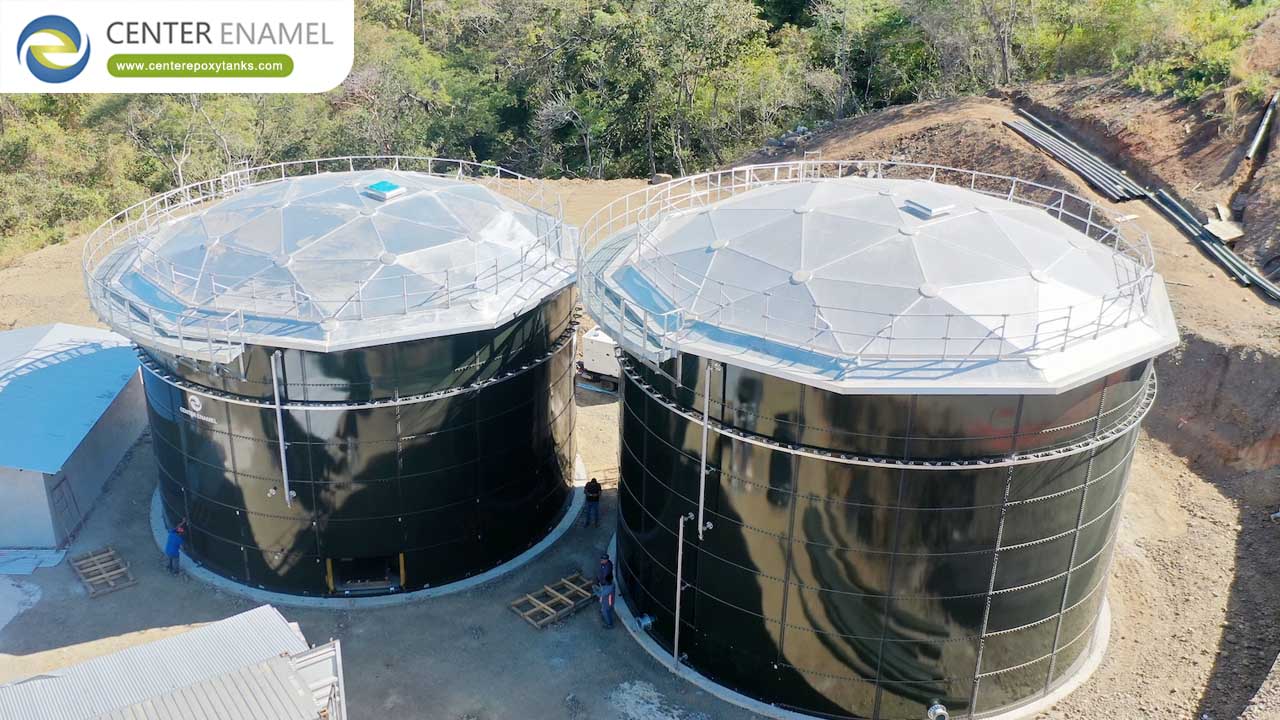
What is an Aluminum Dome Roof?
An Aluminum Dome Roof (often referred to as an Aluminum Geodesic Dome or AGDR) is a high-performance, self-supporting structural cover used primarily for large-diameter storage tanks. Unlike traditional steel cone roofs that require internal columns, an aluminum dome utilizes a sophisticated "space-frame" geometry—a network of interconnected triangular aluminum struts and panels—to achieve a "clear-span" structure.
Because it relies on the tank shell for support rather than internal beams or columns, the aluminum dome is the preferred solution for liquid storage in the oil and gas, municipal water, and wastewater treatment sectors.
Why the "Geodesic" Design Matters
The structural integrity of an aluminum dome roof is derived from its geometry, not its mass. By arranging lightweight aluminum components into a series of interconnected triangles, the structure distributes loads (such as snow, wind, and internal pressure) across the entire surface area.
Key Operational Advantages:
Clear-Span Capability: With zero internal columns, there is no obstruction inside the tank. This is critical for industrial processes that require top-entering mixers, aeration systems, or internal floating roofs.
Inherent Corrosion Resistance: Aluminum naturally forms a microscopic, self-healing oxide layer. It does not rust, making it immune to the hydrogen sulfide (H₂S) gas and moisture common in wastewater and petroleum applications.
Low Dead Load: Aluminum is significantly lighter than steel. This reduces the stress on the tank shell and foundation, often allowing for lower construction costs for the tank itself.
Environmental Protection: The dome acts as a protective shield against wind, rain, and snow. It also prevents the "breathing" of the tank, which minimizes evaporation losses in volatile chemical or oil storage.
Technical Comparison: Aluminum Dome vs. Fixed Roof
The following table compares the modern Aluminum Geodesic Dome with traditional storage methods.
Feature | Aluminum Geodesic Dome | Fixed Steel Cone Roof | Concrete Roof |
Internal Supports | Clear-span (Zero Columns) | Requires Internal Columns | Requires Massive Columns |
Corrosion Resistance | Excellent (Inert Material) | Low (Requires Painting) | Moderate (Requires Coating) |
Weight/Load | Ultra-Lightweight | Heavy | Extremely Heavy |
Installation Speed | Fast (Bolted/Modular) | Slow (Field Welding) | Very Slow (Pouring/Curing) |
Maintenance | Minimal (Maintenance-Free) | High (Periodic Recoating) | High (Crack Repair) |
Where Are They Used?
Oil & Gas: Used as a vapor-tight cover to minimize VOC (Volatile Organic Compound) emissions and evaporation losses in refined fuel tanks.
Water Treatment: Protects potable water reservoirs from airborne contamination, debris, and UV-induced algae growth.
Wastewater Treatment: Ideal for anaerobic digesters or clarifiers where a gas-tight seal is required to contain odors and collect biogas.
Bulk Dry Storage: Used to protect dry bulk products (like coal or grain) from moisture and environmental degradation.
Frequently Asked Questions (FAQ)
1. Can an aluminum dome be retrofitted to an existing steel tank?
Yes. Because these roofs are lightweight and clear-span, they are often used to replace aging, corroded steel cone roofs on existing tanks without needing to modify the tank shell or foundation.
2. How long is the service life of an aluminum dome roof?
When designed and fabricated in accordance with global standards like API 650 (Appendix G) or AWWA D108, an aluminum geodesic dome can easily exceed a service life of 30 to 40 years with virtually zero maintenance.
3. Does the dome require internal painting or coatings?
No. This is one of its primary benefits. Aluminum is naturally corrosion-resistant, so the dome does not require internal painting, sandblasting, or recoating—even in harsh, chemically aggressive environments.
4. How does the roof handle snow and wind loads?
The geodesic geometry is one of the strongest structural forms in nature. The interconnected triangular panels transfer loads across the entire structure, allowing the dome to withstand extreme wind speeds and heavy snow accumulations according to local building code requirements.
5. Is it possible to install equipment like mixers on the roof?
Yes. The aluminum dome can be engineered to support localized loads, including vents, hatches, and equipment mounts. Because it is a rigid space frame, you can mount necessary process equipment without compromising the structural integrity of the roof.


