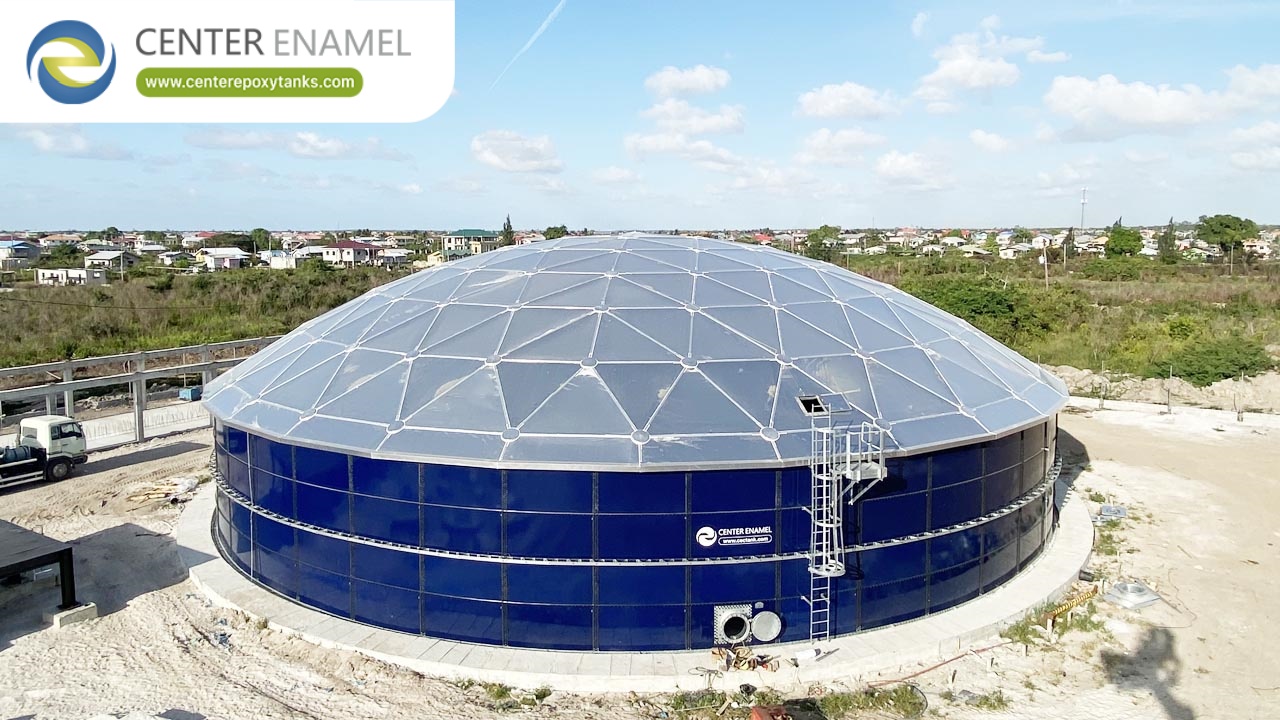
What Is an Aluminum Dome Roof? Comprehensive Engineering Guide to Geodesic Tank Covers
In modern industrial storage, municipal water treatment, wastewater management, and petroleum processing, protecting aboveground storage tanks (ASTs) from harsh environmental elements is crucial for asset longevity and emission control. Traditional fixed-roof structures—such as heavy welded carbon steel cone roofs or poured concrete domes—frequently suffer from severe atmospheric corrosion, high structural dead loads, and complex maintenance requirements.
To overcome these structural limitations, industry professionals rely on Aluminum Dome Roofs (ADRs), also widely known as Aluminum Geodesic Dome Roofs. Combining advanced aerospace geometry with corrosion-resistant metallurgy, aluminum dome roofs represent the pinnacle of modern tank cover engineering.
The Engineering Principle: What Makes a Geodesic Dome Unique?
An aluminum dome roof is a self-supporting, curved structural shell composed of numerous precision-engineered aluminum panels, structural struts, gusset plates, and tension hubs arranged along mathematical geodesic lines.
Triangulated Space-Frame Geometry: The dome's structure breaks down curved surfaces into a dense network of interconnected triangles. Because triangles are geometrically rigid, any external force applied to the roof is distributed evenly across the entire frame, providing exceptional resistance against heavy snow loads, high-velocity winds, and seismic activity.
Clear-Span Capability (Zero Internal Columns): Unlike traditional cone roofs that require internal support poles or central columns for large-diameter reservoirs, aluminum geodesic domes are entirely self-supporting. The entire weight of the dome transfers outward to the tank wall perimeter, leaving the interior completely unobstructed.
Inherent Material Corrosion Resistance: Fabricated primarily from high-strength marine-grade aluminum alloys (such as the 5000 and 6000 series), the metal forms a naturally passivated oxide layer. This eliminates rusting completely, making it ideal for humid, chemical-laden, or corrosive tank headspace environments.
Data Table: Aluminum Dome Roofs vs. Traditional Tank Roofing Systems
Technical Parameter | Aluminum Geodesic Dome Roof | Welded Steel Cone Roof | Cast-in-Place Concrete Cover |
Material Composition | High-strength marine-grade aluminum alloy | Carbon steel plate | Reinforced structural concrete |
Corrosion Resistance | Excellent; natural oxide passivation prevents rust entirely | Low; highly vulnerable to moisture and atmospheric oxidation | Moderate; prone to carbonation, sulfate attack, and spalling |
Internal Support Structure | Self-supporting clear span (zero internal columns required) | Requires center support poles or internal rafters | Requires heavy monolithic formwork and interior pillars |
Installed Dead Load | Extremely lightweight; minimizes structural load on tank walls | Heavy structural dead load | Extremely heavy monolithic dead load |
Maintenance Profile | Near-zero maintenance (no periodic painting or recoating) | High; requires frequent abrasive blasting and repainting | Moderate; periodic crack sealing and surface treatment |
Governing Standards | AWWA D108, API 650 Annex G, ASCE 7-10, ISO 9001 | API 650 / Standard steel codes | ACI Structural Concrete Standards |
Key Benefits and Industrial Applications
Aluminum dome roofs are widely adopted across diverse sectors due to their unique operational and environmental advantages:
Volatile Organic Compound (VOC) & Odor Control: Precision-engineered batten bar or lapped panel joints combined with specialized gasketing systems create a secure, vapor-tight seal that traps emissions and controls wastewater odors.
Drastically Reduced Dead Load: Because aluminum is exceptionally lightweight compared to steel or concrete, the dome imposes minimal structural strain on tank walls and foundations, making it the premier choice for retrofitting aging infrastructure.
Core Industrial Sectors: Commonly installed on potable water reservoirs, municipal sewage clarifiers, anaerobic digesters, fire protection tanks, and bulk petroleum storage facilities.
Frequently Asked Questions (FAQ)
Q: What is an aluminum dome roof?
A: An aluminum dome roof is a self-supporting, lightweight industrial tank cover built using an interconnected network of triangular aluminum struts and panels arranged in a geodesic geometry to provide maximum strength and clear-span coverage.
Q: Do aluminum dome roofs require internal support columns?
A: No. Aluminum geodesic domes are entirely self-supporting, transferring all structural loads directly to the tank wall perimeter, which eliminates internal columns and simplifies tank maintenance.
Q: Can an aluminum dome roof be installed on an existing storage tank?
A: Yes. Because aluminum is lightweight, geodesic domes can be custom-designed and retrofitted onto existing steel or concrete tanks without requiring costly structural reinforcement of the walls or foundations.
Q: What international standards govern aluminum dome roofs?
A: Quality aluminum dome roofs are engineered in strict compliance with major international benchmarks, including AWWA D108 (for water and wastewater structures), API 650 Annex G, ASCE 7-10 (wind and snow load design), and ISO 9001.


