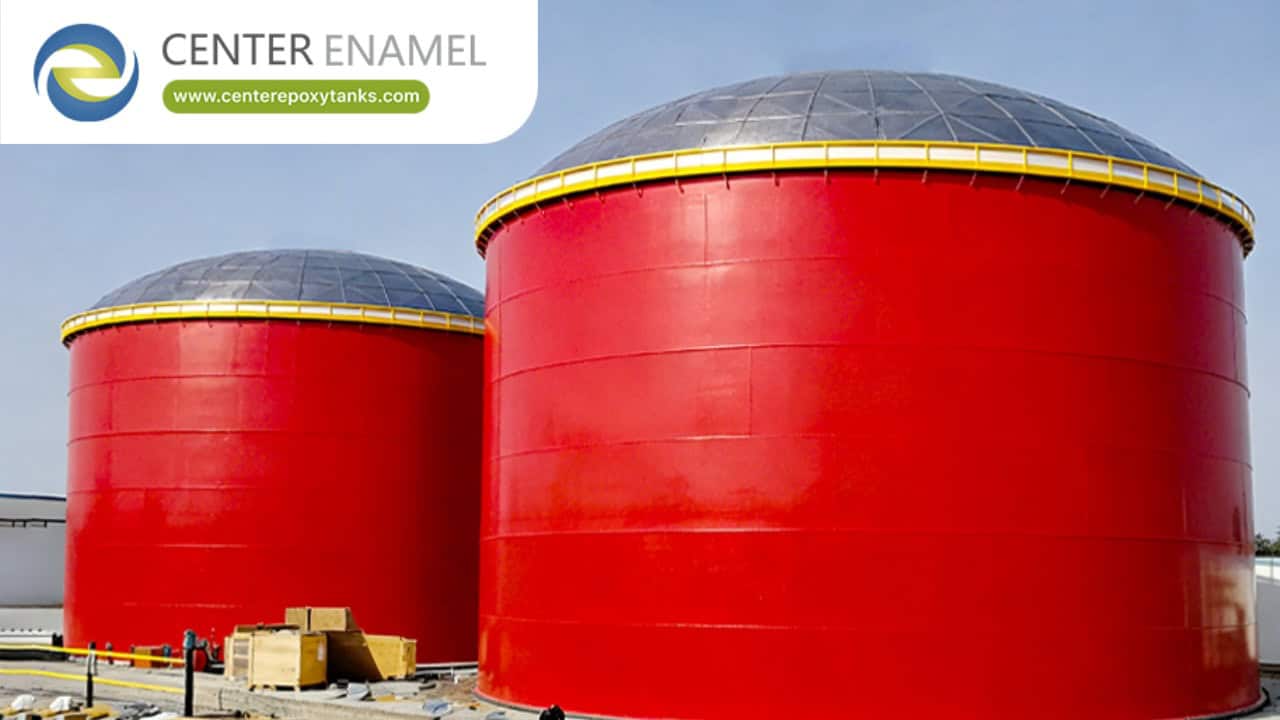
What is a Welded Steel Wastewater Tank?
A welded steel wastewater tank is a high-capacity industrial vessel specifically engineered to contain municipal sewage, industrial process effluent, or sludge. Constructed by fusing large steel plates together through continuous welding processes (such as Submerged Arc Welding or TIG), these tanks create a monolithic, seamless structure that is essentially one single piece of steel.
In the wastewater industry, where leaks are not just costly but environmentally hazardous, the welded steel tank is the preferred choice for massive, long-term infrastructure projects. By integrating high-performance internal linings, these tanks combine the immense structural strength of steel with the chemical resistance necessary to endure harsh wastewater environments.
Why Choose Welded Construction for Wastewater?
Wastewater containment presents a unique challenge: the liquid is often chemically aggressive, fluctuating in temperature, and highly abrasive. Welded steel construction offers distinct advantages for these conditions:
Monolithic Leak Prevention: Wastewater treatment regulations are stringent. Because a welded tank has no joints, bolts, or rubber gaskets, there is zero risk of seepage at the seams—a common failure point in modular bolted tanks.
Structural Permanence: Unlike modular tanks that rely on mechanical components, a welded tank is a permanent structure. It is the gold standard for large-scale municipal facilities where the tank is expected to remain in service for 40+ years.
High-Volume Scalability: Field-erected welded tanks have virtually no upper size limit. Whether you need a 500,000-gallon buffer tank or a 5-million-gallon primary clarifier, welded steel can be engineered to meet the site-specific footprint and hydrostatic requirements.
Comparison: Welded vs. Alternative Wastewater Containment
Feature | Welded Steel Tanks | Bolted Steel Tanks | Concrete Basins |
Seam Integrity | Monolithic (Continuous weld) | Gasketed (Mechanical) | Expansion joints (Prone to crack) |
Installation | High skilled (Hot work) | Fast (Bolt-up) | Very slow (Pour & Cure) |
Chemical Resistance | High (with proper lining) | Moderate (coating dependent) | Low (permeable) |
Lifespan | 40-50+ Years | 20-30 Years | Varies (30-50 years) |
The Critical Role of Linings and Coatings
Steel is structurally perfect for wastewater, but bare steel cannot survive wastewater chemistry. Wastewater often contains sulfides, chlorides, and bacteria that actively corrode carbon steel. Therefore, every welded steel wastewater tank must be paired with an engineered lining system:
Fusion Bonded Epoxy (FBE): A heat-cured, powder-coated lining that provides a dense, chemical-resistant barrier.
High-Build Epoxy/Polyurethane: Applied in multiple layers to provide sacrificial protection and chemical resistance.
Cathodic Protection: Active or passive systems often installed in conjunction with linings to prevent electrochemical corrosion at any small pinholes in the lining.
Frequently Asked Questions (FAQ)
Q: Why is a welded tank better for wastewater than a concrete tank?
A: Concrete is naturally porous and prone to cracking under seismic stress or foundation shifting, which can lead to groundwater contamination. Welded steel is ductile; it flexes with the load and seismic shifts, and because it is welded into one piece, it creates a much more reliable, leak-proof barrier for hazardous industrial effluents.
Q: Do I need a liner for my welded steel wastewater tank?
A: Yes. Wastewater is highly corrosive. Without a high-performance epoxy, polyurethane, or specialized rubber lining, the wastewater will rapidly oxidize the steel shell, leading to structural failure. The lining is the primary line of defense.
Q: Can welded tanks be used for high-temperature industrial effluent?
A: Yes. One of the major advantages of welded steel is its thermal tolerance. While liners have temperature limits, the steel shell itself can handle temperatures far exceeding those of bolted panel gaskets, which would typically melt or fail in high-heat industrial processes.
Q: Does Center Enamel design welded steel wastewater tanks?
A: Yes. Center Enamel provides comprehensive EPC (Engineering, Procurement, and Construction) services. We don't just supply the tank; we provide the complete containment solution, including precise engineering, automated field welding, NDE (Non-Destructive Examination) testing, and the application of high-performance internal linings suitable for your specific wastewater pH and chemical composition.
Q: How long does a welded steel wastewater tank last?
A: When properly lined and maintained with a cathodic protection system, these tanks are built to last over 40 to 50 years. The shell integrity is permanent; the maintenance cycle focuses on the lining and coating condition, which can be easily inspected and touched up as needed.


