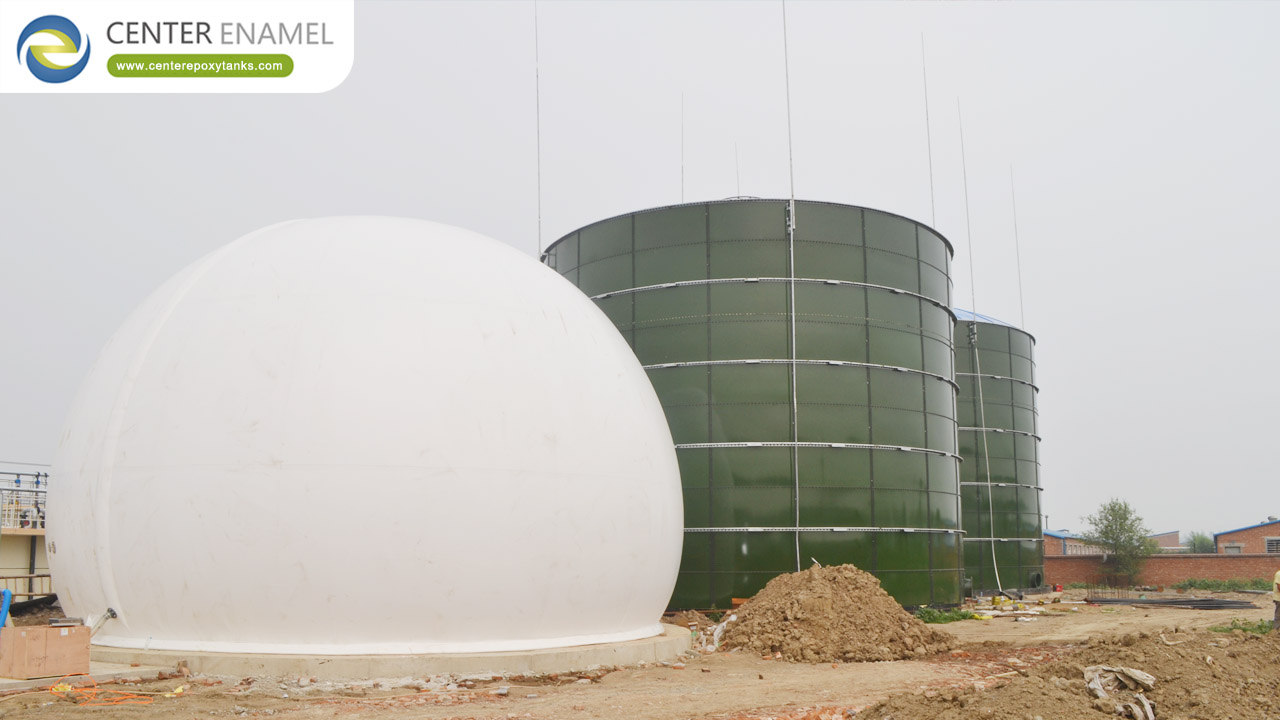
What Is a Stand-Alone Gas Holder?
In modern renewable energy infrastructure, industrial chemical processing, and wastewater treatment, managing fluctuating gas production requires reliable storage buffers. A stand-alone gas holder is an independent, variable-volume, low-pressure gas containment system anchored directly to its own dedicated concrete foundation. Unlike traditional gasholders that are mounted directly on top of anaerobic digester tanks, a stand-alone unit operates as a completely separate structure on the plant site.
Typically built using advanced double-membrane architecture, stand-alone gas holders are engineered to store neutral gases safely—most commonly biogas, methane, carbon dioxide, and air—while automatically adapting to continuous changes in gas generation and consumption rates.
Core Structure and Working Mechanism
A standard stand-alone double-membrane gas holder comprises three primary polymer layers and an automated pressure regulation system:
Bottom Membrane: Seals the storage space directly against the concrete foundation slab, preventing gas leakage and isolating the system from ground moisture.
Inner Membrane: Houses the raw gas directly. It expands upward when gas production increases and contracts downward as gas is consumed by downstream equipment (such as boilers, combined heat and power engines, or flares).
Outer Membrane: Acts as the outer protective shield. An automated support blower continuously pumps air into the interstitial space between the inner and outer membranes, maintaining a constant positive pressure that gives the structure its aerodynamic shape and protects against wind and snow loads.
Constant-Pressure Control Unit: Automatically manages the air volume in the outer chamber to ensure stable gas delivery pressure regardless of how full or empty the inner storage volume is.
Technical Performance Matrix: Stand-Alone Gas Holders vs. Alternative Storage Systems
Performance Dimension | Stand-Alone Double-Membrane Gas Holder | Top-Mounted Digester Gas Holder | Traditional Rigid Steel Gasholder | Fixed-Dome Concrete Gas Vault |
Structural Independence | Completely independent footprint; isolated from primary digestion tanks | Dependent; sits directly on top of the anaerobic reactor structure | Independent, but requires heavy structural framing and foundations | Independent heavy civil structure |
Corrosion Defense | Superior; high-tenacity PVC/PVDF membranes are immune to $H_2S$ and moisture | Moderate to High; underside exposed to corrosive biogas condensate | Low to Moderate; vulnerable to internal rust, requiring frequent recoating | Low; vulnerable to concrete carbonation and acid etching |
Installation Velocity | Rapid; modular components erected quickly on a concrete slab | Moderate; installed during tank roof construction | Slow; intensive plate rolling and field welding | Extremely slow; multi-week concrete curing cycles |
Volume Flexibility & Safety | Dynamic variable volume with built-in pressure safety relief | Dynamic variable volume, but limited by primary tank dimensions | Rigid fixed volume or complex mechanical piston counterweights | Fixed volume capacity with poor surge adaptability |
Key Advantages of Stand-Alone Gas Holders
1. Plant Layout Flexibility
Because stand-alone gas holders do not rely on the structural walls of an anaerobic digester or wastewater basin, they can be positioned anywhere on a facility site. This separation optimizes plant spatial management, simplifies piping layouts, and allows maintenance to be performed on the gas storage system without interrupting primary biological processes.
2. Enhanced Safety and Over-Pressure Protection
Equipped with specialized continuous pressure monitoring, automated blowers, non-return valves, and mechanical/water safety relief valves, stand-alone flexible gasholders safely release excess pressure surges, eliminating catastrophic explosion risks associated with rigid high-pressure vessels.
Frequently Asked Questions (FAQ)
Q: What is the primary function of a stand-alone gas holder?
A: A stand-alone gas holder is designed to safely store and buffer low-pressure industrial gases—such as biogas, methane, or carbon dioxide—balancing variable daily gas production rates with steady consumption by energy generators or industrial burners.
Q: How does a double-membrane stand-alone gas holder maintain its shape?
A: An automated supporting air blower continuously maintains a controlled, positive air pressure in the space between the inner gas storage membrane and the outer protective weather membrane, keeping the structure taut against wind and snow loads.
Q: Are stand-alone gas holders resistant to corrosive gases like hydrogen sulfide ($H_2S$)?
A: Yes. The specialized polymer and PVC/PVDF-coated polyester fabrics used in modern stand-alone gas holders are chemically inert and highly resistant to moisture, ultraviolet radiation, and corrosive trace elements like $H_2S$ found in biogas streams.
Q: Can a stand-alone gas holder capacity be expanded later?
A: Yes. One of the primary operational benefits of modular double-membrane gas holders is that storage capacity can be easily scaled or retrofitted by replacing the membrane assembly to match increased gas yields without requiring civil engineering reconstruction.


