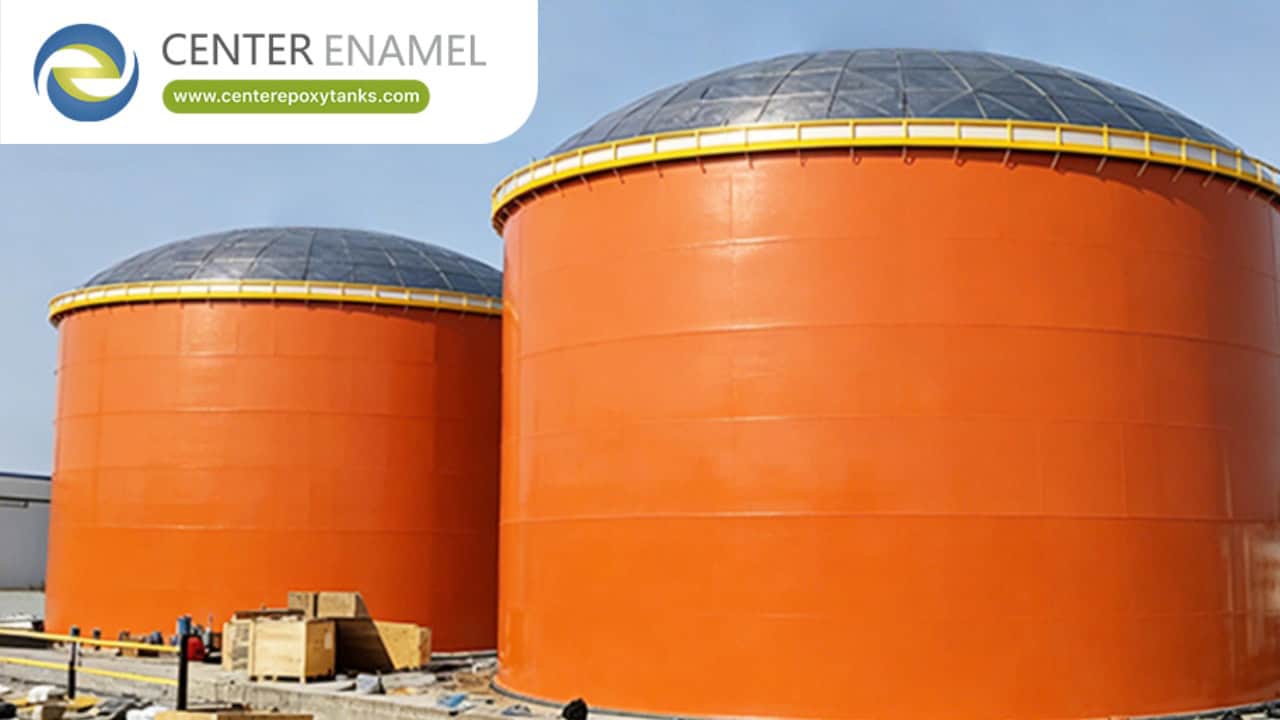
What is a Fixed-Roof Tank?
A fixed-roof tank is an industrial bulk storage vessel consisting of a cylindrical steel shell topped by a permanently attached, immovable roof. Unlike floating-roof tanks—where the roof moves up and down with the liquid level—the roof on a fixed-roof tank remains stationary, creating a fixed vapor space between the liquid surface and the underside of the roof.
These tanks are the most common and cost-effective solution for storing liquids that do not readily vaporize at ambient temperatures, such as water, wastewater, heavy fuel oils, and various chemicals.
Core Engineering & Roof Designs
In industrial manufacturing, fixed-roof tanks are engineered to meet strict international standards, most notably API 650 for welded steel tanks or AWWA standards for bolted water tanks. While the roof is "fixed," its geometry varies based on the tank's diameter, internal pressure requirements, and environmental loads (like snow or wind).
Common fixed-roof geometries include:
Cone Roofs: The most standard design, where the roof slopes upward toward the center, forming a shallow cone. They can be self-supporting on smaller tanks or column-supported on larger diameters.
Dome Roofs: Curved roofs that offer higher structural strength and the ability to withstand slight internal pressures.
Aluminum Geodesic Domes: Often used as fixed roofs on large-scale storage tanks, these lightweight, self-supporting structures offer superior weather protection, require no internal support columns, and are highly resistant to corrosive vapors.
Advanced Material Solutions: Glass-Fused-to-Steel (GFS)
While fixed-roof tanks can be constructed from welded carbon steel or stainless steel, modern industrial storage—particularly in municipal water, wastewater, and biogas sectors—increasingly relies on Glass-Fused-to-Steel (GFS) bolted tanks.
As a leading technology in the storage sector, GFS combines the structural strength of steel with the superior corrosion resistance of glass. In these configurations, a fixed roof (often an aluminum dome or a matched GFS cone roof) seals the highly durable tank shell, making it an ideal containment vessel for harsh environments like anaerobic digesters or chemical leachate storage.
Key Operational Considerations
Because the roof does not rest on the liquid, the vapor space inside a fixed-roof tank expands and contracts due to temperature changes and liquid pumping (filling or emptying). To manage this, fixed-roof tanks require specialized engineering:
Venting Systems: The tank must "breathe." Pressure/Vacuum (P/V) relief valves are installed to allow air or inert gas to enter when the tank is emptied (preventing collapse) and vapors to escape when filled (preventing rupture).
Vapor Recovery: If the stored liquid is volatile or emits hazardous odorous gases (e.g., in wastewater treatment), the fixed roof allows for the capture of these emissions through connected vapor recovery units or flare systems.
Explore the Engineering: Fixed vs. Floating Roofs
Understanding when to specify a fixed-roof tank versus a floating-roof tank is critical for facility design. Use the interactive calculator below to see how product volatility dictates the tank choice:
Frequently Asked Questions (FAQ)
What are the primary applications for fixed-roof tanks?
Fixed-roof tanks are universally utilized for storing municipal drinking water, industrial wastewater, fire-protection water, heavy fuel oils, asphalt, and less volatile chemicals. When constructed with materials like Glass-Fused-to-Steel, they are the industry standard for anaerobic digesters in biogas plants.
Why not use a fixed-roof tank for highly volatile liquids like gasoline?
Highly volatile liquids evaporate quickly. In a fixed-roof tank, this vapor fills the space above the liquid and is pushed out into the atmosphere when the tank is filled, causing significant product loss and environmental pollution. For these liquids, floating-roof tanks (where the roof rests on the liquid, eliminating the vapor space) are required.
Can a fixed-roof tank be pressurized?
Standard API 650 fixed-roof tanks operate at atmospheric pressure or very low internal pressures (typically not exceeding 2.5 psi). If higher pressures are required, the tank design transitions into a specialized pressure vessel (governed by ASME standards) rather than a standard storage tank.
What is "blanketing" in a fixed-roof tank?
Blanketing (or inerting) is the process of injecting a non-reactive gas, usually nitrogen, into the vapor space of a fixed-roof tank. This prevents moisture from entering, protects the product from oxidation, and mitigates the risk of a flammable mixture forming inside the tank.


