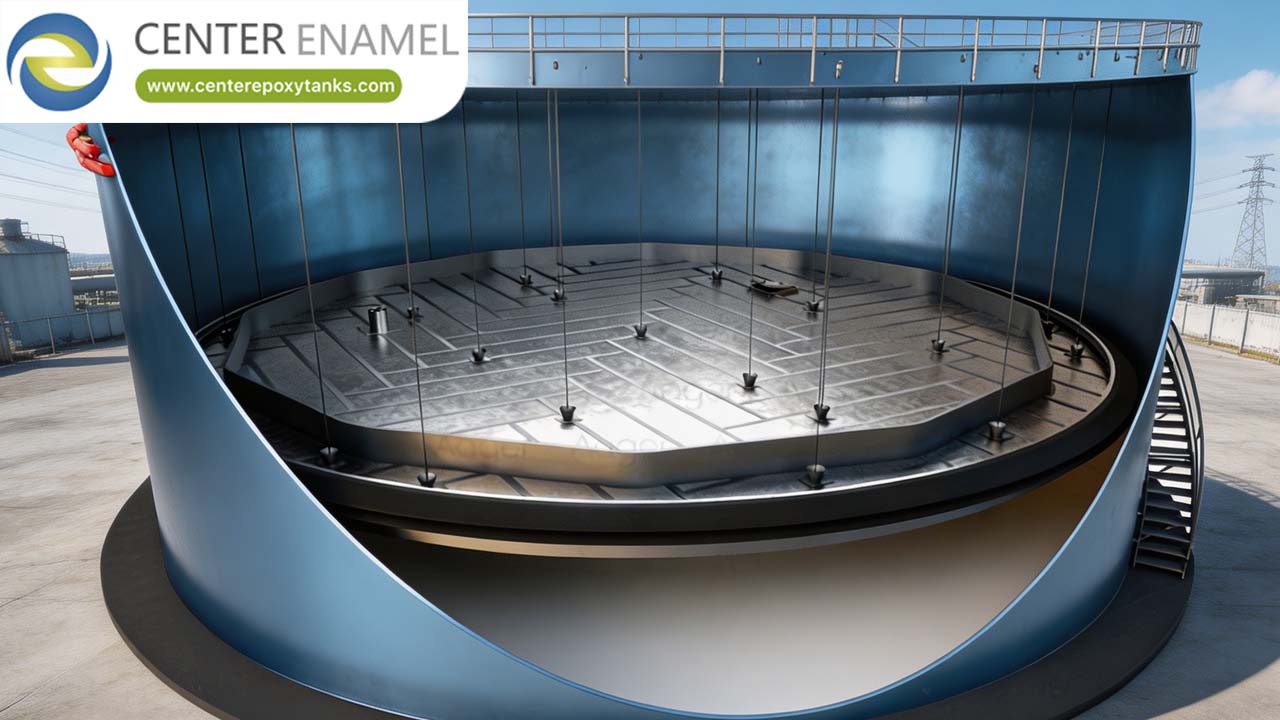
What Are the Components of a Floating Roof Tank? An Engineering Breakdown
In industrial bulk liquid terminals, the safe containment of volatile petroleum products and chemicals relies on specialized vessel design. A floating roof tank features a movable deck that rests directly on the liquid surface, rising and falling dynamically with inventory levels to eliminate the hazardous vapor space (ullage) found in fixed-roof tanks.
To maintain structural integrity, prevent evaporative loss, and ensure environmental compliance under international design standards (such as API 650), a floating roof tank integrates several critical mechanical components.
Core Components of a Floating Roof Tank
1. The Floating Deck (Buoyancy Structure)
The floating deck is the primary operational platform that rides directly on top of the liquid product. It must possess sufficient buoyancy to support its own dead weight plus operational loads (such as workers or equipment during maintenance) without submerging. Decks are typically built in three styles:
·
Pontoon Decks: Features hollow internal compartments around the perimeter, providing buoyancy while leaving the center deck lower.
·
·
Double-Deck Roofs: Constructed with top and bottom steel plates separated by internal bulkheads, offering maximum strength and insulation.
·
·
Full-Contact Decks: A continuous sandwich panel or hollow core that rests entirely flat on the liquid surface, leaving zero air pockets.
·
2. Rim Seal System (Vapor Containment Barrier)
The narrow annular gap between the outer perimeter of the floating deck and the interior wall of the tank shell must be sealed tightly to prevent volatile organic compound (VOC) emissions.
·
Primary Seals: The first line of defense in direct contact with the liquid product, such as mechanical sliding shoe seals or liquid-filled elastomer tubes.
·
·
Secondary Seals: A supplementary wiper seal mounted above the primary seal to provide a redundant barrier against wind currents and vapor evaporation.
·
3. Guide Poles and Anti-Rotation Devices
As the floating roof travels vertically up and down the tank cylinder, it must remain stable. Vertical guide poles or anti-rotation cable systems prevent the deck from twisting, spinning, or binding against the tank shell during rapid filling and emptying cycles.
4. Roof Drains and Rolling Ladders (External Floating Roofs - EFRTs)
Because open-top external floating roof tanks are exposed directly to the elements, precipitation collects on the deck.
·
Roof Drains: A network of articulated sumps and flexible internal drain pipes that safely channel rainwater off the deck and discharge it outside the tank.
·
·
Rolling Ladders: Articulated stairways attached to the tank shell that roll or pivot to provide safe operator access to the floating roof at any liquid level.
·
5. Automatic Bleeder Vents and Vacuum Breakers
During initial tank filling or empty-tank maintenance, pressure differentials can occur beneath the deck. Bleeder vents and vacuum breakers open or close automatically to prevent structural collapse or over-pressurization of the floating deck.
Data Table: Floating Roof Tank Component Matrix
Component Name | Operational Location | Primary Engineering Function | Common Material Specification |
Floating Deck | Liquid surface inside tank | Provides buoyancy and eliminates vapor space | Welded carbon steel or aluminum alloy |
Rim Seal System | Annular gap (Deck-to-shell boundary) | Prevents VOC escape and wind-induced evaporation | Elastomers, Teflon, galvanized steel shoes |
Guide Poles | Vertical axis through deck | Stabilizes roof and prevents rotational binding | Carbon steel or stainless steel tubing |
Roof Drains | Integrated deck sumps | Evacuates accumulated rainwater from open decks | Flexible metallic hose or articulated steel pipe |
Rolling Ladder | Tank shell to floating deck | Provides safe operator access at any liquid level | Structural aluminum or galvanized steel |
Bleeder Vents | Floating deck surface | Prevents vacuum collapse or pressure buildup | Mechanical steel valves with gasket seals |
Frequently Asked Questions (FAQ)
Q: What is the most important component for controlling emissions in a floating roof tank?
A: The rim seal system is critical. While the floating deck eliminates the bulk vapor space, the primary and secondary rim seals close the narrow gap between the deck and tank wall, stopping fugitive VOC emissions from leaking into the atmosphere.
Q: Why do external floating roof tanks require rolling ladders?
A: Because external floating roofs move vertically with the liquid level, standard fixed ladders cannot provide safe access. A rolling or articulating ladder adjusts its angle continuously as the roof rises and falls.
Q: What prevents a floating roof from getting stuck or twisting inside the tank?
A: Guide poles and anti-rotation devices are installed vertically through the deck to keep it aligned, ensuring smooth vertical travel without jamming against the tank shell walls.
Q: Are internal floating roof tanks equipped with roof drains?
A: No. Because internal floating roofs are protected by a permanent fixed outer roof or geodesic aluminum dome, precipitation cannot enter the tank, eliminating the need for deck drains or rolling ladders.


