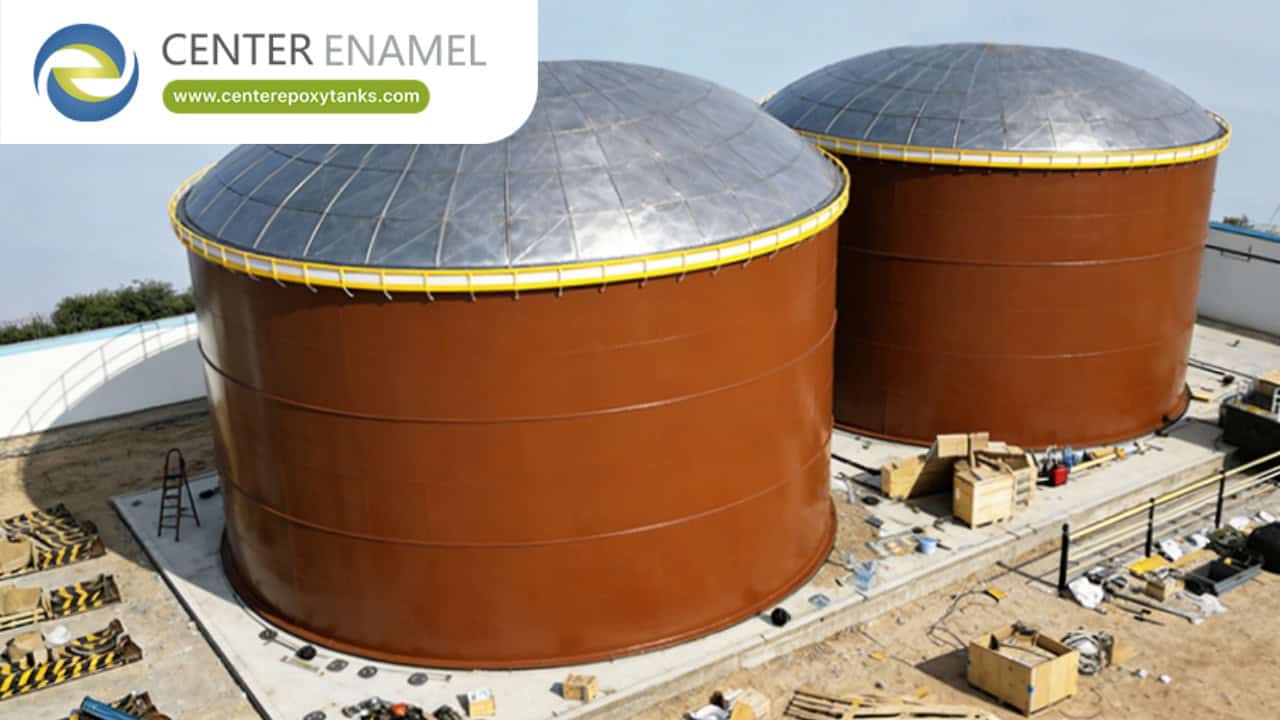
Welded Steel Tanks: Robust Structural Engineering for Industrial and Municipal Liquid Storage
In heavy industry, petrochemical processing, municipal water distribution, and energy infrastructure, the integrity of liquid storage is paramount. When facilities require massive volume capacity, high-pressure tolerance, or containment of hazardous and volatile substances, bolted configurations alone may not suffice. Instead, engineers rely on welded steel tanks—field-erected or shop-welded structures built to withstand the most demanding operating environments.
Built by fusing heavy steel plates together through rigorous welding procedures, welded tanks offer absolute leak-tightness and limitless structural scaling. As a globally trusted leader in advanced liquid storage and containment engineering, Shijiazhuang Zhengzhong Technology Co., Ltd. (Center Enamel) delivers precision-engineered welded steel tanks designed in strict accordance with international standards, ensuring decades of reliable performance.
Engineering Superiority: Governing Standards and Structural Integrity
Welded steel storage vessels are distinguished by strict adherence to internationally recognized engineering codes that dictate plate thickness, weld quality, and seismic resilience:
·
API 650 (Welded Tanks for Oil Storage): The dominant global standard for atmospheric and low-pressure large-scale vertical cylindrical tanks. It governs the storage of crude oil, refined petroleum products, aggressive chemicals, and industrial process liquids, incorporating comprehensive wind and seismic design appendices.
·
·
AWWA D100 (Welded Carbon Steel Tanks for Water Storage): Published by the American Water Works Association, this standard governs municipal water supply systems, elevated storage towers, standpipes, and fire protection reservoirs, ensuring potable water safety and structural durability under heavy hydrodynamic loads.
·
·
Absolute Leak-Tightness via Continuous Welding: Unlike mechanical joints or bolted laps, continuous full-penetration and fillet welds create a monolithic steel shell. This eliminates potential leak pathways, making welded tanks ideal for hazardous or volatile chemical containment.
·
·
Limitless Capacity and Design Customization: Field-erected welded tanks have virtually no practical upper limit on diameter or height. They can be tailored with internal floating roofs, heating coils, specialized nozzles, and complex platform structures.
·
Data Table: Comprehensive Comparison of Industrial Tank Technologies
Technical Parameter | Field-Erected Welded Steel Tanks | Bolted Steel Storage Tanks | Cast-in-Place Concrete Tanks |
Governing Design Codes | API 650, AWWA D100, ASME | AWWA D103, ISO 28765 | ACI Structural Concrete Standards |
Capacity & Scaling Limits | Unlimited capacity; custom field-erected dimensions | High capacity, but bounded by standard panel sizes | Massive permanent structures, non-relocatable |
Structural Integrity | Monolithic welded steel shell; absolute leak-tightness | High-strength bolted panels with specialized sealing gaskets | High compressive strength; prone to cracking and rebar corrosion |
Installation Profile | Complex field welding, NDE testing, and crane erection | Rapid modular bolted assembly using high-tensile hardware | Multi-month multi-stage pouring, formwork, and curing |
Primary Applications | Petroleum refineries, heavy chemicals, large municipal water reservoirs | Potable water, dry bulk, wastewater, agricultural storage | Large municipal water basins, clarifiers, and stormwater vaults |
Key Industrial Applications and Operational Safety
Welded steel tanks serve as critical infrastructure cornerstones across multiple sectors:
1.
Petrochemical and Refining Terminals: Storing crude oil, diesel, gasoline, and fuel additives under strict environmental and fire safety codes.
2.
3.
Municipal Water and Fire Protection: Maintaining large-volume potable water reserves and dedicated fire suppression storage complying with NFPA 22 and AWWA standards.
4.
5.
Heavy Chemical Processing: Containing corrosive or high-temperature industrial liquids using specialized alloy plates (such as stainless or duplex steels) paired with rigorous Non-Destructive Examination (NDE) testing.
6.
Frequently Asked Questions (FAQ)
Q: When should an engineer choose a welded steel tank over a bolted steel tank?
A: Welded steel tanks are selected when storage requirements exceed standard bolted panel dimensions, when governing codes (such as API 650 for oil or heavy chemicals) mandate field-welded construction, or when storing high-pressure and high-temperature process liquids.
Q: What is the difference between API 650 and AWWA D100 standards?
A: API 650 governs welded steel tanks used primarily for petroleum, fuel, and chemical storage under atmospheric or low-pressure conditions. AWWA D100 governs welded carbon steel tanks specifically engineered for municipal water supply, standpipes, and fire protection reservoirs.
Q: How are field welds inspected in welded steel tanks?
A: All field welds are executed by certified technicians and undergo rigorous Non-Destructive Examination (NDE)—including radiographic (RT), ultrasonic (UT), magnetic particle (MT), or vacuum box testing—to guarantee complete structural soundness and leak prevention.
Q: What is the expected lifespan of a properly maintained welded steel tank?
A: With routine inspections (per API 653 guidelines for maintenance and repair) and proper industrial coating or cathodic protection, a field-erected welded steel tank can deliver a reliable operational lifespan exceeding 30 to 50 years.


