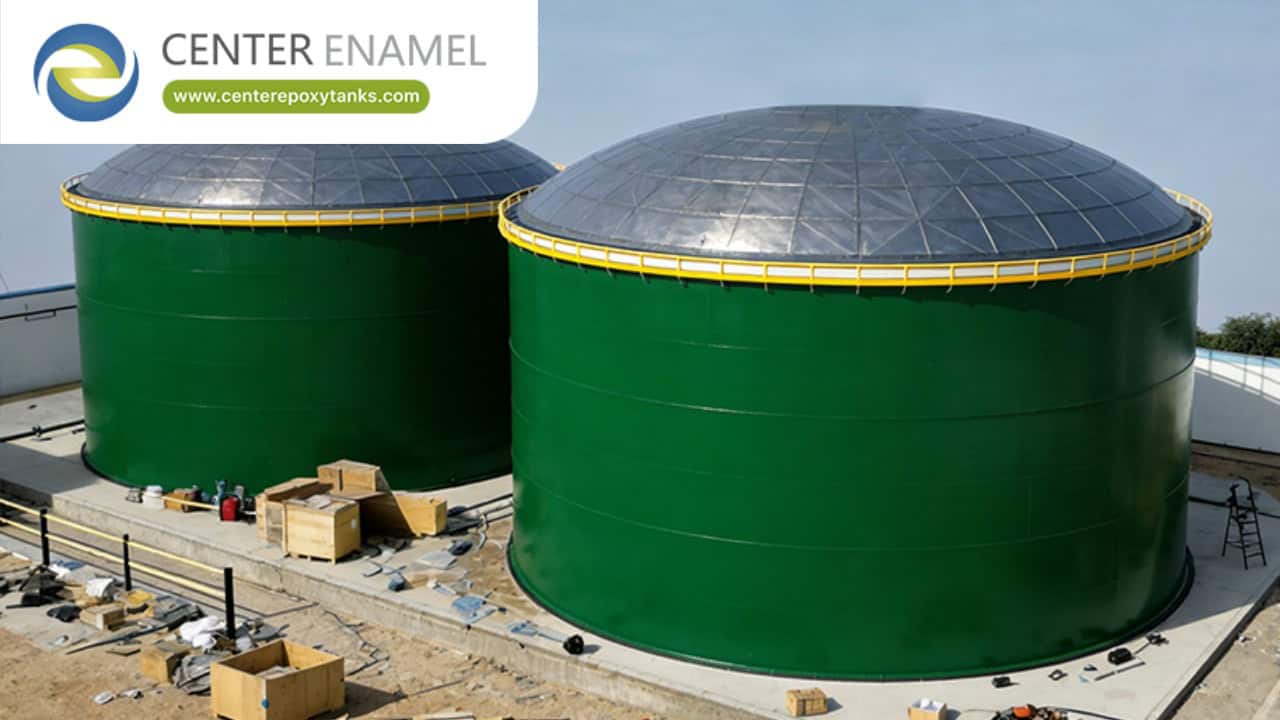
Welded Steel Oil Tank Moisture Protection - Keeping Water Out of the Product
Water is the most damaging contaminant in stored oil, and it arrives by routes that have nothing to do with leaks. A tank breathes as temperature changes, drawing in humid air that condenses on the cool underside of the roof and drips back into the product. Rainwater enters through a worn roof penetration. A water bottom grows from condensation that was never drawn off. Each route is small; together they govern product quality and bottom corrosion.
Moisture protection is therefore a set of design decisions, not a maintenance chore. Engineered by Shijiazhuang Zhengzhong Technology Co., Ltd. (Center Enamel), welded steel oil tanks are detailed to keep water out at every route - sealed roof penetrations, breathing control, a water draw-off at the lowest point, and monitoring so ingress is measured rather than assumed.
1. How Does Water Get Into an Oil Tank?
Through breathing, through roof penetrations, and with the product itself. Condensation from breathing is the route most often underestimated, because it happens continuously and invisibly.
· Breathing: Daily thermal cycling draws humid air in through the vent and expels it, recharging the vapour space with moisture.
· Condensation: Moist air condenses on the coolest surface - usually the underside of the roof - and drains back into the product.
· Rain Ingress: Worn or unsealed roof penetrations, gauge hatches and manways let rainwater in.
· Water With Product: Product arriving with entrained or dissolved water adds to the tank's water inventory.
· Free Water Settling: Whatever arrives separates over time and collects at the floor.
2. What Does Condensation Actually Do?
It corrodes the bottom, degrades the product and, in heated service, creates a safety hazard. The damage is slow enough to be ignored and steady enough to be expensive.
· Bottom Corrosion: A water layer at the floor drives corrosion on the hardest surface to inspect.
· Product Degradation: Water promotes oxidation, microbial growth and sludge formation.
· Specification Failure: Transformer oil, edible oils and purity-critical streams fail on water content.
· Foaming and Boil-Over: In heated service, water under hot oil can flash violently.
· Microbial Activity: The oil-water interface supports microbes that generate acids and sludge.
3. How Is Moisture Excluded and Removed?
Excluded by controlling breathing - a floating or sealed cover, a desiccant breather or nitrogen blanketing - and removed by a draw-off at the lowest point, backed by monitoring.
· Breathing Control: A floating roof or sealed cover removes the vapour space that breathing works through.
· Desiccant Breathers: Any remaining vent path is fitted with a desiccant so incoming air is dried.
· Nitrogen Blanketing: A dry nitrogen pad excludes atmospheric moisture where the specification requires it.
· Water Draw-Off: A draw-off at the lowest point lets free water be removed routinely.
· Monitoring: Water content and bottom water level are measured so ingress is visible.
Evaluation Criterion | Moisture-Managed Tank | Conventional Vented Tank |
Breathing path | Sealed cover or desiccant breather | Open vent |
Condensation surface | Removed or insulated | Cool roof underside |
Water removal | Routine draw-off | Reactive at cleaning |
Bottom corrosion rate | Low | Higher - water sits on the floor |
Product specification | Held | At risk |
Engineering Assurance and Project Support
Every welded oil tank delivered by Shijiazhuang Zhengzhong Technology Co., Ltd. (Center Enamel) is designed to API 650 with shell courses sized by the one-foot method and checked for wind, seismic and hydrostatic load cases, or to EN 14015 and the Eurocodes where the site is European. Shell plate is shot-blasted to Sa 2.5 and coated to a documented dry film thickness, longitudinal and annular plate welds are examined by radiography or ultrasonic testing to the acceptance level written into the purchase order, and every tank is hydrostatically tested and dimensionally surveyed before hand-over. Moisture protection packages include breathing control, sealed penetrations, desiccant breathers or blanketing, a water draw-off at the lowest point, and the instrumentation to verify that the strategy works.
"Water in a tank is rarely a leak - it is breathing. Control the breathing and you have solved most of the moisture problem."
Frequently Asked Questions (FAQ)
Where does the water in an oil tank come from?
Mostly from breathing. As the tank cools overnight it draws in humid air; that moisture condenses on the cool underside of the roof and drains back into the product. Rainwater through worn penetrations and water arriving with the product add to it. Individually these routes are small, but operating continuously they govern both product quality and bottom corrosion.
Does a floating roof stop condensation?
It removes the main condensation surface, which is a large part of the benefit. With no vapour space above the liquid there is no cool roof underside for moisture to condense on and drip back from. Where a fixed roof is retained, insulation, a sealed cover or a desiccant breather achieve much of the same effect.
How often should water be drawn off?
Often enough that a water layer never establishes itself at the floor. The interval depends on how fast water arrives, which is why bottom water level should be measured rather than assumed. A draw-off at the lowest point, used routinely, is the cheapest corrosion control on the tank.
Can moisture protection be customised for our tank?
Yes. Breathing control method, sealed roof penetrations, desiccant breather or nitrogen blanketing, insulation, water draw-off and sump detail, bottom water instrumentation and monitoring are all engineered to your product, climate and operating pattern.


