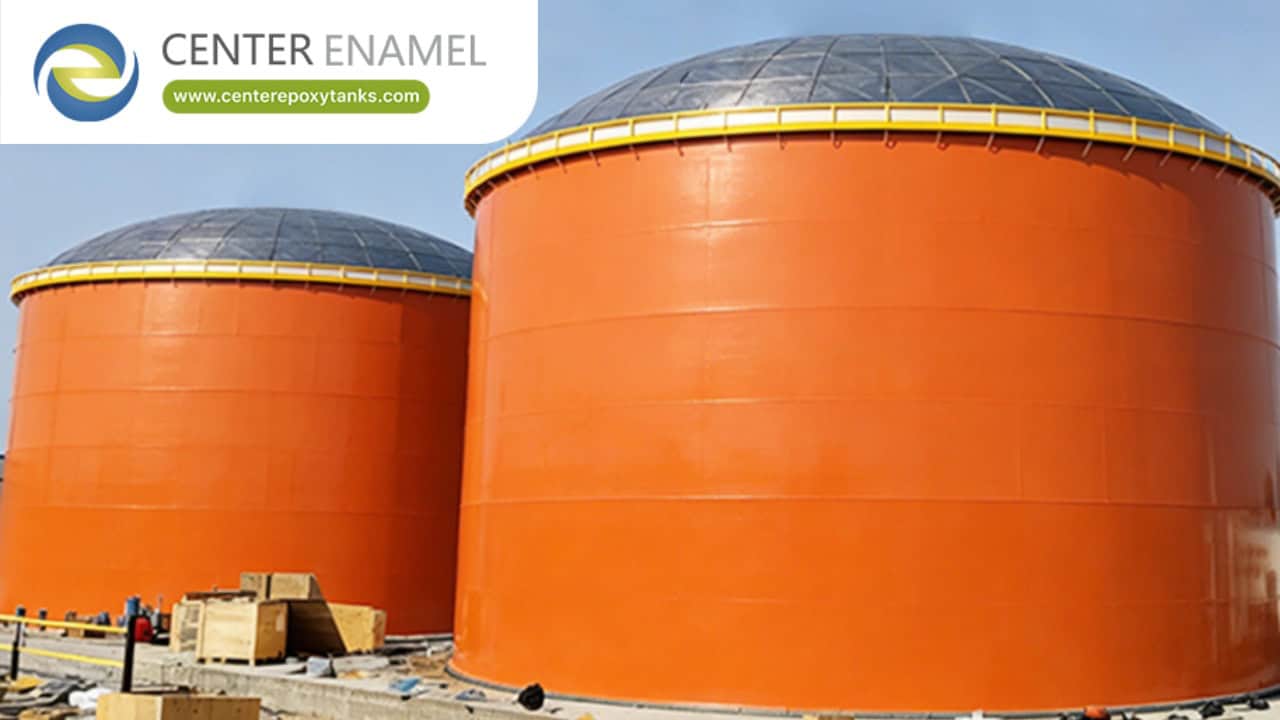
Welded Steel Aboveground Oil Storage Tanks - The Industry Standard Explained
Almost every large oil storage tank in the world is a welded steel aboveground tank, and the reason is simple: for large volumes at atmospheric pressure nothing else competes on cost per cubic metre, inspectability or repairability. The design is mature, the codes are well developed, and an operator can look at the outside of the tank and know a great deal about what is going on inside it.
Engineered by Shijiazhuang Zhengzhong Technology Co., Ltd. (Center Enamel), welded steel aboveground oil tanks are designed to API 650 - or to EN 14015 on European projects - with shell courses sized for the product and the site, and with the foundation, testing and inspection regime planned as part of the design rather than left to site judgement.
1. How Is the Shell Designed and Built?
Shell courses are sized from the product density and the tank geometry, with thicker courses at the bottom where the hydrostatic head is greatest. Plates are welded with qualified procedures and examined to the acceptance level in the purchase order.
· Course Sizing: Plate thickness is calculated for each course, thickest at the bottom, using the applicable design method.
· Material Selection: Plate grade is selected for the product, the design temperature and the site's lowest ambient temperature.
· Welding Procedures: Qualified procedures and qualified welders, with the weld map recorded.
· Examination: Radiography or ultrasonic testing is applied to the specified percentage of joints at the agreed acceptance level.
· Annular Ring and Bottom: The bottom plate and any annular ring are detailed for the hydrostatic test and for corrosion management.
2. What Foundation Does It Need?
One that carries the load without differential settlement that would distort the shell. Foundation behaviour governs tank geometry, and tank geometry governs whether a floating roof will travel freely years later.
· Load Distribution: The ring beam or compacted pad spreads the shell load so bearing capacity is not exceeded.
· Settlement Control: Differential settlement is the parameter that matters; uniform settlement is far more tolerable.
· Drainage: The foundation is arranged to shed water so the bottom does not sit wet.
· Bottom Protection: A suitable pad or coating system protects the underside of the floor plate.
· Survey Baseline: Elevation and roundness are surveyed at handover as the baseline for future comparison.
3. How Is It Tested and Inspected?
Hydrostatically tested before hand-over, then inspected on a regime that combines routine external checks with periodic internal examination. Records from commissioning become the baseline against which future readings are compared.
· Hydrostatic Test: The tank is filled and held, with settlement and shell behaviour monitored, before it enters service.
· Baseline Measurements: Thickness readings, elevations and roundness establish the reference condition.
· Routine External Checks: Foundation, coating, vents, fittings and containment are checked on a defined schedule.
· Periodic Internal Examination: Full internal inspection is planned on the interval in the owner's programme, aligned to API 653.
· Record Keeping: Every reading is logged so trends are visible rather than discovered.
Evaluation Criterion | Welded Steel AST | Shop-Fabricated Skid Tank |
Economical volume range | Large - thousands of cubic metres | Small to medium |
Design code | API 650 or EN 14015 | Shop standards or UL 142 |
Field welding | Yes | Minimal - factory built |
Inspectability | Excellent - internal access | Limited |
Repairability | Good - plate can be renewed | Limited |
Engineering Assurance and Project Support
Every welded oil tank delivered by Shijiazhuang Zhengzhong Technology Co., Ltd. (Center Enamel) is designed to API 650 with shell courses sized by the one-foot method and checked for wind, seismic and hydrostatic load cases, or to EN 14015 and the Eurocodes where the site is European. Shell plate is shot-blasted to Sa 2.5 and coated to a documented dry film thickness, longitudinal and annular plate welds are examined by radiography or ultrasonic testing to the acceptance level written into the purchase order, and every tank is hydrostatically tested and dimensionally surveyed before hand-over. Tanks are delivered with design calculations, material certificates, welding procedure and qualification records, weld maps, non-destructive examination reports, hydrostatic test records and a foundation loading drawing.
"An aboveground welded tank is the most inspectable storage asset you can own. That is why it stays the default at every scale where the volume justifies the weld."
Frequently Asked Questions (FAQ)
What size range suits a welded steel aboveground tank?
Welded steel construction becomes economical from a few hundred cubic metres upward and scales to the largest tanks built. Below a few hundred cubic metres, shop-fabricated skid or containerised units are often more practical because they arrive complete and tested with minimal site work.
Which code applies - API 650 or EN 14015?
API 650 is the international default for welded tanks for oil storage and is widely specified outside Europe. EN 14015 is the European specification for site-built vertical cylindrical welded steel tanks and is commonly used on European projects. Both are accepted approaches; the choice is normally made by the project specification and the authority having jurisdiction.
Why is foundation settlement taken so seriously?
Because differential settlement distorts the shell, and a distorted shell stops a floating roof travelling freely and opens seal gaps. Uniform settlement is far more tolerable than differential movement, so the foundation is designed to distribute load evenly and a survey baseline is taken at handover for future comparison.
Can the tank be customised for our project?
Yes. Diameter and height, shell material and corrosion allowance, roof type, coating system, foundation loading data, nozzles and manways, heating and insulation, instrumentation, access and containment are all engineered to your product, capacity and site conditions.


