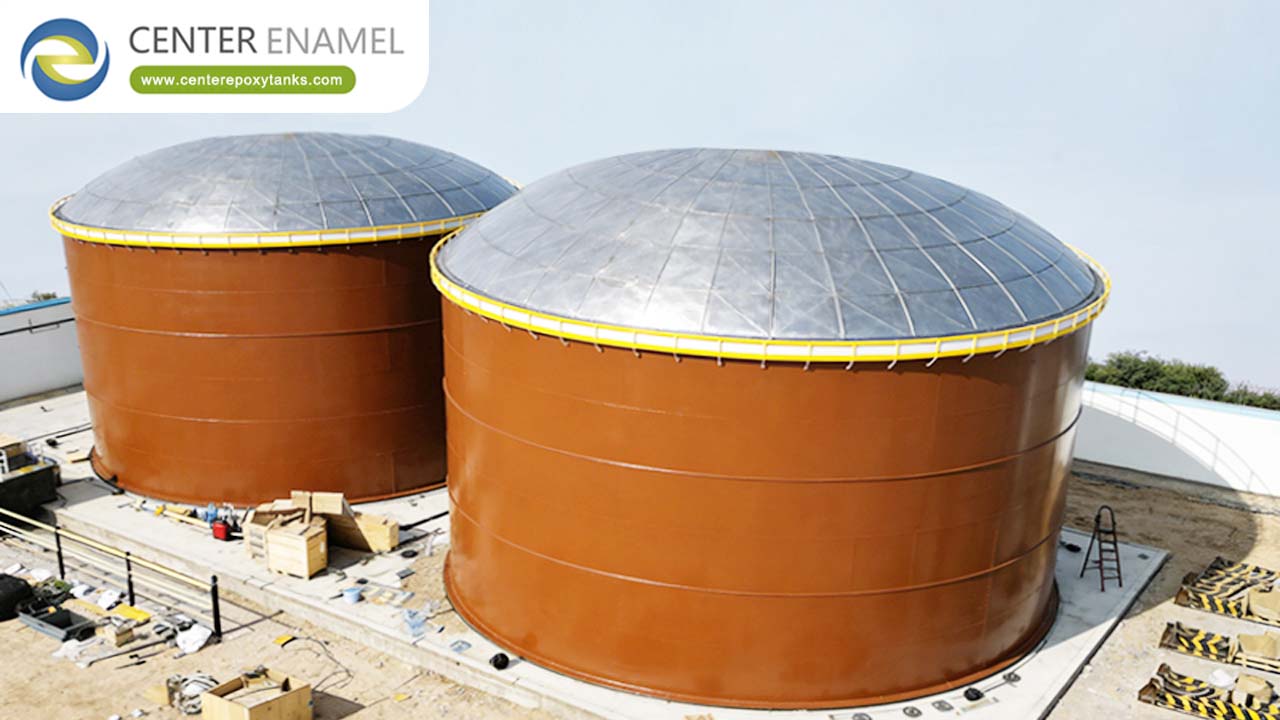
Welded Steel Aviation Fuel Storage Tank Manufacturer: Center Enamel
Shijiazhuang Zhengzhong Technology Co., Ltd. (Center Enamel) is a specialized manufacturer of high-performance welded carbon steel aviation fuel storage tanks. Engineered to meet the rigorous API 650 international standard, these tanks are designed to preserve the physical and chemical integrity of aviation fuels (such as Jet A-1) by prioritizing fuel purity and volatility management. Key features include precision-sloped bottom floors to facilitate water drainage, specialized non-reactive internal epoxy lining systems, and the integration of Internal Floating Roofs (IFR) to minimize vapor space and reduce emissions. Center Enamel provides comprehensive, end-to-end storage solutions that ensure long-term operational safety and compliance for commercial and military airport infrastructure.
The Criticality of Aviation Fuel Storage
Storing aviation fuel is fundamentally different from storing general industrial fuel. The requirements are dictated by flight safety—where the smallest amount of water or particulate contamination can lead to catastrophic engine failure. A superior storage tank is an engineered barrier that protects the fuel from the environment.
Engineering Pillars for Jet Fuel Purity
Precision Sloped Bottom Design
Aviation fuel is highly susceptible to water contamination (condensate). To prevent this, our tanks feature a consistent, engineered slope in the floor plates leading to a centralized sump. This design ensures that any free water or sediment is channeled to a single point for efficient, routine removal, keeping the bulk fuel pristine.
Specialized Internal Lining Systems
Carbon steel, while structurally ideal, requires a protective barrier to prevent contact with fuel. Before final assembly, the tank interior undergoes abrasive blasting followed by the application of a high-solids, non-reactive, jet-fuel-certified epoxy lining. This lining prevents microbial growth and corrosion, ensuring that the fuel remains "on-spec" from the moment it enters the tank to the moment it is pumped into an aircraft.
Volatility & Vapor Control (IFR Integration)
Jet fuel is volatile. To manage vapor space and prevent the risk of ignitable mixtures, we integrate Internal Floating Roofs (IFR). These floating pontoons stay in constant contact with the fuel surface, effectively capping the liquid and drastically reducing evaporation losses and fire risk, strictly adhering to environmental and safety benchmarks.
Structural Standards: The API 650 Benchmark
When sourcing fuel storage, compliance with API 650 is non-negotiable. This standard governs everything from shell thickness and wind-girder placement to seismic loading and weld integrity.
Automated Welding & NDT: We employ automated welding systems for continuous, full-penetration seams. Every critical weld undergoes exhaustive Non-Destructive Testing (NDT)—including radiographic and ultrasonic examination—to guarantee monolithic structural integrity that can withstand decades of high-pressure service.
Seismic and Wind Hardening: Aviation infrastructure is critical. Our tanks are engineered with enhanced shell geometry and robust anchoring systems to maintain containment integrity even under extreme environmental loads.
Infrastructure Integration
A storage tank is not an isolated vessel; it is a component of a larger refueling system. Our manufacturing process accommodates:
Dedicated Filtration Connections: Integrated, reinforced nozzles for high-efficiency filter-separator systems.
ATG and Overfill Protection: Pre-engineered ports for Automatic Tank Gauging (ATG) and mechanical overfill prevention, facilitating seamless integration with modern airport monitoring systems.
Routine Inspection Access: Compliant access platforms, stairs, and large-format manways are strategically placed to ensure maintenance teams can easily conduct mandated internal inspections.
Frequently Asked Questions (FAQ)
Q: Why is internal lining so critical for Jet Fuel?
A: Jet fuel can be sensitive to materials it contacts. A specialized epoxy lining prevents the fuel from reacting with the carbon steel, stops rust particles from forming, and inhibits the biological growth that thrives in stagnant fuel environments.
Q: Can you provide tanks for remote or high-altitude airports?
A: Yes. Our engineering team calculates specific environmental loads, including extreme temperature variations, snow accumulation, and wind speeds, to ensure the tank structure is reinforced accordingly.
Q: How do your tanks facilitate fuel sampling?
A: We install dedicated sampling ports at multiple elevations. This allows operators to test fuel quality at the top, middle, and bottom of the tank, ensuring the entire inventory remains compliant with aviation quality standards.
Q: What is the lead time for an API 650 aviation tank?
A: Lead times are determined by the capacity and specific site requirements (e.g., IFR, lining, or ancillary equipment). We prioritize the manufacturing cycle to meet project timelines, with automated fabrication ensuring speed without sacrificing quality.
Are you managing an airport terminal expansion or a new fuel storage project? Contact our engineering team with your required fuel volume and site specifications for a detailed technical proposal.


